MHB Show that this is not a Sturm-Liouville problem

  • Thread starter Thread starter mathmari
  • Start date Start date
mathmari
Gold Member
MHB
Messages
4,984
Reaction score
7
Hey! :o

I got stuck at the following exercise.

Knowing that:
$"$The eigenvalue problem $Ly=(py')'+qy, a \leq x \leq b$ is a Sturm-Liouville problem when it satisfies the boundary conditions:
$$p(a)W(u(a),v^*(a))=p(b)W(u(b),v^*(b))"$$I have to show that the eigenvalue problem $y''+λy=0$, with boundary conditions $y(0)=0, y'(0)=y'(1)$ is not a Sturm -Liouville problem.

This is what I've done so far:

Let $u, v^*$ solutions of the eigenvalue problem $y''+λy=0$, then:
$u(0)=0, u'(0)=u'(1)$ and $v^*(0)=0, v^{*'}(0)=v^{*'}(1)$.

$W(u(0),v^*(0))=u(0)v^{*'}(0)-u'(0)v^*(0)=0$

$W(u(1),v^*(1))=u(1)v^{*'}(1)-u'(1)v^*(1)=u(1) v^{*'}(0)-u'(0)v^*(1)$

How can I continue? How can I show that this is not equal to $0$?
 
Physics news on Phys.org
mathmari said:
Hey! :o

I got stuck at the following exercise.

Knowing that:
$"$The eigenvalue problem $Ly=(py')'+qy, a \leq x \leq b$ is a Sturm-Liouville problem when it satisfies the boundary conditions:
$$p(a)W(u(a),v^*(a))=p(b)W(u(b),v^*(b))"$$I have to show that the eigenvalue problem $y''+λy=0$, with boundary conditions $y(0)=0, y'(0)=y'(1)$ is not a Sturm -Liouville problem.

This is what I've done so far:

Let $u, v^*$ solutions of the eigenvalue problem $y''+λy=0$, then:
$u(0)=0, u'(0)=u'(1)$ and $v^*(0)=0, v^{*'}(0)=v^{*'}(1)$.

$W(u(0),v^*(0))=u(0)v^{*'}(0)-u'(0)v^*(0)=0$

$W(u(1),v^*(1))=u(1)v^{*'}(1)-u'(1)v^*(1)=u(1) v^{*'}(0)-u'(0)v^*(1)$

How can I continue? How can I show that this is not equal to $0$?

Hi! :)

Have you tried to solve the ODE and find $u(1)$ respectively $v^*(1)$?
 
I like Serena said:
Hi! :)

Have you tried to solve the ODE and find $u(1)$ respectively $v^*(1)$?

Do you mean the following?

$y''+λy=0$

The characteristic equation is $m^2+λ=0$.

  • λ=0: $y(x)=c_1x+c_2, y(0)=0 \Rightarrow c_2=0 \Rightarrow y(x)=c_1 x, y'(0)=y'(1) \Rightarrow c_1=c_1$
  • λ<0: (λ=-k, k>0) $y(x)=c_1 e^{ \sqrt{k}x}+c_2e^{- \sqrt{k}x}, y(0)=0 \Rightarrow c_1=-c_2 \Rightarrow y(x)=c_1(e^{\sqrt{k}x}-e^{- \sqrt{k}x} \Rightarrow y'(x)=\sqrt{k} c_1 (e^{\sqrt{k}x}+e^{- \sqrt{k}x}, y'(0)=y'(1) \Rightarrow 1=e^{\sqrt{k}}+e^{- \sqrt{k}} \Rightarrow e^{\sqrt{k}}=e^{2 \sqrt{k}}+1$
  • λ>0: $y(x)=c_1 \cos(\sqrt{λ}x)+c_2 \sin( \sqrt{λ}x), y(0)=0 \Rightarrow c_1=0 \Rightarrow y(x)=c_2 \sin( \sqrt{λ}x) \Rightarrow y'(x)=c_2 \sqrt{λ} \cos(\sqrt{λ}x), y'(0)=y'(1) \Rightarrow 1=\cos(\sqrt{λ}) \Rightarrow λ_n=4n^2 \pi^2 \Rightarrow y_n(x)=\cos(2 n \pi)$

So the solution is $y_n(x)=\cos(2 n \pi)$, isn't it?

How can I find now the values of $u$ and $v^*$? Do I have to take two different $n$ at the solution and find them?
 
mathmari said:
Do you mean the following?

$y''+λy=0$

The characteristic equation is $m^2+λ=0$.

  • λ=0: $y(x)=c_1x+c_2, y(0)=0 \Rightarrow c_2=0 \Rightarrow y(x)=c_1 x, y'(0)=y'(1) \Rightarrow c_1=c_1$
  • λ<0: (λ=-k, k>0) $y(x)=c_1 e^{ \sqrt{k}x}+c_2e^{- \sqrt{k}x}, y(0)=0 \Rightarrow c_1=-c_2 \Rightarrow y(x)=c_1(e^{\sqrt{k}x}-e^{- \sqrt{k}x} \Rightarrow y'(x)=\sqrt{k} c_1 (e^{\sqrt{k}x}+e^{- \sqrt{k}x}, y'(0)=y'(1) \Rightarrow 1=e^{\sqrt{k}}+e^{- \sqrt{k}} \Rightarrow e^{\sqrt{k}}=e^{2 \sqrt{k}}+1$
  • λ>0: $y(x)=c_1 \cos(\sqrt{λ}x)+c_2 \sin( \sqrt{λ}x), y(0)=0 \Rightarrow c_1=0 \Rightarrow y(x)=c_2 \sin( \sqrt{λ}x) \Rightarrow y'(x)=c_2 \sqrt{λ} \cos(\sqrt{λ}x), y'(0)=y'(1) \Rightarrow 1=\cos(\sqrt{λ}) \Rightarrow λ_n=4n^2 \pi^2 \Rightarrow y_n(x)=\cos(2 n \pi)$

So the solution is $y_n(x)=\cos(2 n \pi)$, isn't it?

Yes, that is what I meant. (Nod)

But you appear to have made a substitution error at the end. (Worried)
How can I find now the values of $u$ and $v^*$? Do I have to take two different $n$ at the solution and find them?

You only need $u(1)$ and $v^*(1)$, which you should be able to get (after you fix your solution and apply the boundary conditions).
 
I like Serena said:
But you appear to have made a substitution error at the end. (Worried)
Yes, you're right! (Blush)

It's $y_n(x)=\sin(2 n \pi x)$
I like Serena said:
You only need $u(1)$ and $v^*(1)$, which you should be able to get (after you fix your solution and apply the boundary conditions).

So $u(1)=v^*(1)=0$, isn't it?

But $W(u(1),v^*(1))=u(1) v^{*'}(0)-u'(0) v^*(1)=0$, that would mean that it equals to $W(u(0),v^*(0))$ and the problem would be Sturm-Liouville, but it shouldn't be.. (Worried)
Have I done something wrong?
 
mathmari said:
Yes, you're right! (Blush)

It's $y_n(x)=\sin(2 n \pi x)$

So $u(1)=v^*(1)=0$, isn't it?

Yep! (Wink)

(A little more accurate would be $y(x)=c_1\sin(2 n \pi x)$.)

But $W(u(1),v^*(1))=u(1) v^{*'}(0)-u'(0) v^*(1)=0$, that would mean that it equals to $W(u(0),v^*(0))$ and the problem would be Sturm-Liouville, but it shouldn't be.. (Worried)
Have I done something wrong?

I believe it is all correct.
 
I like Serena said:
Yep! (Wink)

(A little more accurate would be $y(x)=c_1\sin(2 n \pi x)$.)
I believe it is all correct.

But how can I show then that this is not a Sturm-Liouville problem?? (Worried)
 
mathmari said:
But how can I show then that this is not a Sturm-Liouville problem?? (Worried)

Perhaps there is a typo in your problem statement?
 
I like Serena said:
Perhaps there is a typo in your problem statement?

The problem statement is the following:
"Show that the eigenvalue problem $u''+λy=0$ with boundary conditions $y(0)=0, y'(0)=y'(1)$ is not a Sturm-Liouville problem."

First of all, shouldn't it be $y''+λy=0$ ? (Thinking)
 
  • #10
mathmari said:
The problem statement is the following:
"Show that the eigenvalue problem $u''+λy=0$ with boundary conditions $y(0)=0, y'(0)=y'(1)$ is not a Sturm-Liouville problem."

First of all, shouldn't it be $y''+λy=0$ ? (Thinking)

Yeah. That looks like a regular typo.
Apparently the ODE should use $y$, while $u$ and $v$ are supposed to be 2 specific solutions for it.Wiki gives a slightly different definition for a Sturm-Liouville problem, which boils down to the same thing.
Wiki does not mention the Wronskian, but it does refer to a regular S-L problem.
It might make sense to verify if your problem is a regular S-L problem, but I'm merely guessing here.
 
  • #11
I like Serena said:
Wiki gives a slightly different definition for a Sturm-Liouville problem, which boils down to the same thing.
Wiki does not mention the Wronskian, but it does refer to a regular S-L problem.
It might make sense to verify if your problem is a regular S-L problem, but I'm merely guessing here.

So can we not show that the problem is not a S-L problem using the Wronskian? (Wondering)
 
  • #12
At the exercise I have to show also that the eigenvalues are real and that the eigenfunctions are orthogonal to each other, but the eigenfunctions don't consist a complete set.

At the post #3 I had found that the eigenvalues are $\lambda_n=4n^2 \pi^2$.
They are real, aren't they? Or do I have to do something else to show that they are real?

The eigenfunctions are $y_n=\sin{(2 n \pi x)}$.
So to show that they are orthogonal do I have to do the following?

For $m \neq n$:
$$(y_m,y_n)=\int_0^1{y_m y_n}dx=\int_0^1{\sin{(2 m \pi x)} \sin{(2 n \pi x)}}dx=\frac{1}{2} \int_0^1{ \cos{(2 \pi x (m-n))}-\cos{(2 \pi x (m+n))}}dx=\frac{1}{2} [\frac{\sin{(2 \pi x (m-n))}}{2 \pi (m-n)}-\frac{\sin{(2 \pi x (m+n))}}{2 \pi (m+n)}]_0^1=\frac{\frac{\sin{(2 \pi (m-n))}}{m-n}-\frac{\sin{(2 \pi (m+n))}}{m+n}}{4 \pi}$$

I got stuck.. (Worried) Is this correct? Is this equal to $0$? (Wondering)
 
  • #13
mathmari said:
At the exercise I have to show also that the eigenvalues are real and that the eigenfunctions are orthogonal to each other, but the eigenfunctions don't consist a complete set.

At the post #3 I had found that the eigenvalues are $\lambda_n=4n^2 \pi^2$.
They are real, aren't they? Or do I have to do something else to show that they are real?

Since $n$ is an integer they are indeed real.

The eigenfunctions are $y_n=\sin{(2 n \pi x)}$.
So to show that they are orthogonal do I have to do the following?

For $m \neq n$:
$$(y_m,y_n)=\int_0^1{y_m y_n}dx=\int_0^1{\sin{(2 m \pi x)} \sin{(2 n \pi x)}}dx=\frac{1}{2} \int_0^1{ \cos{(2 \pi x (m-n))}-\cos{(2 \pi x (m+n))}}dx=\frac{1}{2} [\frac{\sin{(2 \pi x (m-n))}}{2 \pi (m-n)}-\frac{\sin{(2 \pi x (m+n))}}{2 \pi (m+n)}]_0^1=\frac{\frac{\sin{(2 \pi (m-n))}}{m-n}-\frac{\sin{(2 \pi (m+n))}}{m+n}}{4 \pi}$$

I got stuck.. (Worried) Is this correct? Is this equal to $0$? (Wondering)

That should be, according to your definition of the inner product (formally):
$$(y_m,y_n)=\int_0^1{y_m^* y_n}dx=\int_0^1{y_m y_n}dx$$

What is $\sin(2 \pi k )$ if $k$ is an integer?
 
  • #14
I like Serena said:
Since $n$ is an integer they are indeed real.
Great! (Smile)

I like Serena said:
That should be, according to your definition of the inner product (formally):
$$(y_m,y_n)=\int_0^1{y_m^* y_n}dx=\int_0^1{y_m y_n}dx$$

What is $\sin(2 \pi k )$ if $k$ is an integer?

$\sin(2 \pi k )=0$ if $k$ is an integer! (Yes)How can I show that the eigenfunctions don't consist a complete set?
 
  • #15
mathmari said:
Great! (Smile)

$\sin(2 \pi k )=0$ if $k$ is an integer! (Yes)

Good! (Mmm)

How can I show that the eigenfunctions don't consist a complete set?

Fourier theory says that $\{ \cos 2\pi n x, \sin 2\pi n x \}$ is a complete set.
So show for instance that $\cos 2 \pi x$ is orthogonal, although it is not included in the set.
 
  • #16
I like Serena said:
Fourier theory says that $\{ \cos 2\pi n x, \sin 2\pi n x \}$ is a complete set.
So show for instance that $\cos 2 \pi x$ is orthogonal, although it is not included in the set.

I got stuck... (Doh) Why do we have to show that $\cos 2 \pi x$ is orthogonal, to show that the set of eigenfunctions is not complete? (Wondering)
 
  • #17
mathmari said:
I got stuck... (Doh) Why do we have to show that $\cos 2 \pi x$ is orthogonal, to show that the set of eigenfunctions is not complete? (Wondering)

What does it mean for a set of functions to be complete?

I am assuming it means whether the set of functions forms a basis for all differentiable functions on the unit interval.
That is, that each function can be written as a linear combination from that set of functions and that you can leave none of them out.
 
  • #18
I like Serena said:
What does it mean for a set of functions to be complete?

I am assuming it means whether the set of functions forms a basis for all differentiable functions on the unit interval.
That is, that each function can be written as a linear combination from that set of functions and that you can leave none of them out.

So we want to show that $\cos{(2 \pi x)}$ cannot we written as a linear combination from the set $\{ \sin{(2 n \pi x)} \}$?

If it could be written as a linear combination it would be:
$$\cos{(2 \pi x)}= \sum_{n=1}^{+\infty}{c_n \sin{(2 n \pi x)}}$$

Then from the Fourier series: (Is the period of $\cos{(2 \pi x)}$ equal to $2 \pi$ ? (Wondering) )
$$c_n= \frac{2}{2 \pi} \int_0^{2 \pi}{ \cos{(2 \pi x)} \sin{(\frac{2 n \pi x}{2 \pi})}}dx=\frac{1}{ \pi} \int_0^{2 \pi}{ \cos{(2 \pi x)} \sin{(nx)}}dx= \dots =0 $$

That means that $\cos{(2 \pi x)}= 0$, but that is not true $\forall x \in [0,1]$.

So $\cos{(2 \pi x)}$ cannot we written as a linear combination from the set $\{ \sin{(2 n \pi x)} \}$, that means that not each function can be written as a linear combination from the set $\{ \sin{(2 n \pi x)} \}$. Therefore the set of the eigenfunctions is not complete.

Is this correct? (Wondering)
 
  • #19
mathmari said:
So we want to show that $\cos{(2 \pi x)}$ cannot we written as a linear combination from the set $\{ \sin{(2 n \pi x)} \}$?

Yes.
Although I'm just realizing that they probably meant a function that satisfies the boundary conditions.
So we might use $\cos 2\pi x - 1$ instead.
If it could be written as a linear combination it would be:
$$\cos{(2 \pi x)}= \sum_{n=1}^{+\infty}{c_n \sin{(2 n \pi x)}}$$

Yes

Then from the Fourier series: (Is the period of $\cos{(2 \pi x)}$ equal to $2 \pi$ ? (Wondering) )

I'm afraid not. What do you get if you substitute $x=2\pi$? (Tauri)

$$c_n= \frac{2}{2 \pi} \int_0^{2 \pi}{ \cos{(2 \pi x)} \sin{(\frac{2 n \pi x}{2 \pi})}}dx=\frac{1}{ \pi} \int_0^{2 \pi}{ \cos{(2 \pi x)} \sin{(nx)}}dx= \dots =0 $$

Hmm. So you're using that $\{ \sin{(2 n \pi x)} \}$ is an orthogonal set to find the coefficients eh?
Good! (Smile)

However, I'm afraid you have the wrong boundary.
You'll still get the same result though.
That means that $\cos{(2 \pi x)}= 0$, but that is not true $\forall x \in [0,1]$.

So $\cos{(2 \pi x)}$ cannot we written as a linear combination from the set $\{ \sin{(2 n \pi x)} \}$, that means that not each function can be written as a linear combination from the set $\{ \sin{(2 n \pi x)} \}$. Therefore the set of the eigenfunctions is not complete.

Is this correct? (Wondering)

Yep!
Though I suspect we should use $\cos 2\pi x - 1$, which satisfies the boundary conditions.
 
  • #20
I like Serena said:
I'm afraid not. What do you get if you substitute $x=2\pi$? (Tauri)

Is the period maybe $1$ ? (Wondering)
 
  • #21
mathmari said:
Is the period maybe $1$ ? (Wondering)

Yep. (Wasntme)
 
  • #22
So, after having changed the function, is it as followed? (Blush)

We suppose that each function that satisfies the boundary condition of the eigenvalue problem can be written as a linear combination from the set $\{ \sin{(2 n \pi x)} \}$.

Let $f(x)=\cos{(2 \pi x)}-1$, $f(0)=0, f'(0)=f'(1)$.

$$\cos{(2 \pi x)}-1= \sum_{n=1}^{+\infty}{c_n \sin{(2 n \pi x)}}$$

$$c_n= \frac{2}{1} \int_0^{1}{[ \cos{(2 \pi x)}-1] \sin{({2 n \pi x})}}dx= \dots =0 $$

That means that $\cos{(2 \pi x)}-1= 0 \Rightarrow \cos{(2 \pi x})=1$, but that is not true $\forall x \in [0,1]$.

So $\cos{(2 \pi x)}-1$ cannot we written as a linear combination from the set $\{ \sin{(2 n \pi x)} \}$, that means that not each function can be written as a linear combination from the set $\{ \sin{(2 n \pi x)} \}$. Therefore the set of the eigenfunctions is not complete.
 
  • #23
mathmari said:
$y''+λy=0$

The characteristic equation is $m^2+λ=0$.

  • λ=0: $y(x)=c_1x+c_2, y(0)=0 \Rightarrow c_2=0 \Rightarrow y(x)=c_1 x, y'(0)=y'(1) \Rightarrow c_1=c_1$
  • λ<0: (λ=-k, k>0) $y(x)=c_1 e^{ \sqrt{k}x}+c_2e^{- \sqrt{k}x}, y(0)=0 \Rightarrow c_1=-c_2 \Rightarrow y(x)=c_1(e^{\sqrt{k}x}-e^{- \sqrt{k}x} \Rightarrow y'(x)=\sqrt{k} c_1 (e^{\sqrt{k}x}+e^{- \sqrt{k}x}, y'(0)=y'(1) \Rightarrow 1=e^{\sqrt{k}}+e^{- \sqrt{k}} \Rightarrow e^{\sqrt{k}}=e^{2 \sqrt{k}}+1$
  • λ>0: $y(x)=c_1 \cos(\sqrt{λ}x)+c_2 \sin( \sqrt{λ}x), y(0)=0 \Rightarrow c_1=0 \Rightarrow y(x)=c_2 \sin( \sqrt{λ}x) \Rightarrow y'(x)=c_2 \sqrt{λ} \cos(\sqrt{λ}x), y'(0)=y'(1) \Rightarrow 1=\cos(\sqrt{λ}) \Rightarrow λ_n=4n^2 \pi^2 \Rightarrow y_n(x)=\cos(2 n \pi)$

Isn't λ=0 also an eigenvalue with the corresponding eigenfunction $y_n(x)=x$? (Wondering)
 
  • #24
mathmari said:
Isn't λ=0 also an eigenvalue with the corresponding eigenfunction $y_n(x)=x$? (Wondering)

Oh nice!
I missed that one! (Bow)

With that solution the Wronskians are different! (Evilgrin)

And that solution can also not be written as a linear combination of $\{ \sin 2\pi n x \}$.
 
  • #25
I like Serena said:
Oh nice!
I missed that one! (Bow)

With that solution the Wronskians are different! (Evilgrin)

And that solution can also not be written as a linear combination of $\{ \sin 2\pi n x \}$.

So I suppose that $u(x)=\sin{(2 n \pi x)}$ and $v(x)=v^*(x)=x$, right?

Then $W(u(0), v^*(0)) \neq W(u(1),v^*(1))$. (Party)

The eigenvalues are:
$4 n^2 \pi^2 \in \mathbb{R}$ and the corresponding eigenfunctions: $y_n=\sin{(2 n \pi x)}$
$0 \in \mathbb{R}$ and the corresponding eigenfunction is $y=0$
So the eigenvalues are real.

To show that the eigenfunctions are orthogonal, do I have to do calculate the dot product of $\sin{(2 n \pi x)}$ and $x$? But $\int_0^1{x \sin{(2 n \pi x)}}dx = - \frac{1}{2 n \pi} \neq 0$ (Wondering)
 
  • #26
mathmari said:
So I suppose that $u(x)=\sin{(2 n \pi x)}$ and $v(x)=v^*(x)=x$, right?

Then $W(u(0), v^*(0)) \neq W(u(1),v^*(1))$. (Party)

Yay! (drink)

The eigenvalues are:
$4 n^2 \pi^2 \in \mathbb{R}$ and the corresponding eigenfunctions: $y_n=\sin{(2 n \pi x)}$
$0 \in \mathbb{R}$ and the corresponding eigenfunction is $y=0$
So the eigenvalues are real.

I think you meant $y=x$. :eek:

To show that the eigenfunctions are orthogonal, do I have to do calculate the dot product of $\sin{(2 n \pi x)}$ and $x$? But $\int_0^1{x \sin{(2 n \pi x)}}dx = - \frac{1}{2 n \pi} \neq 0$ (Wondering)

Yes.
So $y=x$ is indeed not orthogonal with the other eigenfunctions.
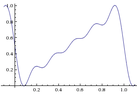
It can be written on the interval (0, 1) as:
$$y=\frac 1 2 - \sum_{n=1}^\infty \frac {\sin 2\pi n x}{\pi n}$$

View attachment 2353

Note however that $\frac 1 2$ is not in the set of eigenfunctions.

Perhaps they are only orthogonal if the Wronskian condition is satisfied? (Wondering)
 

Attachments

  • fourier_sine_series_x.png
    fourier_sine_series_x.png
    2.6 KB · Views: 110
  • #27
I like Serena said:
I think you meant $y=x$. :eek:

Yes, I meant that.. (Wasntme)
I like Serena said:
Perhaps they are only orthogonal if the Wronskian condition is satisfied? (Wondering)

Yes, maybe they are only orthogonal if the Wronskian condition is satisfied, because the Wronskian comes from the dot product of two solutions. When the dot product is equal to zero(so they are orthogonal), then at the last relation of the integral the difference of its value at the two boundary points should be equal to zero, and this relation is the Wronkian, isn't it? So the Wronskian at the one boundary should be equal to the Wronskian at the other boundary. Or did I understand it wrong?

So what am I supposed to answer at the subquestion: "...show that the eigenfunctions are orthogonal to each other"? Do I have to show that only $\sin{( 2 n \pi x)}$ and $\sin{(2 m \pi x)}$ are orthogonal, as I did at the post #12?

I like Serena said:
Yes.
So $y=x$ is indeed not orthogonal with the other eigenfunctions.
It can be written on the interval (0, 1) as:
$$y=\frac 1 2 - \sum_{n=1}^\infty \frac {\sin 2\pi n x}{\pi n}$$

View attachment 2353

Note however that $\frac 1 2$ is not in the set of eigenfunctions.

That means that $y=x$ cannot be written as a linear combination from the set $\{x, sin{(2 n \pi x)}\}$, therefore the set of eigenfunctions is not complete. Is this right?
 
  • #28
mathmari said:
Yes, maybe they are only orthogonal if the Wronskian condition is satisfied, because the Wronskian comes from the dot product of two solutions. When the dot product is equal to zero(so they are orthogonal), then at the last relation of the integral the difference of its value at the two boundary points should be equal to zero, and this relation is the Wronkian, isn't it? So the Wronskian at the one boundary should be equal to the Wronskian at the other boundary. Or did I understand it wrong?

It sounds about right... (Wondering)

So what am I supposed to answer at the subquestion: "...show that the eigenfunctions are orthogonal to each other"? Do I have to show that only $\sin{( 2 n \pi x)}$ and $\sin{(2 m \pi x)}$ are orthogonal, as I did at the post #12?

That seems reasonable...
That means that $y=x$ cannot be written as a linear combination from the set $\{x, \sin{(2 n \pi x)}\}$, therefore the set of eigenfunctions is not complete. Is this right?

Actually, it can, since you've included $x$. (Smirk)

Which definition of "complete" do you have in this context?
 
  • #29
I like Serena said:
It sounds about right... (Wondering)That seems reasonable...

Good! (Sun)
I like Serena said:
Which definition of "complete" do you have in this context?

In my notes there is the following sentence:
"For a Sturm-Liouville problem the set of the orthonormal functions $u_1, u_2, u_3, \dots$ is complete, that means that each square-integrable $f$ can be written with a unique way as $f(x)=\sum_{n=1}^{\infty}{c_n u_n(x)}$."
 
Last edited by a moderator:
  • #30
mathmari said:
In my notes there is the following sentence:
"For a Sturm-Liouville problem the set of the orthonormal functions $u_1, u_2, u_3, \dots$ is complete, that means that each square-integrable $f$ can be written with a unique way as $f(x)=\sum_{n=1}^{\infty}{c_n u_n(x)}$."
Do I have to find any square-integrable $f$ and check if it can be written with a unique way as $f(x)=\sum_{n=1}^{\infty}{c_n u_n(x)}$?
So, I have to find a counterexample, right?

For example, could I use $e^{-\frac{x^2}{2}}$?
$$\int_{-\infty}^{+\infty}{e^{-\frac{x^2}{2}}}dx=\sqrt{2 \pi} < \infty$$

Let's suppose that it can be written as a linear combination of the eigenfunctions:

$$e^{\frac{x^2}{2}}=C x+ \sum_{n=0}^{\infty}{c_n \sin{(2 n \pi x)}}$$

How can I find the coefficients? (Wondering)
 
Last edited by a moderator:

Similar threads

  • · Replies 13 ·
Replies
13
Views
4K
  • · Replies 1 ·
Replies
1
Views
1K
  • · Replies 2 ·
Replies
2
Views
2K
  • · Replies 8 ·
Replies
8
Views
5K
  • · Replies 0 ·
Replies
0
Views
2K
Replies
0
Views
2K
  • · Replies 2 ·
Replies
2
Views
3K
  • · Replies 2 ·
Replies
2
Views
3K
Replies
1
Views
2K
  • · Replies 5 ·
Replies
5
Views
2K