Show that X satisfies the equation

  • Context:
  • Thread starter Thread starter mathlearn
  • Start date Start date
Join the discussion
Registration is free. Ask a follow-up in this thread, or start your own.
10 replies · 6K views
mathlearn
Messages
331
Reaction score
0
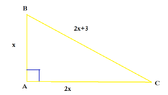
View attachment 5923

Solve that x satisfies the equation $x^2-12x-9$=$0$

Solve the above equation ($\sqrt{5}=2.24$)

Any Ideas on how to begin ? (Crying)
 

Attachments
  • Capture.PNG
    Capture.PNG
    2.3 KB · Views: 139
Mathematics news on Phys.org
mathlearn said:
Solve that x satisfies the equation $x^2-12x-9$=$0$

Solve the above equation ($\sqrt{5}=2.24$)

Any Ideas on how to begin ? (Crying)

Hey mathlearn! ;)

Let's start with the Pythagorean theorem.
In a right triangle, we have:
$$a^2+b^2=c^2$$

What would it look like if we replace $a,b,c$ by the respective formulas? (Wondering)
 
I like Serena said:
Hey mathlearn! ;)

Let's start with the Pythagorean theorem.
In a right triangle, we have:
$$a^2+b^2=c^2$$

What would it look like if we replace $a,b,c$ by the respective formulas? (Wondering)

OK ,Using the pythagorean theorem It would look like this (Happy)
$2x^2+x^2 = (2x+3)^2$
$4x^2+x^2 = (4x^2+9)$
 
mathlearn said:
OK ,Using the pythagorean theorem It would look like this (Happy)
$2x^2+x^2 = (2x+3)^2$
$4x^2+x^2 = (4x^2+9)$

Let's put a couple of parentheses into make sure we evaluate everything in the correct order:
$$(2x)^2+(x)^2 = (2x+3)^2$$

Now if we want to evaluate something like $(a+b)^2$, it works out like this:
$$(a+b)(a+b) = a(a+b) + b(a+b) = a^2 + ab + ba + b^2 = a^2 + 2ab + b^2$$
Or for short:
$$(a+b)^2 = a^2 + 2ab + b^2$$

That means:
$$(2x+3)^2 = (2x)^2 + 2(2x)(3) + (3)^2 = 4x^2 + 12x + 9$$
 
(Nod) True!

mathlearn said:
Solve that x satisfies the equation $x^2-12x-9$=$0$

Solve the above equation ($\sqrt{5}=2.24$)

Any Ideas on how to begin ? (Crying)
I like Serena said:
That means:
$$(2x+3)^2 = (2x)^2 + 2(2x)(3) + (3)^2 = 4x^2 + 12x + 9$$

$$(2x+3)^2 = 4x^2 + 12x + 9 $$

Now to satisfy $x^2-12x-9$=$0$. (Happy)
 
Have you forgotten what the original problem was?

Previously, using the Pythagorean theorem, you correctly said that
$x^2+ (2x)^2= (2x+ 3)^2$ but incorrectly expanded the right side.

Now, knowing that $(2x+ 3)^2= 4x^2+ 12x+ 9$, your equation becomes
$x^2+ 4x^2= 4x^2+ 12x+ 9$. Simplify that.
 
mathlearn said:
(Nod) True!

$$(2x+3)^2 = 4x^2 + 12x + 9 $$

Now to satisfy $x^2-12x-9$=$0$. (Happy)

We have:
\begin{align}(2x)^2 + (x)^2 = (2x+3)^2
&\quad\Rightarrow\quad 4x^2 + x^2 = 4x^2 + 12x + 9 \\
&\quad\Rightarrow\quad 4x^2 + x^2 - 4x^2 - 12x - 9 = 0 \\
&\quad\Rightarrow\quad x^2 - 12x - 9 = 0
\end{align}
 
(Nod) $ x^2 - 12x - 9 = 0 $

Now $x=\frac{-b\pm\sqrt{b^2-4ac}}{2a}$.

$x=\frac{12\pm\sqrt{180}}{2}$.

$x=\frac{12\pm6\sqrt{5}}{2}$.

$x=\frac{25.44}{2}$.

$x=12.72$., Correct ?(Thinking)
 
Yes, but that has nothing at all to do with the original problem! You were not asked to solve the equation.
 
(Yes)(Wink)(Smile) Thank you very much both of you. I Like Serena & hallsofivy
 
HallsofIvy said:
Yes, but that has nothing at all to do with the original problem! You were not asked to solve the equation.

Erm... the OP says:

mathlearn said:
Solve the above equation ($\sqrt{5}=2.24$)