MHB How to Solve Simultaneous Equations with Multiplication Symbols?

Click For Summary
SUMMARY

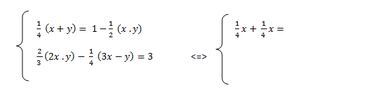
The discussion focuses on solving a system of simultaneous equations involving multiplication symbols represented by dots. The equations presented include $ \dfrac{x}{4} + \dfrac{x}{4} = \dfrac{x}{2} $ and $ \dfrac{x+y}{4} = 1 - \dfrac{xy}{2} $. Participants concluded that the system has no real solutions, as demonstrated through algebraic manipulation leading to a quadratic equation with no real roots. The final derived equation is $ 17x^2 + 10x + 12 = 0 $, confirming the absence of real solutions.

PREREQUISITES
  • Understanding of algebraic manipulation and solving equations
  • Familiarity with simultaneous equations
  • Knowledge of quadratic equations and their properties
  • Basic skills in handling fractions and multiplication in equations
NEXT STEPS
  • Study methods for solving simultaneous equations with multiple variables
  • Learn about the properties of quadratic equations and their discriminants
  • Explore algebraic techniques for eliminating fractions in equations
  • Investigate graphical methods for visualizing solutions to systems of equations
USEFUL FOR

Students, educators, and anyone interested in algebra, particularly those tackling simultaneous equations and quadratic equations in their studies or teaching.
AstroBoy1
Messages
1
Reaction score
0
Can someone solve this, i know its not very hard but for me it is :/
View attachment 2014
The dot . is meaned to be * (multiplication)

can someone help me :)
 

Attachments

  • Untitled.png
    Untitled.png
    1.7 KB · Views: 125
Last edited by a moderator:
Mathematics news on Phys.org
AstroBoy said:
Can someone solve this, i know its not very hard but for me it is :/
View attachment 2014
The dot . is meaned to be * (multiplication)

can someone help me :)

You want to find $ \dfrac{x}{4} + \dfrac{x}{4} = \dfrac{x}{2} $ we want half of x

$ \dfrac{x+y}{4} = 1 - \dfrac{xy}{2} $

$ \dfrac{2(2xy)}{3} - \dfrac{3x-y}{4} = 3 $

From the first equation write y with respect to x, first i would like to multiply it with 4 to eliminate the denominator

$ x+y = 4 - 2xy \Rightarrow y( 1 + 2x) = 4-x \Rightarrow y = \dfrac{4 -x }{1+2x} $
Sub it in the second and solve it for x
Tell us what you get...
I supposed that (1+2x) =/= 0
 
Hey Astroboy,

I noticed the system of equations that you cited has no solution over the real numbers. Are you sure you have copied the problem correctly?:)
 
Hello, AstroBoy!

I agree with anemone.

\begin{array}{cccc}\tfrac{1}{4}(x+y) \;=\;1 - \tfrac{1}{2}xy & [1] \\ \tfrac{2}{3}(2xy) - \tfrac{1}{4}(3x-y) \;=\;3 & [2] \end{array}

\begin{array}{cccccccc}4\times[1]& x+y \,=\,4-2xy \\ 12\times[2] & 16xy - 9x + 3y \,=\,36 \end{array}We have: .\begin{array}{cccc}x + y + 2xy &=& 4 & [3] \\ 9x - 3y - 16xy &=& \text{-}36 & [4] \end{array}
\begin{array}{cccccc}8\times[3] & 8x + 8y + 16xy &=& 32 \\ \text{Add [4]} & 9x - 3y - 16xy &=& \text{-}36 \end{array}

We have: .17x + 5y \:=\:\text{-}4 \quad\Rightarrow\quad y \:=\:\text{-}\frac{17x+4}{5}

Substitute into [3]: .x - \frac{17x+4}{5} + 2x\left(\text{-}\frac{17x+4}{5}\right) \:=\:4

Multiply by 5: .5x - 17x - 4 - 34x^2 - 8x \:=\:20

And we have: .34x^2 + 20x + 24 \:=\:0But .17x^2 + 10x + 12 \:=\:0 .has no real roots.
 

Similar threads

  • · Replies 4 ·
Replies
4
Views
1K
  • · Replies 1 ·
Replies
1
Views
1K
  • · Replies 9 ·
Replies
9
Views
3K
  • · Replies 11 ·
Replies
11
Views
3K
  • · Replies 2 ·
Replies
2
Views
2K
  • · Replies 22 ·
Replies
22
Views
2K
  • · Replies 5 ·
Replies
5
Views
2K
  • · Replies 6 ·
Replies
6
Views
1K
Replies
9
Views
3K
  • · Replies 50 ·
2
Replies
50
Views
5K