Skewed Generalized Gaussian Distribution

Click For Summary
SUMMARY

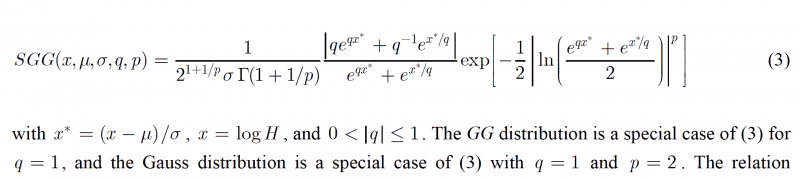
The discussion centers on the four-parameter Skewed Generalized Gaussian (SGG) distribution, with participants seeking more information on its cumulative distribution function (CDF) and descriptive statistics. The original publication of the SGG was traced back to a paper that derived it from the General Gaussian distribution. Key insights include the relationship between parameters in the SGG and the General Gaussian, specifically that "p" in the SGG corresponds to beta in the General Gaussian, and 2*sigma is equivalent to alpha. Participants suggest utilizing Mathematica or other symbolic math packages for further analysis.

PREREQUISITES
  • Understanding of probability distributions, specifically General Gaussian distributions.
  • Familiarity with statistical concepts such as CDF and descriptive statistics.
  • Experience with symbolic math software like Mathematica.
  • Knowledge of parameter transformations in statistical distributions.
NEXT STEPS
  • Research the mathematical derivation of the Skewed Generalized Gaussian distribution.
  • Learn how to compute the CDF for the Skewed Generalized Gaussian distribution using Mathematica.
  • Explore the relationship between the General Gaussian and Skewed Generalized Gaussian distributions in detail.
  • Investigate parameter transformations in statistical distributions to understand their implications.
USEFUL FOR

Statisticians, data scientists, and researchers working with advanced probability distributions, particularly those interested in the Skewed Generalized Gaussian distribution and its applications in statistical modeling.

geo101
I am looking for more information (e.g., reference, the CDF and descriptive stats) about a four-parameter skewed generalized Gaussian (SGG) distribution. I have come across the PDF for this distribution, but with no reference and not a lot of other information. Here is a snippet...
SGG.png


On Wikipedia, there are two forms of three parameter generalized Gaussian distributions (http://en.wikipedia.org/wiki/Generalized_normal_distribution). One that controls kurtosis, the other, essentially, skewness.

I'm wondering if anyone here can point me in the right direction for sourcing this PDF and more information about it (e.g., the CDF and descriptive stats).

Cheers
Geo101
 
Physics news on Phys.org
I'm unfamilar with that distribution, but here are some things to try if you get desperate.

Reveal the title of the article or book you quoted. Post more of it. If the article or book you quoted lists any references at all, list a few. Perhaps a forum member with access to one of the references can find something about the distribution.

Ask in the programming section if any user of Mathematica (or other symbolic math packages) can use it to compute the things you need.

Consider whether the 4-parameter distribution can be viewed as a tranformation of the data. For example the log-normal distribution can be viewed as tranforming the data by taking a logarithm and then saying the transformed data is normally distributed. The Wikipedia article on the two types of 3-parameter gaussians isn't enlightening in that respect.

It might help to ask a less imposing question! People might jump into answer a general question such as "Can probability distributions given by a family of functions with several parameters be expressed as a family of distributions defined by a few of the parameters applied to data which has been transformed by a function defined by the other parameters?" For example, the family of normal distributions can be regarded as a zero-parameter family of functions consisting of the standard normal distribution with mean 0 and variance 1 applied to transformed data. We could regard \mu and \sigma as parameters used in transforming a datum x to \frac{x - \mu}{\sigma}.
 
Hi Stephen

Thanks for the reply. This distribution was used is a piece of software and the previous snippet was from the manual. I have tracked it back to the original publication and it looks like the author derived it themselves. You were right, though, it appears that they have started from the General Gaussian (version 1in the wiki link in my first post) and transformed the variables to derive what they call the "Skewed Generalized Gaussian".

Here is a snippet form the original paper (full version found here...
http://onlinelibrary.wiley.com/doi/10.1029/2002JB002023/abstract)
SGG_v2.png


By setting q = 1 in the above and comparing the last exponential term with that of the Generalized Gaussian (GG) it seems that "p" as used is equivalent to beta in the GG and that 2*sigma is equivalent to alpha in the GG.

I guess my question now becomes, can anyone help me determine what the transformation is and what the transformed CDF would be?

I have also emailed the original author, so if I hear back I'll post it here.

Cheers

Edit: the references they give appear only to reference the General Gaussian distribution.
Evans, M., N. Hastings, and B. Peacock, Statistical Distributions, John Wiley, New York, 2000
 

Similar threads

  • · Replies 22 ·
Replies
22
Views
6K
  • · Replies 4 ·
Replies
4
Views
3K
  • · Replies 2 ·
Replies
2
Views
2K
  • · Replies 10 ·
Replies
10
Views
4K
  • · Replies 1 ·
Replies
1
Views
8K
  • · Replies 1 ·
Replies
1
Views
3K
Replies
1
Views
3K
  • · Replies 5 ·
Replies
5
Views
4K
  • · Replies 1 ·
Replies
1
Views
3K
  • · Replies 4 ·
Replies
4
Views
2K