Smallest Set Containing All n-point Sets

  • Context: Graduate 
  • Thread starter Thread starter jgm340
  • Start date Start date
  • Tags Tags
    Set Sets
Click For Summary
SUMMARY

The discussion centers on determining the smallest set S in R^m that can contain an n-point set P, where the distance between any two points in P is less than 2. For n=2, the smallest set is identified as [0,1] U {2}, while for n=3, it involves a more complex configuration. The concept of translations and orthogonal transformations is crucial, as the set S must accommodate transformations that allow P to fit within it. The closed ball B(x0, r) around a point x0 with radius r, derived from the diameter of P, is a key component in this analysis.

PREREQUISITES
  • Understanding of n-point sets in R^m
  • Familiarity with the concept of diameter in metric spaces
  • Knowledge of transformations including translations and orthogonal transformations
  • Basic principles of geometric shapes, specifically squares and circles
NEXT STEPS
  • Explore the properties of closed balls in metric spaces
  • Research the implications of orthogonal transformations on geometric sets
  • Investigate the mathematical definitions and applications of diameter in higher dimensions
  • Study the intersection of geometric shapes and their implications in set containment
USEFUL FOR

Mathematicians, geometry enthusiasts, and anyone interested in advanced concepts of set theory and geometric transformations.

jgm340
Messages
103
Reaction score
2
I've been thinking about this. Suppose you have an n-point set P in Rm which has the property that for any two points x, y in P, ||x - y|| < 2. If we fix n, what can we say about the smallest set S in Rm that contains P, allowing for both translations and orthogonal transformations of S?

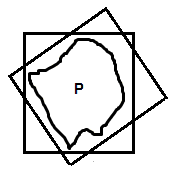
If we start in R2, the answer is not what you'd expect! As illustrated in this picture, P must be able to fit inside of any 2 by 2 square after only translation:
attachment.php?attachmentid=26839&stc=1&d=1278316407.png

That is, if I were to have a square hoola-hoop, I could swing it around P. However, for n > 2, the intersection of all those squares would not necessarily fit inside a circle of diameter 2.

For n=2, the smallest set would be something like [0,1] U {2}.
For n=3, I think the smallest set would be {x = (x1, x2) : ||x - (0,1)|| < 2, x1 < 0, x2 < 0} U {x = (x2,x2) : x1 = 0, -1 < x2 < 1}

Any thoughts?
 

Attachments

  • shape rotated.png
    shape rotated.png
    1.9 KB · Views: 613
Physics news on Phys.org
I'm not sure what exactly you mean by "translations" and "orthogonal transformation".

If you have an n-point subset P of R^m, take max{||x - y||, x, y from P} = diam(P) = r = d(x0, y0) (for some x0, y0 in P), and then the closed ball B(x0, r) around x with radius r contains the set P.
 
radou said:
I'm not sure what exactly you mean by "translations" and "orthogonal transformation".

If you have an n-point subset P of R^m, take max{||x - y||, x, y from P} = diam(P) = r = d(x0, y0) (for some x0, y0 in P), and then the closed ball B(x0, r) around x with radius r contains the set P.

Yes, but that's not the smallest. :wink:
Take the intersection of the balls about x0 and y0. This would also necessarily contain P.

About the "translations and orthogonal transformations" business: I'm looking for a closed form for a set S which must "be able to contain" P. By "be able to contain", I mean that for any P, we ought to find some transformation T (involving only rotations, reflections, and translations) such that P is contained in T(S).
 

Similar threads

  • · Replies 3 ·
Replies
3
Views
2K
  • · Replies 6 ·
Replies
6
Views
3K
  • · Replies 4 ·
Replies
4
Views
3K
  • · Replies 54 ·
2
Replies
54
Views
7K
  • · Replies 7 ·
Replies
7
Views
2K
  • · Replies 3 ·
Replies
3
Views
3K
  • · Replies 7 ·
Replies
7
Views
3K
  • · Replies 2 ·
Replies
2
Views
1K
  • · Replies 5 ·
Replies
5
Views
4K
  • · Replies 1 ·
Replies
1
Views
2K