Math Amateur
Gold Member
MHB
- 3,920
- 48
I am reading Houshang H. Sohrab's book: "Basic Real Analysis" (Second Edition).
I am focused on Chapter 2: Sequences and Series of Real Numbers ... ...
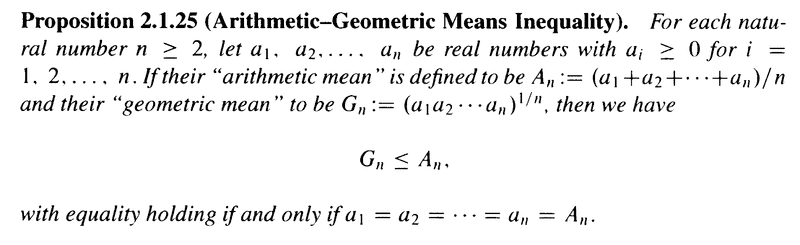
I need help with the proof of Proposition 2.1.25 ...
Proposition 2.1.25 reads as follows:
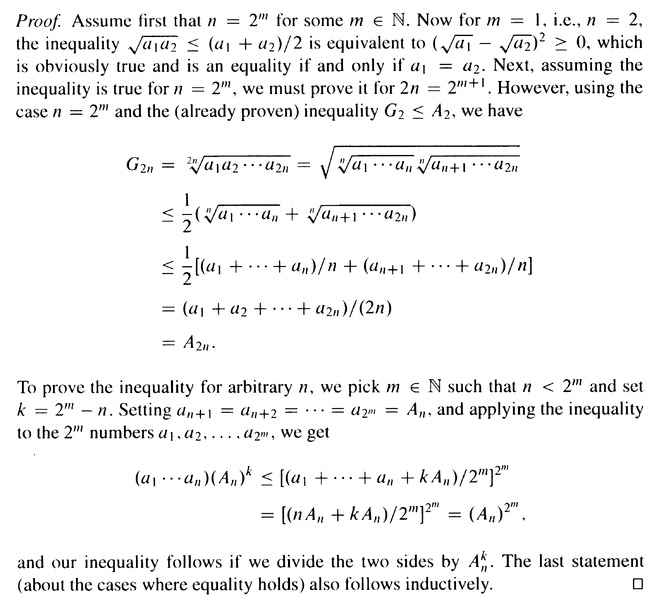 In the above proof, Sohrab appears to be using mathematical induction ... BUT ... he proves the inequality for ##n= 2##, but then, in the inductive step, instead of assuming the inequality is true for ##n## and then proving it is true for ##n+1## ... Sohrab assumes the inequality is true for ##n = 2^m## and then proceeds to prove it true for ##2n = 2^{ m+1}## ... then finishes the proof by picking an ##m## such that ##n \lt 2^m## and establishing the inequality ...
My questions are as follows:
What is the valid proof process here ... ?
How does the proof process fit with the usual mathematical induction strategy ...Peter
I am focused on Chapter 2: Sequences and Series of Real Numbers ... ...
I need help with the proof of Proposition 2.1.25 ...
Proposition 2.1.25 reads as follows:
My questions are as follows:
What is the valid proof process here ... ?
How does the proof process fit with the usual mathematical induction strategy ...Peter
Attachments

