Solve Bartlett's Formula: Example 2.4.2 | Get Expert Help

  • Context:
  • Thread starter Thread starter nacho-man
  • Start date Start date
  • Tags Tags
    Formula
Join the discussion
Registration is free. Ask a follow-up in this thread, or start your own.
4 replies · 3K views
nacho-man
Messages
166
Reaction score
0
Hi,
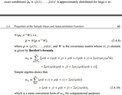
Just having some difficulty computing the example (i,j) element of the cov matrix W here from the given formula.

Could anyone provide some guidance?
I have attached the example question (example 2.4.2) and also the supporting equation previous from it.

Any assistance is greatly appreciated.

Thanks!
 

Attachments

  • relevant.jpg
    relevant.jpg
    29.4 KB · Views: 119
  • example.jpg
    example.jpg
    22.7 KB · Views: 106
Physics news on Phys.org
Hi nacho,

I will start with I probably can't help you but am interested in this question as well. Last semester I took a course on Time Series and I think that's what you are doing as well. The theory can be difficult at times.

In your post though I don't see any actual problem to solve. I see the two formulas for an infinite sum to calculate $w_{ij}$ and some text in the second picture, but nothing that looks like a question. Can you explain a bit more please what you are trying to do?
 
Thanks for replying Jameson.

in particular, i am trying to find out how they did the example 2.4.2.

They worked out $w_{ij}$ using (2.4.10) but I am not entirely sure what the inputs for the formula are.
 
nacho said:
Hi,
Just having some difficulty computing the example (i,j) element of the cov matrix W here from the given formula.

Could anyone provide some guidance?
I have attached the example question (example 2.4.2) and also the supporting equation previous from it.

Any assistance is greatly appreciated.

Thanks!
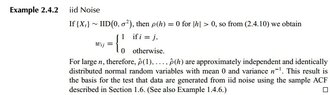
I know nothing about Bartlett's formula, but I can tell you how to get 2.4.2 from 2.4.10. The formula 2.4.10 says $$w_{ij} = \sum_{k=-\infty}^\infty \{\rho(k+i) + \rho(k-i) -2\rho(i)\rho(k)\} \times \{\rho(k+j) + \rho(k-j) -2\rho(j)\rho(k)\}.$$ In Example 2.4.2 you are told that $\rho(h)=0$ for almost all values of $h$. In fact, the only value of $h$ for which $\rho(h)\ne0$ is $h=0$, and in that case $\rho(0) = 1$. All the terms on the right side of 2.4.10 involve values of $\rho$, so you can put them all equal to $0$ unless they might be equal to $\rho(0).$ So in the expression $\rho(k+i) + \rho(k-i) -2\rho(i)\rho(k)$, the terms $\rho(k+i)$ and $2\rho(i)\rho(k)$ will always be zero, and the only term that can survive is $\rho(k-i)$ (which will be nonzero when $k=i$). The same argument applies to the other expression in the formula 2.4.10, namely $\rho(k+j) + \rho(k-j) -2\rho(j)\rho(k)$, which reduces to $\rho(k-j).$ Thus 2.4.10 becomes $$w_{ij} = \sum_{k=-\infty}^\infty \rho(k-i)\rho(k-j).$$ In that infinite sum, all the terms will again be zero (because either $k-i$ or $k-j$ will be nonzero), unless $i=j$, in which case there is one nonzero term (when $k=j$). Therefore $w_{ij}=0$ unless $i=j$ in which case $w_{ij}=1.$
 
Opalg said:
I know nothing about Bartlett's formula, but I can tell you how to get 2.4.2 from 2.4.10. The formula 2.4.10 says $$w_{ij} = \sum_{k=-\infty}^\infty \{\rho(k+i) + \rho(k-i) -2\rho(i)\rho(k)\} \times \{\rho(k+j) + \rho(k-j) -2\rho(j)\rho(k)\}.$$ In Example 2.4.2 you are told that $\rho(h)=0$ for almost all values of $h$. In fact, the only value of $h$ for which $\rho(h)\ne0$ is $h=0$, and in that case $\rho(0) = 1$. All the terms on the right side of 2.4.10 involve values of $\rho$, so you can put them all equal to $0$ unless they might be equal to $\rho(0).$ So in the expression $\rho(k+i) + \rho(k-i) -2\rho(i)\rho(k)$, the terms $\rho(k+i)$ and $2\rho(i)\rho(k)$ will always be zero, and the only term that can survive is $\rho(k-i)$ (which will be nonzero when $k=i$). The same argument applies to the other expression in the formula 2.4.10, namely $\rho(k+j) + \rho(k-j) -2\rho(j)\rho(k)$, which reduces to $\rho(k-j).$ Thus 2.4.10 becomes $$w_{ij} = \sum_{k=-\infty}^\infty \rho(k-i)\rho(k-j).$$ In that infinite sum, all the terms will again be zero (because either $k-i$ or $k-j$ will be nonzero), unless $i=j$, in which case there is one nonzero term (when $k=j$). Therefore $w_{ij}=0$ unless $i=j$ in which case $w_{ij}=1.$
precisely what I needed, thank you! that makes complete sense, I just couldn't recognise that the k's, i's and j's were just referring to h