Solve for $x$ and $y$: Real Number Condition

  • Context: MHB 
  • Thread starter Thread starter anemone
  • Start date Start date
  • Tags Tags
    Condition
Click For Summary
SUMMARY

The discussion focuses on proving that for two positive real numbers $x$ and $y$ satisfying the equations $x^3 = x + 1$ and $y^6 = 3x + y$, the condition $x > y$ holds true. The participants analyze the functions $y_1 = x^2 - x + 1$ and $y_2 = x$ for $x > 1$ to compare their values. The conclusion emphasizes the necessity of finding valid solutions for both equations before making comparisons between $x$ and $y$. The discussion also corrects a misunderstanding regarding the equivalence of two mathematical expressions.

PREREQUISITES
  • Understanding of polynomial equations, specifically cubic and sixth-degree equations.
  • Familiarity with real number properties and inequalities.
  • Basic knowledge of function comparison and graphical methods.
  • Ability to manipulate and solve algebraic expressions.
NEXT STEPS
  • Study the properties of cubic equations, particularly $x^3 = x + 1$.
  • Explore the implications of the inequality $y^6 = 3x + y$ on the relationship between $x$ and $y$.
  • Learn about function comparison techniques in algebra.
  • Investigate alternative methods for solving polynomial equations without graphical representation.
USEFUL FOR

Mathematicians, students studying algebra, and anyone interested in inequalities and polynomial equations will benefit from this discussion.

anemone
Gold Member
MHB
POTW Director
Messages
3,851
Reaction score
115
For two positive real numbers $x$ and $y$ that satisfy the condition $x^3=x+1$ and $y^6=3x+y$, show that $x>y$.
 
Mathematics news on Phys.org
anemone said:
For two positive real numbers $x$ and $y$ that satisfy the condition $x^3=x+1$ and $y^6=3x+y$, show that $x>y$.

View attachment 2460

$x^3=x+1----(1)$ and
$y^6=3x+y---(2)$
from (1)(2):
1<x<2 , 1<y<2(for x,y>0)
if we want to prove x>y we only have to prove :$x^6>y^6$
that is to prove :$x^2+2x+1>3x+y$
$=>x^2-x+1>y$
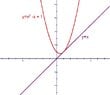
from the diagram x=y is the tangent line of $x^2-x+1 $ at point (1,1)
when x>1 then $y=x^2-x+1$ is all above $y=x$
and the prove x>y is done.
 

Attachments

  • x is bigger than y.jpg
    x is bigger than y.jpg
    10.5 KB · Views: 108
Albert said:
View attachment 2460

$x^3=x+1----(1)$ and
$y^6=3x+y---(2)$
from (1)(2):
1<x<2 , 1<y<2(for x,y>0)
if we want to prove x>y we only have to prove :$x^6>y^6$
that is to prove :$x^2+2x+1>3x+y$
$=>x^2-x+1>y$
from the diagram x=y is the tangent line of $x^2-x+1 $ at point (1,1)
when x>1 then $y=x^2-x+1$ is all above $y=x$
and the prove x>y is done.

$x^ 2 −x+1$ is all above y=x means x >y means it is rue but it does not mean that x >y $
 
consider the range when x>1 then we set:

$y_1=x^2-x+1$

$y_2=x$

compare $y_1 $ and $ y_2$(for the same $x$)
 
Albert said:
consider the range when x>1 then we set:

$y_1=x^2-x+1$

$y_2=x$

compare $y_1 $ and $ y_2$(for the same $x$)

if y < x this is true agreed

but x = 1.7 and y = 1.8 means

x^2 - x + 1 = 2.19 > y even though y is > x we need to prove y < x and not the other way around
 
Last edited:
from $x^3=x+1----(1)$
$y^6=3x+y--------(2)$
at first you must find the solution of (1)
and put the soluion x to (2) and find the solution of y and compare the value of x and y
so x and y must both meet the restriction of (1) and (2)
this can be said as find the solution of (1) and (2) and compare its value
are you sure x=1.7 and y=1.8 will satisfy (1) and (2) ?
the value of y is based on the same value of x in (1)
 
Last edited:
$x^3 =x+1−−−−(1)$

x has to be > 1 as $x^3>= 1$ and if

$x^3 - x - 1= x^2(x-1) - 1$ is monotonically increasing for x > 1

as x = 2 => $x^3 - x -1 = 5$ > 0 so x is between 1 and 2

$y^ 6 =3x+y$

$y^6$ > 1 so y > 1

as x < 2 so $y^6 - y < 6$ and y < 2 because $y^6- y$ monotonically increasing for y > 1 and for y = 2 it is 62

to show x > y we need to prove $x^6 > y^6$

or $x^2 +2x+1>3x+y$
=>$x 2 −x+1>y$

now $x 2 −x+1 = (x-1)^2 + x + 1$ > 2 ( as x > 1) > y

hence proved

edit: above is mistake
based on comment by Albert $x 2 −x+1 = (x-1)^2 + x $
it is > x and without proving x > y we cannot prove it > y so we are back to square one. I am sorry and thanks to Albert
 
Last edited:
kaliprasad said:
$x^3 =x+1−−−−(1)$

x has to be > 1 as $x^3>= 1$ and if

$x^3 - x - 1= x^2(x-1) - 1$ is monotonically increasing for x > 1

as x = 2 => $x^3 - x -1 = 5$ > 0 so x is between 1 and 2

$y^ 6 =3x+y$

$y^6$ > 1 so y > 1

as x < 2 so $y^6 - y < 6$ and y < 2 because $y^6- y$ monotonically increasing for y > 1 and for y = 2 it is 62

to show x > y we need to prove $x^6 > y^6$

or $x^2 +2x+1>3x+y$
=>$x 2 −x+1>y$

now $x 2 −x+1 = (x-1)^2 + x + 1$ > 2 ( as x > 1) > y

hence proved
you said : $x 2 −x+1 = (x-1)^2 + x + 1$
but :$x^ 2 −x+1 \neq (x-1)^2 + x + 1$
 
Albert said:
you said : $x 2 −x+1 = (x-1)^2 + x + 1$
but :$x^ 2 −x+1 \neq (x-1)^2 + x + 1$

Yes .It is my mistake
 
  • #10
Albert said:
View attachment 2460

$x^3=x+1----(1)$ and
$y^6=3x+y---(2)$
from (1)(2):
1<x<2 , 1<y<2(for x,y>0)
if we want to prove x>y we only have to prove :$x^6>y^6$
that is to prove :$x^2+2x+1>3x+y$
$=>x^2-x+1>y$
from the diagram x=y is the tangent line of $x^2-x+1 $ at point (1,1)
when x>1 then $y=x^2-x+1$ is all above $y=x$
and the prove x>y is done.

Well done, Albert! And thanks for participating!:)

Here is another solution that I saw online that doesn't use the graphical method for proving the result and hence I will share it:
Note that $x^3>1$ which implies $x>1$ and $y^6>y$ and $\therefore y>1$.

Also, $x^6=x^2+2x+1 \ge 4x$ so we have $x^6-y^6 \ge 4x-y-3x=x-y$

$x^6-y^6 \ge x-y$

$(x-y)(x^5+x^4y+x^3y^2+x^2y^3+xy^4+y^5) \ge x-y$

If $x<y$, we have $(x^5+x^4y+x^3y^2+x^2y^3+xy^4+y^5) \le 1$ for all $x,\,y>0$ and this is clearly impossible.

If $x=y$, we have $x^5=4$ and $x^6=x^2+2x+1$ and we get $4x=x^2+2x+1$ which yields $x=1$ and this leads a contradiction since $x>1$.

So it must be $x>y$ that holds and we're done.
 

Similar threads

  • · Replies 1 ·
Replies
1
Views
1K
Replies
4
Views
2K
  • · Replies 1 ·
Replies
1
Views
1K
  • · Replies 1 ·
Replies
1
Views
1K
  • · Replies 0 ·
Replies
0
Views
529
  • · Replies 1 ·
Replies
1
Views
1K
  • · Replies 1 ·
Replies
1
Views
1K
  • · Replies 1 ·
Replies
1
Views
1K
  • · Replies 13 ·
Replies
13
Views
2K
  • · Replies 48 ·
2
Replies
48
Views
4K