Solve ODE: (x^2+2)y'''-(x^2+2x+2)y''+2(x+1)y'-2y=0

  • Context: Graduate 
  • Thread starter Thread starter GodsmacK
  • Start date Start date
  • Tags Tags
    Ode Strange
Click For Summary
SUMMARY

The differential equation (x^2+2)y'''-(x^2+2x+2)y''+2(x+1)y'-2y=0 can be solved using elementary functions. The discussion reveals that exponential functions and second-order polynomials are effective approaches. Specifically, the particular solutions identified are y=x^2-2 and y=x^2+2x, leading to the general solution y=c1 e^x + c2 (x^2-2) + c3 (x^2+2x). The conversation emphasizes the importance of recognizing patterns in the coefficients of the ODE to simplify the solution process.

PREREQUISITES
  • Understanding of ordinary differential equations (ODEs)
  • Familiarity with polynomial functions and their derivatives
  • Knowledge of exponential functions and their properties
  • Experience with linear algebra concepts, particularly matrix methods
NEXT STEPS
  • Explore methods for solving higher-order linear ODEs
  • Study the method of undetermined coefficients for finding particular solutions
  • Learn about the Wronskian and its role in determining linear independence of solutions
  • Investigate substitution techniques for simplifying complex ODEs
USEFUL FOR

Mathematicians, engineering students, and anyone involved in solving differential equations will benefit from this discussion, particularly those seeking to enhance their problem-solving skills in ODEs.

GodsmacK
Messages
4
Reaction score
1
Hello again,

I've got another trouble with a new differential equation:

(x^2+2)y'''-(x^2+2x+2)y''+2(x+1)y'-2y=0

I did a try using matrices(file is attached), however the system to be solved is hard to compute.
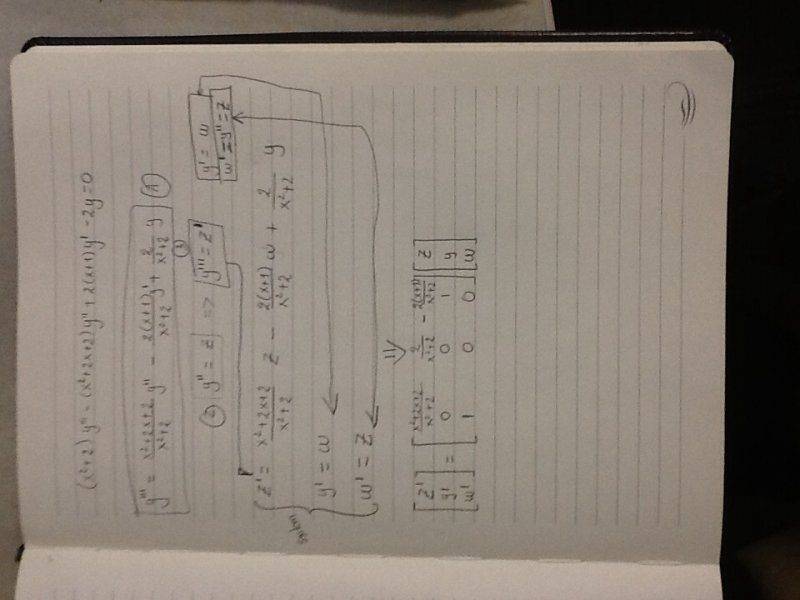
image.jpg


Do you have any idea to help me solve this out?
 
Physics news on Phys.org
Since it is probably a training exercise, the result can certainly be expressed with elementary functions. So, before using more complicated approachs, one can try to find some convenient very simple functions.
One first idea is to try exponential. The form of the coefficients in the ODE draw to check and observe that ex is a particular solution.
An other idea is to try polynomials. Trying first order polynomials is not succesfull. Then, trying second order polynomials, on the form y=x2+bx+c leads too two particular solutions : y=x2-2 and y=x2+2x. Now we have three indepêndant particular solutions. So the general solution is :
y=c1 ex + c2 (x2-2) + c3 (x2+2x)
 
There is a pattern to the ODE that suggests a clever substitution. How does the polynomial multiplying the third derivative differ from the polynomial multiplying the second derivative? Whats different between the polynomials multiplying the second and first derivative?
 

Similar threads

  • · Replies 2 ·
Replies
2
Views
2K
  • · Replies 2 ·
Replies
2
Views
3K
  • · Replies 3 ·
Replies
3
Views
2K
  • · Replies 3 ·
Replies
3
Views
3K
Replies
6
Views
2K
  • · Replies 7 ·
Replies
7
Views
3K
Replies
9
Views
2K
  • · Replies 4 ·
Replies
4
Views
2K
  • · Replies 2 ·
Replies
2
Views
3K
  • · Replies 2 ·
Replies
2
Views
4K