Can the ODE \psi''-y^2\psi=0 be solved using a general method?

Click For Summary
SUMMARY

The ordinary differential equation (ODE) \(\psi'' - y^2\psi = 0\) can be approached using the parabolic cylinder functions as outlined in the discussion. Attempts to solve the ODE through variable separation and integrating factors were unsuccessful. A proposed solution of the form \(e^{f(y)}\) led to the identification of \(f(y) = \frac{y^2}{2}\), although the presence of the \(y^m\) term was not initially anticipated. The discussion suggests expanding in Laurent series at infinity as a viable method for solving this ODE.

PREREQUISITES
  • Understanding of ordinary differential equations (ODEs)
  • Familiarity with parabolic cylinder functions
  • Knowledge of series expansions, particularly Laurent series
  • Basic concepts of quantum mechanics as related to Shankar's Principles of Quantum Mechanics
NEXT STEPS
  • Research the properties and applications of parabolic cylinder functions
  • Study the method of series expansions, focusing on Laurent series
  • Explore advanced techniques for solving second-order linear ODEs
  • Investigate the implications of boundary conditions in quantum mechanics related to ODE solutions
USEFUL FOR

Mathematicians, physicists, and students studying quantum mechanics or differential equations, particularly those interested in advanced ODE solving techniques and their applications in physics.

Luke Tan
Messages
29
Reaction score
2
TL;DR
How do i solve this ODE?
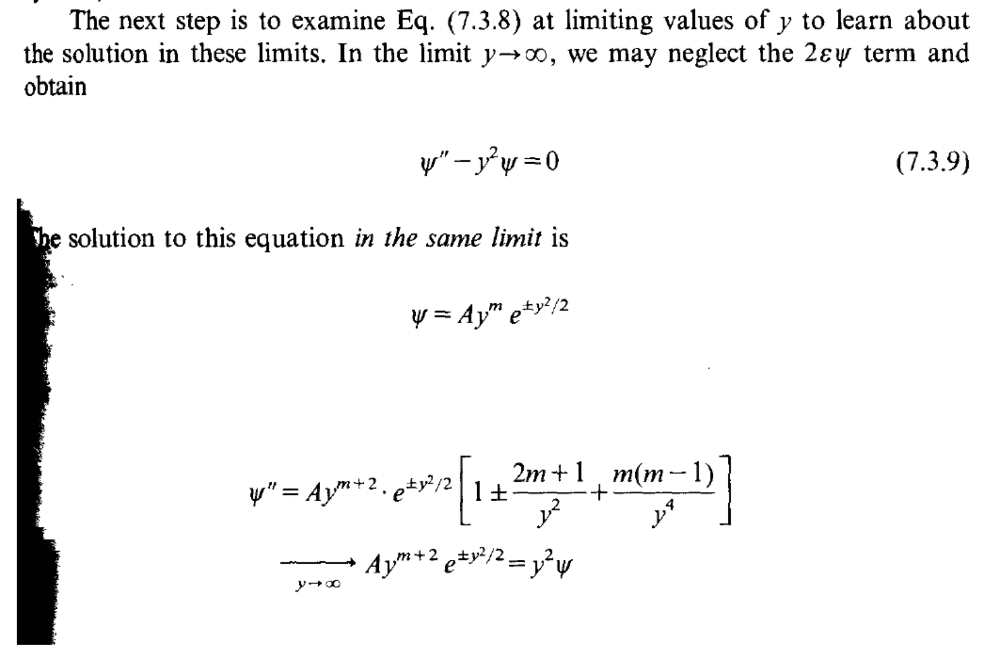
When reading through Shankar's Principles of Quantum Mechanics, I came across this ODE
Screenshot_3.png


\psi''-y^2\psi=0
solved in the limit where y tends to infinity.

I have tried separating variables and attempted to use an integrating factor to solve this in the general case before taking the limit, but they didn't work.

I also tried to guess a solution of the form e^{f(y)}, and it quickly became clear that f(y)=\frac{y^2}{2}, but it feels like my guess is unmotivated and i didn't get the y^m term since i didn't guess it would be there.

Is there any general method for this kind of ODE?
 
Physics news on Phys.org
You could try to expand in Laurent series at infinity and factor out ##y^m##...
 

Similar threads

  • · Replies 3 ·
Replies
3
Views
3K
  • · Replies 5 ·
Replies
5
Views
2K
  • · Replies 36 ·
2
Replies
36
Views
6K
  • · Replies 2 ·
Replies
2
Views
2K
  • · Replies 0 ·
Replies
0
Views
3K
  • · Replies 1 ·
Replies
1
Views
2K
  • · Replies 3 ·
Replies
3
Views
2K
  • · Replies 2 ·
Replies
2
Views
3K
  • · Replies 7 ·
Replies
7
Views
2K
  • · Replies 6 ·
Replies
6
Views
3K