Solving an epicyclic gearbox with multiple compound gears

  • Thread starter dstealth
  • Start date
  • Tags Tags
    Epicyclic
3 replies · 3K views · last reply
dstealth
Messages
3
Reaction score
0
Hi all, I'm Chris, a first time poster!

Currently stuck on an assignment question for my mechanical engineering course. The question is shown in the picture below. The capital T refers to 'teeth', as in 20T is 20 teeth on that particular gear. Ignore the little arrows with P and S - that is just me labeeling up the planetary and the sun gears. I answered a previous question on epicyclic gearboxes no problem but we have not been taught how to answer one this complex:-
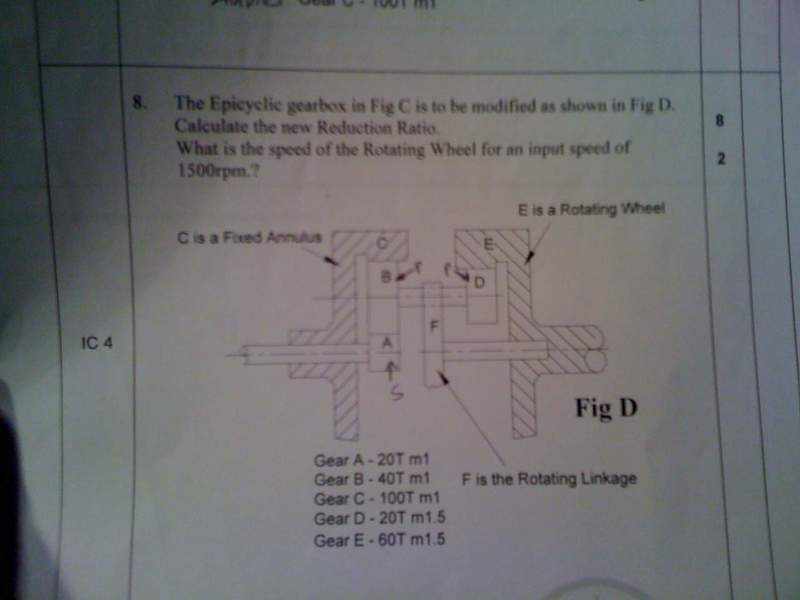
Photo of a printed exam question with a cross-section sketch labelled Fig D showing an epicyclic gearbox with fixed annulus C, rotating wheel E, rotating linkage F, and gears A, B and D, plus a gear list: A 20T m1, B 40T m1, C 100T m1, D 20T m1.5, E 60T m1.5.


Any pointers?

Thanks in advance.
 
The question is essentially asking for the ratio of the output speed to the input speed.

If I remember correctly the module m= D/T and for meshing gears, the modules are the same.
 
rock.freak667 said:
The question is essentially asking for the ratio of the output speed to the input speed.

If I remember correctly the module m= D/T and for meshing gears, the modules are the same.

Shown in the pictures is the previous question which that question is based upon, along with my working out. I calculated a 6:1 reeduction ratio for the first question and a fixing torque of 25.46 Nm. I just don't know how to do the second question of the 'modified' gearbox that I posted in the first post.

Hand-marked exam sheet with a diagram of an epicyclic gearbox, Fig C, showing a fixed annulus C, planet gear B, sun gear A and output linkage F, with gear data Gear A - 20T m1, Gear B - 40T m1, Gear C - 100T m1.


Handwritten working on lined paper headed 'False Mechanical Engineering' and 'TM502', showing a table of planet gear values, a gear ratio of 6:1 reduction, and torque calculations T = P/(2πn) giving T = 25.48 Nm.


Thanks
 
I'm sure the working out is simple, it's just we haven't covered any examples like this in the lesson.