giodude
- 30
- 1
Hello,
I'm working on the following differential equation:In problem 23 through 30 use the method of reduction of order to find a second solution of the given differential equation.
27. xy'' - y' + 4*x^3*y = 0, x > 0; y_1(x) = sin(x^2)
I begin my solution by writing out the known equations of y, y', y'' in terms of v and y_1. I also differentiate y_1 to find y_1', y_1'':
Let v denote v(x):
y = v*y_1
y' = v'*y_1 + v*y_1'
y'' = v''*y_1 + 2v'y_1' + v*y_1''
y_1 = sin(x^2) (given)
y_1' = 2*x*cos(x^2)
y_1'' = 2*cos(x^2) - 4*x^2*sin(x^2)
Next, I plug y, y', and y'' into the original differential:
x*(v''*y_1 + 2*v'*y_1' + v*y_1'') - v'*y_1 - v*y_1' + 4*x^3*v*y_1 = 0
x*v''*y_1 + (2*x*y_1' - y_1)*v' + (xy'' - y' + 4*x^3*y)v = 0 (the coefficient of v is our original differential so we may set that to 0)
x*v''*y_1 + (2*x*y_1' - y_1)*v' = 0
v'' + (2*x*y_1' - y_1) / (x*y_1)*v' = 0
Now we need to solve this first order differential equation (I use integration factors to solve):
d[mu]/dx = (2*x^2*cos(x^2)/xsin(x^2) - sin(x^2)/(x*sin(x^2))) * mu
d[mu]/dx = (2*x*cot(x^2) - 1/x)*mu
(1/mu)*d[mu]/dx = 2*x*cot(x^2) - 1/x
Differentiating both sides:
ln(mu) = -ln(sin(x^2)) - ln(x)
Exponentiating both sides:
mu = 1/(x*sin(x^2))
Plugging the integrating factor back in we get:
d[(1/(x*sin(x^2))) * v']/dx = 0
1/(x*sin(x^2)) * v' = C_1
v' = C_1*x*sin(x^2)
Integrating v':
v = -C_1*(1/2)*cos(x^2) + C_2
We can collapse -C_1*(1/2) into a C_1 to represent that entire constant term. Solving for y by computing v*y_1:
y = C_1*cos(x^2)*sin(x^2) + C_2*sin(x^2)
The answer in the textbook I'm using says that y_2 = cos(x^2), however this indicates a solution of y_2 = cos(x^2)*sin(x^2). Is this an interpretation problem such that this answer does in fact suggest y_2 = cos(x^2) or did I go wrong somewhere within my process of solving?
Thank you!
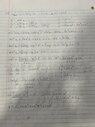
I'm working on the following differential equation:In problem 23 through 30 use the method of reduction of order to find a second solution of the given differential equation.
27. xy'' - y' + 4*x^3*y = 0, x > 0; y_1(x) = sin(x^2)
I begin my solution by writing out the known equations of y, y', y'' in terms of v and y_1. I also differentiate y_1 to find y_1', y_1'':
Let v denote v(x):
y = v*y_1
y' = v'*y_1 + v*y_1'
y'' = v''*y_1 + 2v'y_1' + v*y_1''
y_1 = sin(x^2) (given)
y_1' = 2*x*cos(x^2)
y_1'' = 2*cos(x^2) - 4*x^2*sin(x^2)
Next, I plug y, y', and y'' into the original differential:
x*(v''*y_1 + 2*v'*y_1' + v*y_1'') - v'*y_1 - v*y_1' + 4*x^3*v*y_1 = 0
x*v''*y_1 + (2*x*y_1' - y_1)*v' + (xy'' - y' + 4*x^3*y)v = 0 (the coefficient of v is our original differential so we may set that to 0)
x*v''*y_1 + (2*x*y_1' - y_1)*v' = 0
v'' + (2*x*y_1' - y_1) / (x*y_1)*v' = 0
Now we need to solve this first order differential equation (I use integration factors to solve):
d[mu]/dx = (2*x^2*cos(x^2)/xsin(x^2) - sin(x^2)/(x*sin(x^2))) * mu
d[mu]/dx = (2*x*cot(x^2) - 1/x)*mu
(1/mu)*d[mu]/dx = 2*x*cot(x^2) - 1/x
Differentiating both sides:
ln(mu) = -ln(sin(x^2)) - ln(x)
Exponentiating both sides:
mu = 1/(x*sin(x^2))
Plugging the integrating factor back in we get:
d[(1/(x*sin(x^2))) * v']/dx = 0
1/(x*sin(x^2)) * v' = C_1
v' = C_1*x*sin(x^2)
Integrating v':
v = -C_1*(1/2)*cos(x^2) + C_2
We can collapse -C_1*(1/2) into a C_1 to represent that entire constant term. Solving for y by computing v*y_1:
y = C_1*cos(x^2)*sin(x^2) + C_2*sin(x^2)
The answer in the textbook I'm using says that y_2 = cos(x^2), however this indicates a solution of y_2 = cos(x^2)*sin(x^2). Is this an interpretation problem such that this answer does in fact suggest y_2 = cos(x^2) or did I go wrong somewhere within my process of solving?
Thank you!
Attachments
Last edited: