DaveC426913
Gold Member
2025 Award
- 24,562
- 8,900
- TL;DR
- I am disappointed that Stellarium does not seem to recognize it, even though the article pulled screengrabs from Stellarium.
This article.
https://earthsky.org/space/large-asteroid-visible-telescopes-pass-earth-june-27-2026/
Anyway, I'm having a really tough time locating exactly where to look for 1997 NC1 (152637) this weekend.
So I made my own from his screenshots.
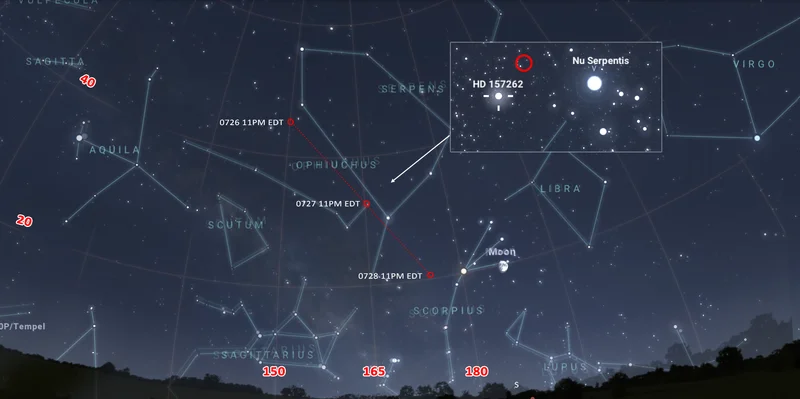
It's still not good enough. I need higher rez in order to "starhop".
I don't know what field of view I'll need to get it if I centre on, say, Nu Serpentis (Mag 4.4). And I won't know until I've taken some sort of picture 5-20 minutes apart and can tell if one of the little dots is moving.
https://earthsky.org/space/large-asteroid-visible-telescopes-pass-earth-june-27-2026/
Anyway, I'm having a really tough time locating exactly where to look for 1997 NC1 (152637) this weekend.
So I made my own from his screenshots.
It's still not good enough. I need higher rez in order to "starhop".
I don't know what field of view I'll need to get it if I centre on, say, Nu Serpentis (Mag 4.4). And I won't know until I've taken some sort of picture 5-20 minutes apart and can tell if one of the little dots is moving.