Spring momentum conservation problem

Join the discussion
Ask a follow-up here, or get your own question answered by working scientists, mathematicians and engineers — people, not an autocomplete.
Real named experts · corrections over time · the nuance an AI answer skips
4 replies · 2K views
member 731016
Homework Statement
I have successfully solved the problem below by assuming that momentum is conserved and that there is an inelastic collision occurring between the masses. However, I am wondering whether the momentum being conserved is a valid assumption that I have made.
Relevant Equations
##E_i = E_f##
##\vec p_i = \vec p_f##
For this problem,
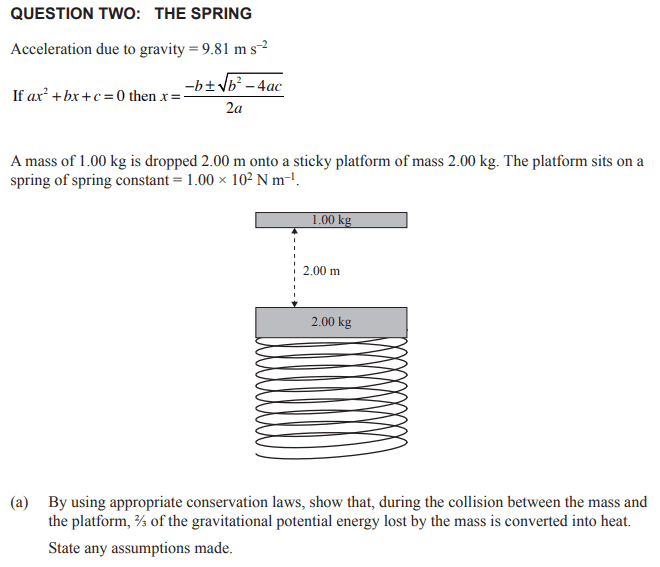
1692395139491.png

The reason why I am not sure whether it is a valid assumption whether momentum is conserved because during the collision if we consider the two masses to be the system, then there will be a uniform gravitational field acting on both masses, and a spring force that is acting upwards. Therefore, there will be two external forces acting on the system. The only reason I can think of for momentum being conserved in this case is if the forces acting on the both the masses acted over such a short time interval that there was no change in the momentum due to the forces.

However, if we define the system as everything, the two masses, the spring, and the source of the g-field, then I believe everything is internal force pairs so momentum is conserved.

If someone please knows whether momentum is conserved is a valid assumption and why, that would be greatly appreciated!

Many thanks!
 
Physics news on Phys.org
ChiralSuperfields said:
The only reason I can think of for momentum being conserved in this case is if the forces acting on the both the masses acted over such a short time interval that there was no change in the momentum due to the forces.
This reasoning is correct. Over the time interval that the masses stick together they are not displaced appreciably in the gravitational field.
 
Reply
  • Like
Likes   Reactions: member 731016
ChiralSuperfields said:
Homework Statement: I have successfully solved the problem below by assuming that momentum is conserved and that there is an inelastic collision occurring between the masses. However, I am wondering whether the momentum being conserved is a valid assumption that I have made.
Relevant Equations: ##E_i = E_f##
##\vec p_i = \vec p_f##

For this problem,
View attachment 330735
The reason why I am not sure whether it is a valid assumption whether momentum is conserved because during the collision if we consider the two masses to be the system, then there will be a uniform gravitational field acting on both masses, and a spring force that is acting upwards. Therefore, there will be two external forces acting on the system. The only reason I can think of for momentum being conserved in this case is if the forces acting on the both the masses acted over such a short time interval that there was no change in the momentum due to the forces.

However, if we define the system as everything, the two masses, the spring, and the source of the g-field, then I believe everything is internal force pairs so momentum is conserved.

If someone please knows whether momentum is conserved is a valid assumption and why, that would be greatly appreciated!

Many thanks!
The momentum of the 1.0 kg mass is clearly not conserved. Neither is the momentum of the 2.0 kg mass. But if you take the 1.0 kg mass, the 2.0 kg mass, and the spring (which is ideal, and thus massless) to be your system, then the momentum is conserved, (If you want to be picky, throw the Earth into this and use the Newtonian gravitational potential energy.)

-Dan
 
Reply
  • Like
Likes   Reactions: member 731016
topsquark said:
The momentum of the 1.0 kg mass is clearly not conserved. Neither is the momentum of the 2.0 kg mass. But if you take the 1.0 kg mass, the 2.0 kg mass, and the spring (which is ideal, and thus massless) to be your system, then the momentum is conserved, (If you want to be picky, throw the Earth into this and use the Newtonian gravitational potential energy.)

-Dan
That doesn’t really help. The issue is the time interval over which momentum is to be considered.
If you take the time up until the dropped mass reaches its lowest point, clearly momentum of the two mass+spring system is not conserved. Including the Earth is not being picky, it's essential.
To avoid that, we can use a very short time interval, making the assumption that the coalescence is achieved quickly.
In between these extremes, we could model the coalescence as a spring of high constant during compression and zero constant in relaxation.
 
Reply
  • Like
Likes   Reactions: member 731016 and topsquark
kuruman said:
This reasoning is correct. Over the time interval that the masses stick together they are not displaced appreciably in the gravitational field.
topsquark said:
The momentum of the 1.0 kg mass is clearly not conserved. Neither is the momentum of the 2.0 kg mass. But if you take the 1.0 kg mass, the 2.0 kg mass, and the spring (which is ideal, and thus massless) to be your system, then the momentum is conserved, (If you want to be picky, throw the Earth into this and use the Newtonian gravitational potential energy.)

-Dan
haruspex said:
That doesn’t really help. The issue is the time interval over which momentum is to be considered.
If you take the time up until the dropped mass reaches its lowest point, clearly momentum of the two mass+spring system is not conserved. Including the Earth is not being picky, it's essential.
To avoid that, we can use a very short time interval, making the assumption that the coalescence is achieved quickly.
In between these extremes, we could model the coalescence as a spring of high constant during compression and zero constant in relaxation.
Thank you for your replies @kuruman, @topsquark and @haruspex!