MHB Double-Check My Problem Solving | Correct Reasoning Verification

  • Thread starter Thread starter Albert Einstein1
  • Start date Start date
Click For Summary
SUMMARY

The discussion centers on verifying the continuity of a function at x=0 and the necessity of demonstrating that $\lim_{x\to 0} f(x) = 1$. The initial assertion regarding the continuity was incorrect, as the limit must be explicitly shown rather than assumed. Albert's interpretation of the inequalities involving $x^2$ was also challenged, clarifying that the limits stated were inaccurate. The correct approach requires a thorough examination of the limits rather than relying solely on continuity.

PREREQUISITES
  • Understanding of limits in calculus
  • Knowledge of continuity in functions
  • Familiarity with inequalities and their implications
  • Basic proficiency in mathematical reasoning and proof techniques
NEXT STEPS
  • Study the formal definition of continuity and its implications in calculus
  • Learn how to compute limits using epsilon-delta definitions
  • Explore the properties of limits involving polynomial functions
  • Review common pitfalls in reasoning about inequalities in calculus
USEFUL FOR

Students of calculus, educators teaching mathematical analysis, and anyone involved in problem-solving within mathematical contexts.

Albert Einstein1
Messages
3
Reaction score
0
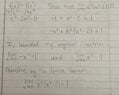
I am not entirely sure if I solved this problem correctly. Please let me know if my reasoning is flawed. Thank you and I appreciate your help greatly.
 

Attachments

  • 0EC6D101-ED4B-4D59-9103-D8F298F7F027.jpeg
    0EC6D101-ED4B-4D59-9103-D8F298F7F027.jpeg
    42 KB · Views: 129
  • 779A43FE-A23E-449E-9B66-A4FCFD72DE41.jpeg
    779A43FE-A23E-449E-9B66-A4FCFD72DE41.jpeg
    279.4 KB · Views: 124
Mathematics news on Phys.org
The function is continuous, just substitute x = 0...
 
On second thought, I didn't read the question properly... Please disregard my previous post.
 
The function IS continuous at x=0 but you need to show that $\lim_{x\to 0} f(x)= 1$ to show THAT so continuity cannot be used to do this exercise.

Albert, you state that $-1\le x^2- 2\le 1$. That is the same as $1\le x^2\le 3$. If x is close to 0 that is NOT true! You also have $\lim_{x\to 0} -x^2= 1$ and $\lim_{x\to 0} x^2= 1$. Those are certainly not true! Did you mean "= 0"?
 

Similar threads

  • · Replies 2 ·
Replies
2
Views
1K
  • · Replies 11 ·
Replies
11
Views
3K
  • · Replies 21 ·
Replies
21
Views
2K
  • · Replies 3 ·
Replies
3
Views
2K
  • · Replies 13 ·
Replies
13
Views
3K
  • · Replies 9 ·
Replies
9
Views
2K
  • · Replies 5 ·
Replies
5
Views
2K
  • · Replies 2 ·
Replies
2
Views
2K
  • · Replies 4 ·
Replies
4
Views
2K
  • · Replies 3 ·
Replies
3
Views
2K