MHB Stochastic Differential Equation using Ito's Lemma

Click For Summary
The discussion revolves around understanding Stochastic Differential Equations (SDE) and specifically applying Ito's Lemma. A user seeks clarification on the steps involved in using Ito's Lemma to derive the SDE for a process defined as \(dY_t = \mu_t dt + \sigma_t dX_t\). Another participant explains the application of Ito's Lemma, detailing how to express \(dy\) using the function \(g(u) = e^u\) and the relationships between the variables. The explanation emphasizes the importance of differentiability conditions for the function involved and clarifies how to derive the final equation for \(dy/y\). The conversation highlights the complexities of Ito's Lemma and the need for clear step-by-step guidance in its application.
cdbsmith
Messages
6
Reaction score
0
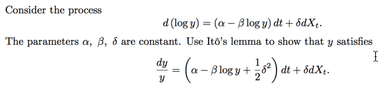
I am new to SDE, and especially Ito's Lemma. I have a question that I simply cannot answer. It attached.

Can someone please help?
 

Attachments

  • Q1 - Itos Lemma.png
    Q1 - Itos Lemma.png
    6.8 KB · Views: 139
Physics news on Phys.org
cdbsmith said:
I am new to SDE, and especially Ito's Lemma. I have a question that I simply cannot answer. It attached.

Can someone please help?

Hi cdbsmith,

Let $u = \log y $, $\mu_t = \alpha - \beta u$, and $\sigma_t = \delta$. Then $du = \mu_t dt + \sigma_t dX_t$. Let $g(u) = e^u$. We have by Ito's lemma

$\displaystyle dg = \left(g'(u)\mu_t + \frac{g"(u)}{2}\sigma_t^2\right) dt + g'(u)\sigma_t\, dX_t $,

$\displaystyle dg = \left[e^u(\alpha -\beta u) + \frac{e^u}{2}\delta^2\right] dt + e^u\delta\, dX_t$,

$\displaystyle \frac{d(e^u)}{e^u} =(\alpha - \beta u + \frac{1}{2}\delta^2) dt + \delta\, dX_t$,

$\displaystyle \frac{dy}{y} = (\alpha - \beta\log y + \frac{1}{2}\delta^2) dt + \delta\, dX_t$.
 
Euge said:
Hi cdbsmith,

Let $u = \log y $, $\mu_t = \alpha - \beta u$, and $\sigma_t = \delta$. Then $du = \mu_t dt + \sigma_t dX_t$. Let $g(u) = e^u$. We have by Ito's lemma

$\displaystyle dg = \left(g'(u)\mu_t + \frac{g"(u)}{2}\sigma_t^2\right) dt + g'(u)\sigma_t\, dX_t $,

$\displaystyle dg = \left[e^u(\alpha -\beta u) + \frac{e^u}{2}\delta^2\right] dt + e^u\delta\, dX_t$,

$\displaystyle \frac{d(e^u)}{e^u} =(\alpha - \beta u + \frac{1}{2}\delta^2) dt + \delta\, dX_t$,

$\displaystyle \frac{dy}{y} = (\alpha - \beta\log y + \frac{1}{2}\delta^2) dt + \delta\, dX_t$.

Thanks, Euge!

But, can you explain to me the steps? Ito's Lemma is confusing for me and I'm having a hard time understanding it.

Thanks again!
 
cdbsmith said:
Thanks, Euge!

But, can you explain to me the steps? Ito's Lemma is confusing for me and I'm having a hard time understanding it.

Thanks again!

Sure, let's start with this. Suppose you have a process $dY_t = \mu_t dt + \sigma_t\, dX_t$ where $X_t$ is a Brownian motion. If $T > 0$ and $f(t, x)$ is a function that is in $C^{1,2}_{t, x}([0, T] ;(0,\infty))$, that is, continuously differentiable with respect to $t$ on $[0, T]$ and continuously twice-differentiable with respect to $x$ on $\Bbb (0,\infty)$, then $f(t, Y_t)$ satisfies the SDE

$\displaystyle df(t, Y_t) = \left(f_t + \mu_t f_x + \frac{\sigma_t^2}{2} f_{xx}\right) dt + \sigma_t f_x \, dX_t$.

This is a version of Ito's lemma which is applicable to several SDE. Now there are more general versions of the lemma which deal with cases where $X_t$ is a semi-martingale, but for your problem the above formula will do.

In your SDE, I let $u = \log y$ so that $y = e^u := g(u)$. Then I can find $dy$ by using Ito's formula with $g$. Note that $g$ is independent of $t$, so $g_t = 0$. That's how I got

$\displaystyle dg = \left(g'(u)\mu_t + \frac{g''(u)}{2}\sigma_t^2\right) dt + g'(u)\sigma_t$.

I hope this helps.
 
The standard _A " operator" maps a Null Hypothesis Ho into a decision set { Do not reject:=1 and reject :=0}. In this sense ( HA)_A , makes no sense. Since H0, HA aren't exhaustive, can we find an alternative operator, _A' , so that ( H_A)_A' makes sense? Isn't Pearson Neyman related to this? Hope I'm making sense. Edit: I was motivated by a superficial similarity of the idea with double transposition of matrices M, with ## (M^{T})^{T}=M##, and just wanted to see if it made sense to talk...

Similar threads

  • · Replies 3 ·
Replies
3
Views
2K
  • · Replies 2 ·
Replies
2
Views
2K
  • · Replies 1 ·
Replies
1
Views
3K
  • · Replies 1 ·
Replies
1
Views
2K
  • · Replies 1 ·
Replies
1
Views
3K
  • · Replies 7 ·
Replies
7
Views
2K
  • · Replies 6 ·
Replies
6
Views
3K
  • · Replies 1 ·
Replies
1
Views
2K
  • · Replies 2 ·
Replies
2
Views
2K
Replies
18
Views
4K