T-Distribution and confidence interval)

Join the discussion
Ask a follow-up here, or get your own question answered by working scientists, mathematicians and engineers — people, not an autocomplete.
Real named experts · corrections over time · the nuance an AI answer skips
3 replies · 2K views
Willjeezy
Messages
29
Reaction score
0
I have a question I've been working on and I've noticed that my solution differs from the textbook solution. I would have considered it a mistake, but the next 4 questions are similar with the same solution "mistake"?

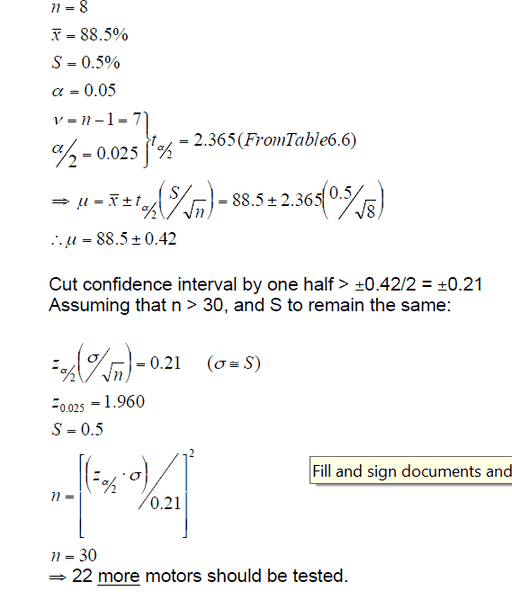
Aside from not converting the % to 0.885, I am wondering about part b. It says to cut the confidence interval to one third; in the solution they cut it to 2, why is that?

(oddly enough, in the next question, they ask to cut the confidence interval to 1/2 but use 1/3 in the solution)

is there something I am not understanding?
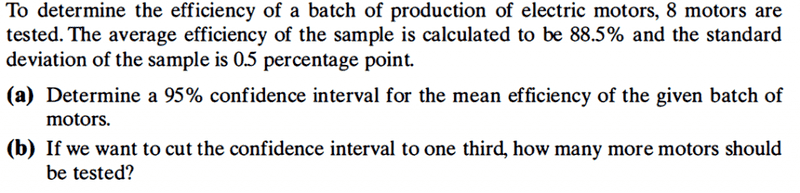
question.png
solution.png
 
Physics news on Phys.org
That all seems good. It appears that there is a problem in the question itself. Either it is asking to shrink your interval to 1/3 of its size or 1/2 of its size.
The process they outlined seems reasonable.
If you were not using a t test, it would be simpler...
## E = \pm z_{\alpha/2}\frac{\sigma}{\sqrt{N}}##
## E/3 = \pm z_{\alpha/2}\frac{\sigma}{\sqrt{N_2}}##
So N_2 would be 9*N, or an increase of 8*N.
With the t-test, you should need slightly fewer, since you reduce the size of your ##t_{\alpha/2, n-1} ## term as n increases.

Not changing the percent to decimal does not affect the solution, since the units for the standard deviation and the mean were the same (%).
 
RUber said:
That all seems good. It appears that there is a problem in the question itself. Either it is asking to shrink your interval to 1/3 of its size or 1/2 of its size.
The process they outlined seems reasonable.
If you were not using a t test, it would be simpler...
## E = \pm z_{\alpha/2}\frac{\sigma}{\sqrt{N}}##
## E/3 = \pm z_{\alpha/2}\frac{\sigma}{\sqrt{N_2}}##
So N_2 would be 9*N, or an increase of 8*N.
With the t-test, you should need slightly fewer, since you reduce the size of your ##t_{\alpha/2, n-1} ## term as n increases.

Not changing the percent to decimal does not affect the solution, since the units for the standard deviation and the mean were the same (%).

Yah the process seemed similar to mine, but I wasnt sure why in the solution the cut the interval in half instead of 1/3

So its safe to say that its wrong, and if i was asked to cut by 1/3, it should be 0.42/3 and not 0.42/2, correct?