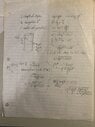
Tetherball rope wrapping around a pole

Join the discussion
Registration is free. Ask a follow-up in this thread, or start your own.
5 replies · 4K views · last reply
a sad student
Messages
2
Reaction score
1
Homework Statement
Not a homework question but an investigation:

A tetherball is tied to the top of a pole with a rope. When the ball spins around the pole, the rope starts to wrap around it. Using a pole with a fixed radius and a ball with a fixed mass, is it possible to find the number of wraps around a pole using a given initial tangential velocity?
Relevant Equations
Vt = rw
Fc = mv^2/r
My work so far is pretty basic, but I'm not too sure how to continue off from here. I haven't included the 2 dimensional aspect of it either, but I would presume that the rate of decrease in length is more sped up in that case? Would appreciate any help :(
 
Attachments
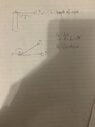
  • Handwritten notes on lined paper: top sketch of a pole with a rope wrapped around it and a ball at the end labelled v, with l marked along the rope and 'L: length of rope' written beside it; below, a top-down sketch of a ball on a rope around a pole with arrows, and equations v_t = lω, l = L − θr, v_t = (L − θr)ω.
    IMG_7717.JPG
    17.6 KB · Views: 294
Physics news on Phys.org
Why not consider the two-dimensional analogue first: a circle of radius ##a## in the plane is the "pole", and a light, inextensible string is attached at, say, ##(a,0)##. Let the initial position of the ball be ##(a, L)##, where ##L## is the length of string, and let its initial velocity be ##(-v_0,0)##.

If the angle through which the string has wrapped is ##\theta##, then energy conservation implies that ##\dot{\theta} = v_0/(L-a\theta)##, but note that if the tension in the string is ##T## then the moment of the tension force is ##-aT## and the particle's angular momentum is not conserved. In any case, ##\dot{\theta}## is an increasing function of ##\theta## in the interval ##[0,L/a)## and the particle will collide with the pole no matter how small its (non-zero) initial speed ##v_0##; the number of wraps is always ##L/(2\pi a)##.

To make progress with the original query, you will probably need to play around with dissipation, string elasticity, etc.
 
Last edited:
  • Like
Likes   Reactions: a sad student
a sad student said:
is it possible to find the number of wraps around a pole using a given initial tangential velocity?
Since it will descend at some (changing) angle, there's no advantage in taking the initial velocity as horizontal. In general, its velocity is angled down, making a right angle to the straight section of string.
I see no obvious relationship between the angle that velocity makes to the horizontal and the angle the string makes, though intuitively I feel they should be about the same.
In terms of the velocity, the current straight string length, the pole radius and those two angles, can you find equations for their rates of change?

Most likely, finding such equations is as far as you can go analytically. After that it would be simulation.
 
  • Like
Likes   Reactions: DaveE, a sad student and ergospherical
Oh, I think I mis-interpreted the question. Do you intend consider the path of the string in three dimensional space when the string is fully wrapped around the cylinder? Ignore #2.
 
  • Like
Likes   Reactions: PhDeezNutz and a sad student
Thank you guys for the replies! I've tried to expand on the problem a bit more, but I'm having trouble coming up with an additional equation to solve it (?). I also think that the angles should be equal but I'm having a hard time coming up with a proof for it. Here's my work (sorry it's a bit of a mess! added the second image bc i realized the quality wasn't great)
 
Attachments
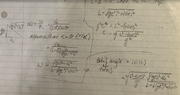
  • Handwritten derivation on lined paper for a tetherball rope wrapping around a cylindrical pole, with a small diagram of the rope and ball and a velocity triangle, plus equations for tangential velocity, angle, rope length and total angle.
    IMG_7747.JPG
    36.2 KB · Views: 222
  • Handwritten derivation on lined paper: L = sqrt((gt^2)^2 + (wr)^2), g^2 t^4 = L^2 - (wr)^2, t = sqrt((L^2 - (wr)^2)/g^2), a triangle with sides gt and Vc, and w = Vt/R = Vt/((L-l)cos theta), with the note 'assume that theta = 0 (??)'. Total angle of turn = w(t) and an expression for w(t) in terms of L, g, r, Vt and Vc.
    temp.PNG
    72.1 KB · Views: 207
a sad student said:
Thank you guys for the replies! I've tried to expand on the problem a bit more, but I'm having trouble coming up with an additional equation to solve it (?). I also think that the angles should be equal but I'm having a hard time coming up with a proof for it. Here's my work (sorry it's a bit of a mess! added the second image bc i realized the quality wasn't great)
It's easy to prove they are not necessarily equal: start it with the string down at some angle but with the mass going horizontally. What we might hope is that once equal they would remain equal, or better, that however they start they converge asymptotically to being equal.