The components of force and velocity vectors in circular motion

Click For Summary
SUMMARY

The discussion centers on the components of force and velocity vectors in circular motion, specifically addressing two key problems. The first question involves the equality of the length of the chord and the arc in a circular motion scenario, where it is clarified that the length of the chord is slightly less than that of the arc due to the sine function's properties. The second question explores the resolution of centripetal force (Fc) and tangential velocity (Vt) vectors, confirming that while these vectors are perpendicular, they can still have components in the same direction depending on the chosen coordinate system.

PREREQUISITES
  • Understanding of circular motion principles
  • Familiarity with vector resolution techniques
  • Knowledge of trigonometric functions, specifically sine
  • Basic calculus concepts related to limits
NEXT STEPS
  • Study the relationship between arc length and chord length in circular motion
  • Learn about vector decomposition in different coordinate systems
  • Explore the properties of centripetal force and tangential velocity in circular motion
  • Investigate the application of calculus in analyzing circular motion dynamics
USEFUL FOR

Students and educators in physics, particularly those focusing on mechanics, as well as anyone interested in understanding the intricacies of circular motion and vector analysis.

PainterGuy
Messages
938
Reaction score
73
Moved from a technical forum and thus no template.
Hi!

I was trying to understand circular motion and came across two problems. I would really appreciate if you could help me with those.

Question 1:
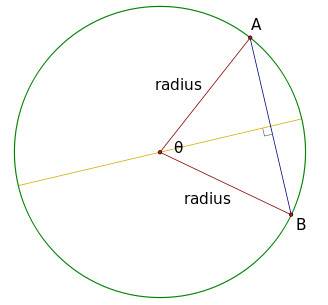
In the picture below let's assume that the angle θ is 1 radian, i.e. 57.3°, radius is 1 m. It would mean that the length of arc AB is also 1 m. The length of chord AB is 2*r*sin(θ/2) = 2*1*sin(57.3°/2) = 1 m

How could be the length of chord and arc equal? It doesn't make any sense to me. The length of arc should be more than that of the chord. Where am I having it wrong?
?temp_hash=4e248c0090b96fb9d4f07f028edae71a.jpg


Question 2:
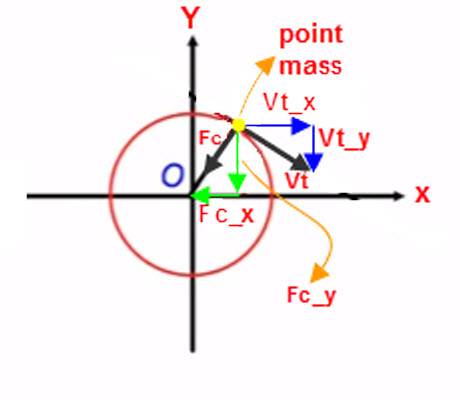
In the picture, it might be that I'm incorrectly resolving the vectors into components. A point mass is following a circular motion in clockwise direction. The centripetal force vector Fc is resolved into Fc_x and Fc_y components, and the tangential velocity vector Vt is resolved into Vt_x and Vt_y. The components Fc_y and Vt_y are in the same direction. But weren't force vector and velocity vector supposed to not have any components parallel to each other? Where am I going wrong? Please help me.
?temp_hash=4e248c0090b96fb9d4f07f028edae71a.jpg
 

Attachments

  • chord1.jpg
    chord1.jpg
    8.1 KB · Views: 471
  • centripetal.jpg
    centripetal.jpg
    11.8 KB · Views: 453
  • ?temp_hash=4e248c0090b96fb9d4f07f028edae71a.jpg
    ?temp_hash=4e248c0090b96fb9d4f07f028edae71a.jpg
    8.1 KB · Views: 785
  • ?temp_hash=4e248c0090b96fb9d4f07f028edae71a.jpg
    ?temp_hash=4e248c0090b96fb9d4f07f028edae71a.jpg
    11.8 KB · Views: 1,169
Physics news on Phys.org
PainterGuy said:
2*1*sin(57.3°/2) = 1 m
Really?

PainterGuy said:
Fc is resolved into Fc_x and Fc_y components
The tips of Fc_x and Fc should meet.
 
  • Like
Likes   Reactions: Chestermiller and PainterGuy
PainterGuy said:
The length of arc should be more than that of the chord.
Of course (in Euclidean geometry). You just need to continue with your derivation and take the result as the limit as θ → 0. The basic way that Calculus works, aamof.
 
  • Like
Likes   Reactions: PainterGuy
PainterGuy said:
Question 2:
In the picture, it might be that I'm incorrectly resolving the vectors into components. A point mass is following a circular motion in clockwise direction. The centripetal force vector Fc is resolved into Fc_x and Fc_y components, and the tangential velocity vector Vt is resolved into Vt_x and Vt_y. The components Fc_y and Vt_y are in the same direction. But weren't force vector and velocity vector supposed to not have any components parallel to each other? Where am I going wrong? Please help me.

View attachment 233933

The velocity and force vectors are perpendicular. That doesn't mean that only one can have an x-component and only one a y-component.

For example, take the vectors ##\vec{a} = (1, 1)## and ##\vec{b} = (1, -1)##. These are perpendicular: ##\vec{a}## is 45° above the x-axis and ##\vec{b}## is 45° below the x-axis. Yet, they both have an x-component and a y-component. And, in fact, have the same x-component.
 
  • Like
Likes   Reactions: PainterGuy
PainterGuy said:
The length of chord AB is 2*r*sin(θ/2) = 2*1*sin(57.3°/2) = 1 m

##\sin(57.3^\circ/2) = 0.479##, not 0.5. So chord AB is slightly less than arc AB, as you'd expect.

PainterGuy said:
But weren't force vector and velocity vector supposed to not have any components parallel to each other?
Force and velocity are perpendicular. That doesn't mean they "don't have any components parallel to each other". That depends on the coordinate system you use to break into coordinates.

On a fresh diagram, draw two vectors which are perpendicular. If you choose the x-axis as the direction of one vector and the y-axis as the direction of the other, then one vector has only x-components and the other has only y-components.

But choose any other direction as an x axis. Then both vectors have an x component. And both have a y-component. There's no such rule for perpendicular vectors that they will never have parallel components in some coordinate systems.

The breaking down of a vector into perpendicular components is not unique. There are infinitely many choices of the two components. It often happens that one particular choice makes the algebra easier (for instance by making one vector purely x and the other purely y). But you could use any other choice you like.
 
  • Like
Likes   Reactions: PainterGuy
Thank you, everyone!

RPinPA said:
sin(57.3∘/2)=0.479sin⁡(57.3∘/2)=0.479\sin(57.3^\circ/2) = 0.479, not 0.5. So chord AB is slightly less than arc AB, as you'd expect.

I get it now. I was thinking that the difference between the lengths would be more, and also I was using rounded off number. Thanks.

About Question 2, I can see it now what's really going on. In the picture below, Figure 2, if point A is to follow a circular path and get to point B, its x-component, Vt_x, should gradually reduce and at the same time its y-component, Vt_y, should increase. For this to happen, Fc_x should increase and Fc_y would reduce as a consequence because Fc=Fc_x + Fc_y. At point B, you can see Vt has only y-component and Fc has only x-component.

?temp_hash=9193e0415dbf4e33fb2d80e241368391.jpg


I have another related question about elliptical orbit which I'll ask later.

Thanks a lot.
 

Attachments

  • centripetal_new.jpg
    centripetal_new.jpg
    13.6 KB · Views: 391
  • ?temp_hash=9193e0415dbf4e33fb2d80e241368391.jpg
    ?temp_hash=9193e0415dbf4e33fb2d80e241368391.jpg
    13.6 KB · Views: 518
PainterGuy said:
Fc=Fc_x + Fc_y.
Yes, but this is not what your diagram shows.
 
A.T. said:
The tips of Fc_x and Fc should meet.

A.T. said:
Yes, but this is not what your diagram shows.

Thank you!

But I'm sorry I don't follow you. In my first post Fc is shown as a sum of vectors Fc_y and Fc_x. The tips of Fc_x and Fc do meet. Could you please explain where I have it wrong? Thanks.
 
PainterGuy said:
Thank you!

But I'm sorry I don't follow you. In my first post Fc is shown as a sum of vectors Fc_y and Fc_x. The tips of Fc_x and Fc do meet. Could you please explain where I have it wrong? Thanks.
@A.T. is complaining that the tip of the black arrowhead is not at the origin. i.e. that the magnitude of the vector is to be proportional to the distance from the arrow tail to the tip of the arrowhead.
For my part, it is enough that the black line representing the vector reaches the origin; the arrowhead merely indicates the direction.
 
  • Like
Likes   Reactions: PainterGuy
  • #10
haruspex said:
@A.T. is complaining that the tip of the black arrowhead is not at the origin. i.e. that the magnitude of the vector is to be proportional to the distance from the arrow tail to the tip of the arrowhead.
It doesn't matter how long you draw the black Fc arrow. But it has to be consistent with the green components Fc_y, Fc_x.
 
  • Like
Likes   Reactions: PainterGuy
  • #11
PainterGuy said:
The tips of Fc_x and Fc do meet.
The tips of the black (Fc) and green (Fc_x) arrowheads must meet.
 
  • #12
Thanks.

I get your point. Those two arrows were already there then I drew other arrows myself. I agree that I should have tried to make it more consistent.
 

Similar threads

Replies
1
Views
810
  • · Replies 12 ·
Replies
12
Views
987
  • · Replies 13 ·
Replies
13
Views
1K
  • · Replies 6 ·
Replies
6
Views
2K
  • · Replies 7 ·
Replies
7
Views
3K
Replies
6
Views
4K
Replies
13
Views
3K
Replies
11
Views
3K
  • · Replies 2 ·
Replies
2
Views
853