MarkFL
Gold Member
MHB
- 13,284
- 12
Overview
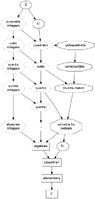
Resident number theorist and global moderator at MMF (Charles R. Greathouse IV) has graciously given permission to reproduce the following image, which illustrates the relationships between various classes of numbers:
In the diagram:
- Rings are shown as circular rings
- Fields are shown as octagons
- Algebraically closed fields are shown as rectangles
Objects drawn with dashed outlines are merely sets (often not even closed under addition).
Key to the Diagram
| Class | Description |
|---|---|
| ##\mathbb{Z}## | The ring of integers ##\{..., -2, -1, 0, 1, ...\}##. |
| ##\mathbb{Q}## | The field of rational numbers. |
| Quadratic (etc.) integers | Roots of monic quadratic (etc.) polynomials with integer coefficients. |
| Quadratic (etc.) numbers | Roots of quadratic (etc.) polynomials with integer coefficients. |
| Polyquadratic numbers | Numbers of the form ##\sqrt{a_1}+\sqrt{a_2}+\cdots+\sqrt{a_k}## with ##a_i## rational; see Conway, Radin, & Sadun. |
| Constructible numbers | Numbers obtainable using field operations and extraction of square roots, for example ##\sqrt{4 + \sqrt{7}}##. |
| Huzita–Hatori numbers | Numbers obtainable using field operations together with extraction of square and cube roots. |
| Algebraic integers | Roots of monic polynomials with integer coefficients. |
| Algebraic numbers | Roots of polynomials with integer coefficients. |
| Solvable by radicals | Numbers obtainable using field operations together with extraction of ##n##-th roots. |
| ##EL## numbers | The smallest subfield of ##\mathbb{C}## closed under ##\exp## and ##\log##, allowing explicit roots such as ##\exp\left(\dfrac{\log(x)}{5}\right)##; Chow denotes this by ##E##. |
| Liouvillian numbers | The algebraic closure of ##EL##, allowing arbitrary roots in addition to ##\exp## and ##\log##; sometimes written ##L##. |
| Elementary numbers | An extension of Liouvillian numbers allowing implicit use of ##\exp## and ##\log##. |
| Periods | Numbers defined as multidimensional integrals of rational functions; see Kontsevich & Zagier. |
| Exponential periods | The (algebraic?) closure of periods and exponentials of periods; see Kontsevich & Zagier. |
| ##\mathbb{C}## | The complex numbers. |
References
- Timothy Y. Chow, The American Mathematical Monthly 106:5 (1999), pp. 440–448.
- John H. Conway, Charles Radin, and Lorenzo Sadun, On Angles Whose Squared Trigonometric Functions are Rational, Discrete Computational Geometry 22 (1999), pp. 321–332.
- Maxim Kontsevich and Don Zagier, Periods, in Mathematics Unlimited, Year 2001 and Beyond, Springer, 2001.
Attachments
Last edited by a moderator: