The first realistic virtual universe created

  • Context: Graduate 
  • Thread starter Thread starter Greg Bernhardt
  • Start date Start date
  • Tags Tags
    Universe Virtual
Click For Summary

Discussion Overview

The discussion revolves around the creation of the first realistic virtual universe through a computer simulation known as "Illustris." Participants explore its implications for cosmology, the accuracy of galaxy distributions, and the potential for future scientific modeling, touching on theoretical and computational aspects.

Discussion Character

  • Exploratory
  • Technical explanation
  • Debate/contested

Main Points Raised

  • Some participants express excitement about the achievement, noting its unprecedented resolution in simulating cosmic evolution over 13 billion years.
  • One participant questions the claim of "computing the laws of Nature," highlighting a lack of clarity on the foundational mathematical theories involved, such as Set Theory and quantum gauge invariance.
  • Another participant emphasizes the simulation's success in reproducing realistic galaxy distributions as supportive of the Lambda-CDM cosmological model, while raising questions about the modeling of supermassive black hole (SMBH) formation.
  • There is curiosity about the factors that differentiate star-forming spirals from "red and dead" ellipticals, suggesting that the simulation could provide insights into these distinctions.
  • Some participants discuss the computational power required for such simulations and speculate on the future role of computer modeling in scientific validation.

Areas of Agreement / Disagreement

Participants generally agree on the significance of the achievement, but there are multiple competing views regarding the implications of the simulation and the methodologies used. Questions remain unresolved about specific modeling techniques and theoretical foundations.

Contextual Notes

Limitations include the lack of detailed explanations regarding the mathematical foundations of the simulation and the specific methods used for modeling SMBH formation. The discussion also reflects varying levels of understanding about the implications of the simulation results.

Who May Find This Useful

Readers interested in cosmology, computational astrophysics, and the intersection of theoretical physics and computer modeling may find this discussion relevant.

Messages
19,911
Reaction score
10,924
Astronomers Create First Realistic Virtual Universe

Cambridge, MA -
Move over, Matrix - astronomers have done you one better. They have created the first realistic virtual universe using a computer simulation called "Illustris." Illustris can recreate 13 billion years of cosmic evolution in a cube 350 million light-years on a side with unprecedented resolution.

"Until now, no single simulation was able to reproduce the universe on both large and small scales simultaneously," says lead author Mark Vogelsberger (MIT/Harvard-Smithsonian Center for Astrophysics), who conducted the work in collaboration with researchers at several institutions, including the Heidelberg Institute for Theoretical Studies in Germany.

These results are being reported in the May 8th issue of the journal Nature.

http://www.cfa.harvard.edu/news/2014-10

http://www.illustris-project.org/
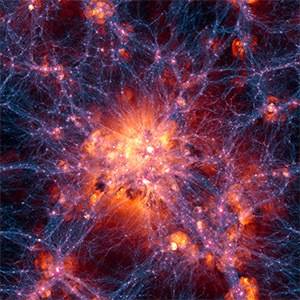
illustris_box_dmdens_gasvel_sm.jpg
 
Space news on Phys.org
Awesome development, can't wait to see the papers on it. As well as the other vids lol
 
Awesome. Although I flinched at the title of the video: "to compute the laws of Nature". I didn't see where they started with (mathematical) Set Theory and arrived at quantum gauge invariance...did I miss it? LOL. Quite an achievement, really (but maybe we're not quite ready to compute the Laws of Nature...unless I missed the revelation about the origin of the "fine tuning" of ~100 or so parameters?)
 
Very nice!
 
An impressive accomplishment. The paper is available on the arXiv if Nature is behind a paywall for you. The fact that they successfully reproduced a realistic distribution of elliptical, spiral, and barred spiral galaxies is yet more proof (if any were needed) of the correctness of the Lambda-CDM standard cosmological model. One question I have after reading the paper is whether anyone knows how they modeled SMBH formation. Do the SMBH's grow naturally or do they need to be put in "by hand"? Any inputs?

(Edit - from reading the web site, it looks like there is a paper in preparation on this topic.)

I'm also curious as to what distinguishes a star-forming spiral from a "red and dead" elliptical. The initial angular momentum? Gas content? These are questions that should be answerable by studying the simulation. Note that they plan to make snapshots of the simulation publicly available for study by third parties.
 
Last edited:
The illustris video is quite interesting. The website just came up a few days ago and has some additional links. The computational power required to generate these images is almost beyond comprehension. Are we entering an age where science will be vetted by computer modeling, or has it already slipped upon us? In any event, this is a milestone achievement.
 
I'd say its slipping upon us, or will shortly do so. The advances in computing power I've been keeping track of is on the threshold of significant advances.
 

Similar threads

Replies
0
Views
2K
  • · Replies 2 ·
Replies
2
Views
601
  • · Replies 7 ·
Replies
7
Views
5K
  • · Replies 17 ·
Replies
17
Views
4K