flofelis
- 6
- 1
Hi all =)
I am interested to find the forces and torques between two (diametrically magnetized) cylindrical permanent magnets (PMs) placed within a vicinity, as shown below:
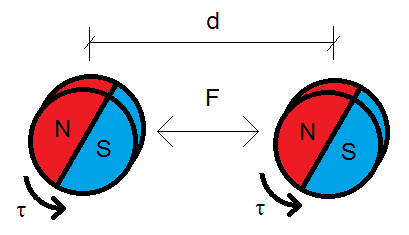
The NdFeB PMs placed beside one another with a distance, d. Both are rotated by independent external sources (I have solenoids to independently drive the PMs). This will affect each PM in terms of the torque and force.
So I am just wondering if I could use the same force/torque equations (e.g. for the force as shown below) between two axially magnetized PMs for the diametrically magnetized ones as well:

I do not have a software for this, thus I would need to model it mathematically.. (i have spent weeks trying to find a way to do it but I ran out of idea)
I see that most cases are calculated for axially magnetized PMs so I am not sure if the generally available equations for the axially magnetized PMs can be used in my case. I got pretty confused as to how I should compute the dynamics (force and torque of one PM (primary) when another is closely present).. as well as how far should the PMs be apart so I could ignore the effect of the other PM onto the primary PM.
Looking forward to hearing from anyone with ideas and advice =) Thank you very much!
I am interested to find the forces and torques between two (diametrically magnetized) cylindrical permanent magnets (PMs) placed within a vicinity, as shown below:
The NdFeB PMs placed beside one another with a distance, d. Both are rotated by independent external sources (I have solenoids to independently drive the PMs). This will affect each PM in terms of the torque and force.
So I am just wondering if I could use the same force/torque equations (e.g. for the force as shown below) between two axially magnetized PMs for the diametrically magnetized ones as well:
I do not have a software for this, thus I would need to model it mathematically.. (i have spent weeks trying to find a way to do it but I ran out of idea)
I see that most cases are calculated for axially magnetized PMs so I am not sure if the generally available equations for the axially magnetized PMs can be used in my case. I got pretty confused as to how I should compute the dynamics (force and torque of one PM (primary) when another is closely present).. as well as how far should the PMs be apart so I could ignore the effect of the other PM onto the primary PM.
Looking forward to hearing from anyone with ideas and advice =) Thank you very much!