- 7,830
- 4,173
Sadly, my camera (Sony a850) is 'beyond repair'. It served with honor and distinction for 6 years, I took about 200k images with it.
Until I replace it, I've been sharing my kids' Canon 1100D (Rebel T3)- an entry level camera- so I got a Nikon-EF adapter. Well.
6 years ago, when I re-discovered 35mm photography, I made a choice to spend my cash on good lenses rather than a high-end camera body. At the time, this meant I needed a Nikon-Alpha adapter, and these have a lens inside. I knew that the adapter lens degraded the performance of the camera lens (both vignetting and aberrations), but I rationalized my choice of a Sony body and used Nikon manual-focus lenses due to the significant cost savings.
So now I'm using the Nikon lenses without a lensed adapter, and the difference is more than I guessed: here's a 400% crop (no interpolation, jpg straight out of the camera) of the moon, taken with the Sony:

The zoom makes it hard to tell, but this image is extremely sharp- this particular feature on the moon is one of the 'benchmarks' I use to judge atmospheric distortion, camera shake, etc. Now here's the same area taken with the Canon (also jpg, straight off the camera):
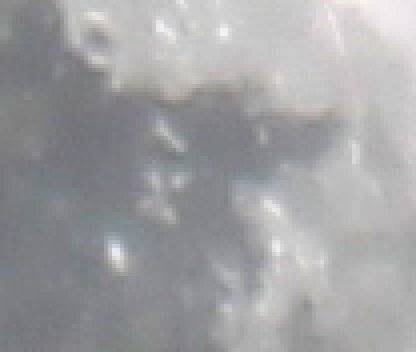
The difference is quite dramatic and results only from the lack of an intermediate lens- the pixel pitch is similar.
The moral of the story is clear- the lens matters more than the camera. When you are ready for a digital camera with interchangeable lenses, spend your money on the lenses rather than the camera- a good lens will last many generations of camera bodies. Unfortunately, newer lenses often omit the aperture ring, which potentially limits their ability to be used on future camera bodies (I'm looking at you, 85/1.4 G!).
Personally, since my lenses are all F-mount, I'm going to share the 1100D until the price of a Nikon D810 drops a bit more; I need the full-frame sensor to take full advantage of my wide angle lens. An attractive alternative (for me) is the D750, we'll see what mood Santa is in.
Until I replace it, I've been sharing my kids' Canon 1100D (Rebel T3)- an entry level camera- so I got a Nikon-EF adapter. Well.
6 years ago, when I re-discovered 35mm photography, I made a choice to spend my cash on good lenses rather than a high-end camera body. At the time, this meant I needed a Nikon-Alpha adapter, and these have a lens inside. I knew that the adapter lens degraded the performance of the camera lens (both vignetting and aberrations), but I rationalized my choice of a Sony body and used Nikon manual-focus lenses due to the significant cost savings.
So now I'm using the Nikon lenses without a lensed adapter, and the difference is more than I guessed: here's a 400% crop (no interpolation, jpg straight out of the camera) of the moon, taken with the Sony:
The zoom makes it hard to tell, but this image is extremely sharp- this particular feature on the moon is one of the 'benchmarks' I use to judge atmospheric distortion, camera shake, etc. Now here's the same area taken with the Canon (also jpg, straight off the camera):
The difference is quite dramatic and results only from the lack of an intermediate lens- the pixel pitch is similar.
The moral of the story is clear- the lens matters more than the camera. When you are ready for a digital camera with interchangeable lenses, spend your money on the lenses rather than the camera- a good lens will last many generations of camera bodies. Unfortunately, newer lenses often omit the aperture ring, which potentially limits their ability to be used on future camera bodies (I'm looking at you, 85/1.4 G!).
Personally, since my lenses are all F-mount, I'm going to share the 1100D until the price of a Nikon D810 drops a bit more; I need the full-frame sensor to take full advantage of my wide angle lens. An attractive alternative (for me) is the D750, we'll see what mood Santa is in.
