This Projectile motion question seems flawed

Join the discussion
Registration is free. Ask a follow-up in this thread, or start your own.
13 replies · 2K views
victorhugo
Messages
127
Reaction score
5
[moderator note: Thread moved from General Physics so no template shown]
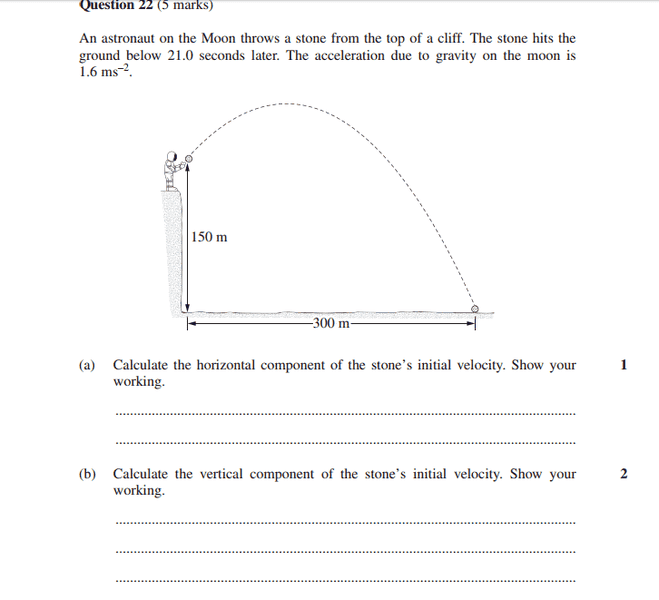
QUESITONWEIRD.png


a) Considering X and Y velocities are independent of one another, simply getting the 300m it covered on the X axis and the total time it was in the air, 21.0s, it's easy to get an X velocity of 14.3 m/s to the right.

b) I HAVE NO IDEA. It is thrown up, reaches an unknown height with an unknown time and comes back down. By the time it reaches the 150m mark, it already has a significant vertical velocity.
The only thing we really have for this is the horizontal velocity and vertical acceleration.
 
Last edited by a moderator:
Physics news on Phys.org
victorhugo said:
The only thing we really have for this is the horizontal velocity and vertical acceleration.
There is more given.
 
A.T. said:
There is more given.
For the parabolic path above 150m, I honestly don't know what else you have. There is more for the total path, but I don't know anything we can use from that to get the initial vertical velocity.
 
A.T. said:
What info did you use for a) ?
Total time of flight (parabolic path time + downward time), and total horizontal displacement...?
 
Need to use vertical projectile motion equation.
 
Austin Z W said:
Need to use vertical projectile motion equation.
Why? Could you please explain the mathematical process?
 
Been a while since I took physics, but your initial height is 150m, time is 21s, and you need to solve for Vo. There are only 3 variables in that equation. Use quadratic formula to solve for t and plug everything in.
 
Sorry, don't solve for t. Solve for Vo. Duh me
 
y=1/2*a*t^2 + Vo*t + yo

Where:
y=height(vertical distance traveled)
t=time
a=acceleration due to gravity
Vo=initial velocity
yo=initial height

Solve equation for Vo and plug in your values.
 
Austin Z W said:
y=height(vertical distance traveled)
Austin Z W said:
yo=initial height
Either y is the vertical displacement (distance travelled, but paying attention to signs) and y0 is redundant, or y0 is initial height and y is final height (again, making sure sign usage is consistent: up must be positive for all displacements, velocities and accelerations, or down must be positive for all).
 
It doesn't matter which way is positive for you.

They are just variables, call them a, b, c, etc. if you want.
yo in this case would be your initial height, 150m in this case. You have to take into account the total flight time, which includes the 150m down from your initial height. Your ending y will be negative because you are throwing it off a cliff.
 
Positive could be down or up, but yes it must be consistent for everything.