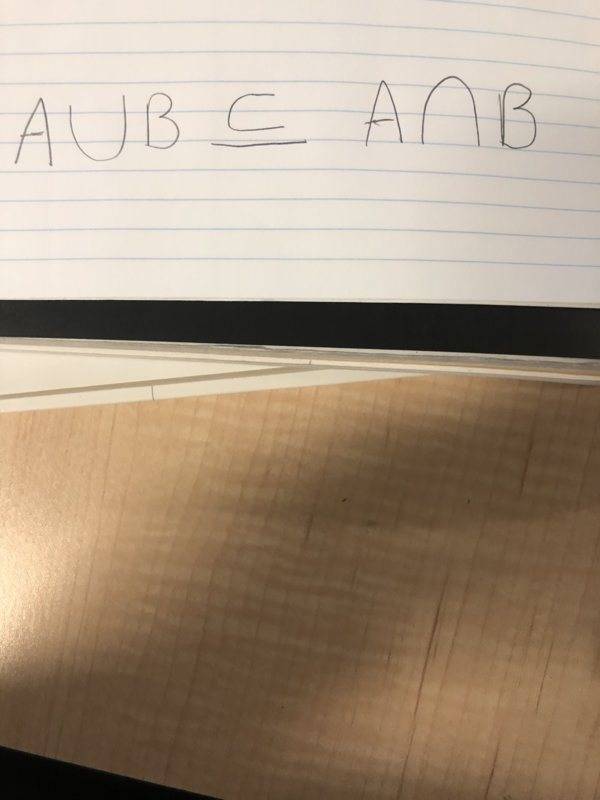
This would be a false statement, correct?

  • Context: Undergrad 
  • Thread starter Thread starter EchoRush
  • Start date Start date
  • Tags Tags
    Abstract algebra Set
Click For Summary
SUMMARY

The discussion centers on the logical relationship between set operations, specifically the statement "A ∪ B ⊆ A ∩ B". Participants clarify that this statement is not universally false; it can be true under certain conditions. The distinction between propositional functions and statements is emphasized, highlighting that the truth value depends on the quantifiers applied. The example provided illustrates that A ∪ B can equal A ∩ B when specific sets are chosen.

PREREQUISITES
  • Understanding of set theory concepts, including unions and intersections.
  • Familiarity with propositional functions and their truth values.
  • Basic knowledge of mathematical notation, particularly LaTeX for typesetting.
  • Ability to interpret Venn diagrams in the context of set operations.
NEXT STEPS
  • Study the properties of unions and intersections in set theory.
  • Learn about quantifiers in mathematical logic, focusing on universal and existential quantifiers.
  • Explore advanced LaTeX typesetting techniques for mathematical expressions.
  • Investigate examples of sets where A ∪ B = A ∩ B to understand the conditions for equality.
USEFUL FOR

Mathematicians, educators, students in mathematics or computer science, and anyone interested in the logical foundations of set theory and propositional logic.
EchoRush
Messages
9
Reaction score
1
TL;DR
A quick question about sets and intersection/unions
I believe that I am correct, the following statement here must be FALSE, right? It has to be false because A union B is like the two entire circles of the Venn diagram and that cannot be a subset of the intersection area, right? Now if this statement was flipped, then it would be true?

31826703-6ACD-452A-94E8-02CDF6802FFF.jpeg
 
Physics news on Phys.org
Correct :wink: !
 
By the way PF would really appreciate typed posts instead of disk-space wasting big pictures !

If you type
##A\cup B \subseteq A\cap B## then you get ##A\cup B \subseteq A\cap B## (in-line math), and if you type
$$A\cup B \subseteq A\cap B$$ then you get $$A\cup B \subseteq A\cap B$$
('displayed math').

##LaTeX## is fun, fairly easy to start with and extremely useful
 
  • Like
Likes Mark44 and Dale
Yes correct. For example take ##A = \{0\}, B = \{1\}##. Then ##A\cup B = \{0,1\}## yet ##A \cap B = \emptyset##.

The other inclusion, that is ##A \cap B \subseteq A \cup B##, is trivially true.
 
EchoRush said:
Summary:: A quick question about sets and intersection/unions

I believe that I am correct, the following statement here must be FALSE, right? It has to be false because A union B is like the two entire circles of the Venn diagram and that cannot be a subset of the intersection area, right? Now if this statement was flipped, then it would be true?

You can, however, have ##A \cup B = A \cap B##, so it's not always false. Can you see when you have this equality?

It is correct that ##A \cup B## can never be a proper subset of ##A \cap B##.
 
  • Like
Likes FactChecker and pbuk
PeroK said:
You can, however, have ##A \cup B = A \cap B##, so it's not always false. Can you see when you have this equality?
Yes, absolutely, it is NOT correct to say that the statement is unconditionally false.
 
EchoRush said:
I believe that I am correct, the following statement here must be FALSE, right?
To reinforce what others have said, there is a difference between talking about a "statement" versus taking about a "propositional function".

If you utter a phrase like "If x > 7 then x > 1" , it is technically a "propositional function", which cannot be assigned a truth value ( True vs False) until "x" is defined to be something specific. In common speech and in informal mathematical writing, it is usually understood that phrases like "If x >7 then x > 1" are intended to have the "universal quantifier" given by the phrase "for each". So the reader interprets the claim "If x > 7 then x > 1" to mean "For each number x, if x >7 then x > 1". With this interpretation, the phrase becomes a statement which can be assigned a truth value.

The other commonly used quantifier is "there exists". Someone writing hasty notes might jot down the phrase "x > 1" intending it to mean "There exists a number x such that x > 1". However, this is not a clear style of writing.

Your question about "##A \cup B \subseteq A \cap B##" is technically a question about a propositional function, so it cannot be assigned a single truth value. You probably intended some universal quantifiers to be supplied, so the phrase would become the statement "For each set ##A## and for each set ##B##, ## A \cup B \subseteq A \cap B##". With the universal quantifiers, the propositional function is converted into a False statement. However, if we supply existential quantifiers, we get "There exists a set ##A## and there exists a set ##B## such that ## A \cup B \subseteq A \cap B##". This converts the propositional function into a True statement.
 
  • Like
  • Informative
Likes PeroK and pbuk

Similar threads

  • · Replies 8 ·
Replies
8
Views
2K
  • · Replies 54 ·
2
Replies
54
Views
6K
Replies
1
Views
2K
  • · Replies 18 ·
Replies
18
Views
2K
  • · Replies 40 ·
2
Replies
40
Views
8K
  • · Replies 10 ·
Replies
10
Views
3K
  • · Replies 1 ·
Replies
1
Views
2K
  • · Replies 7 ·
Replies
7
Views
15K
  • · Replies 16 ·
Replies
16
Views
2K
  • · Replies 2 ·
Replies
2
Views
1K