Torque to turn a large Beam on a Rotisserie

  • Thread starter Thread starter Nick09
  • Start date Start date
Nick09
Messages
5
Reaction score
0
TL;DR
Torque to turn a large Rotisserie
Hi - I'm trying to design a Rotisserie for fabrication of large UC beams, and could do with some physics help if possible please.
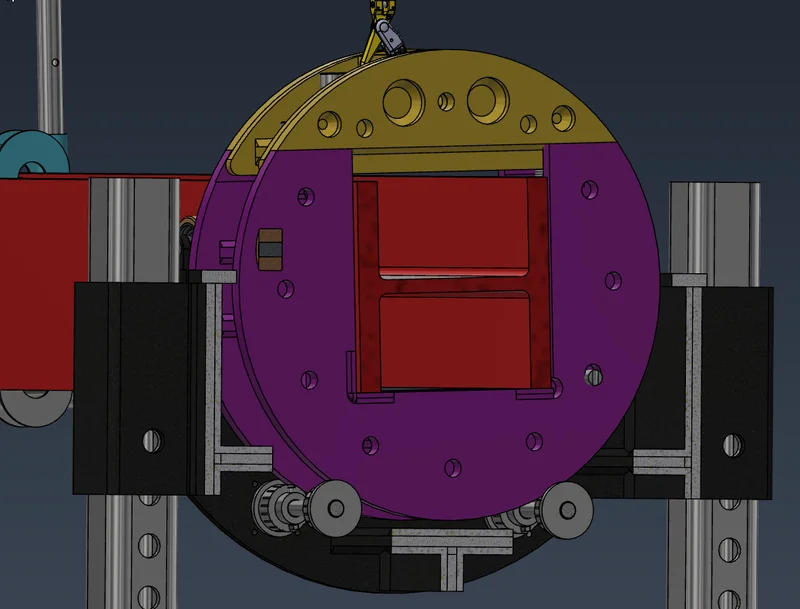
The idea is... I'll create collars to allow a UC beam to turn on a set of rollers during fabrication process.

The largest item I have weighs in at 4225kg including the collars I'm fitting around to make it circular for turning.
The Collar has a radius of 450mm.
The C of G is pretty much axially aligned, but is 3.5mm out due to some features on the beam.
The collar with the beam in sits on 2 off bearing shafts with R45 wheels upon it

What torque would I need to turn the beam in its rotisserie from rest?

I'm looking for force required to turn it in small increments from rest, as I reorient it to welding requirements. Its not spinning at a constant speed etc.

Could anyone assist?
Thanks in advance if you could.
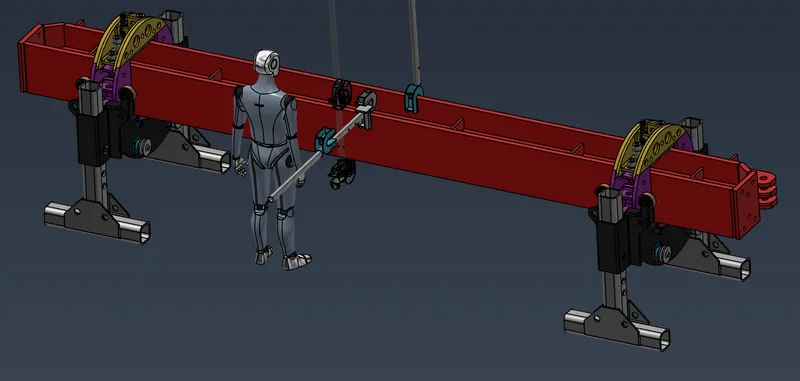
2026-04-30 16_43_54-Autodesk Inventor Professional 2024.webp
2026-04-30 16_43_15-FD-08-499-001.iam ([Primary]) iProperties.webp
2026-04-30 16_54_16-Autodesk Inventor Professional 2024.webp
 
Engineering news on Phys.org
Welcome to PF.

Torque is needed for two separate reasons. One is to overcome the 3.25 mm eccentricity of the mounted beam, the other is the acceleration or deceleration needed to start or stop the beam rotating.

When the column is rotated, what angle will it rotate through, and how much time is available to achieve that?
 
  • Agree
Likes   Reactions: Bystander
Baluncore said:
Welcome to PF.

Torque is needed for two separate reasons. One is to overcome the 3.25 mm eccentricity of the mounted beam, the other is the acceleration or deceleration needed to start or stop the beam rotating.

When the column is rotated, what angle will it rotate through, and how much time is available to achieve that?

Hi,
It will probably be turned in 90deg increments each time, then welded for an hour or so and turned again.
Time to turn through 90deg is not critical.
If it took 30secs or even a minute.

I was really trying to figure out if I can power this manually, as I've already got a 10:1 reduction via the collar to bearing wheel ratio, or if I'll need further ratio reduction and possibly an electric drive and gearbox.
I'm hoping to keep it manual for cost reasons.
 
Nick09 said:
I'll create collars to allow a UC beam to turn on a set of rollers during fabrication process.
Nick09 said:
The largest item I have weighs in at 4225kg including the collars
4225kg or 4225N?
Nick09 said:
The C of G is pretty much axially aligned, but is 3.5mm out due to some features on the beam.
The collar with the beam in sits on 2 off bearing shafts with R45 wheels upon it
What kind of bearings? What friction numbers are we talking about from the bearings? What will you use to hold/clamp the rotational motion in the worst case where the CoG is offset horizonally from the main axis?
 
  • Agree
Likes   Reactions: Bystander
Nick09 said:
I'm hoping to keep it manual for cost reasons.
I see no reason why it cannot be manual, just like a steam railway engine out of a roundhouse, on a turntable.
https://en.wikipedia.org/wiki/Railway_roundhouse

You will need another factor of ten gear reduction, with a right angle gearbox. You may need to link the two supporting rollers at one end with a chain, to prevent slip, but that will depend on friction.

If an overhead crane was used to load the column, then it might also be available to roll the column, by wrapping the hoist chain around the column.
 
berkeman said:
4225kg or 4225N?

What kind of bearings? What friction numbers are we talking about from the bearings? What will you use to hold/clamp the rotational motion in the worst case where the CoG is offset horizonally from the main axis?
Hi Berkeman,
its 4225kg for the mass of the longest variant of these we make, the 10m.
Re bearings - its still a WIP and could change but at the moment, I've put in these agricultural bearings
https://simplybearings.co.uk/shop/p...wcB&gbraid=0AAAAAD-_g0HWf303iiEQY35z9YsWJgVNi
There are 2 off per shaft, so 4 off bearings per Trestle. 8 off total in the 2 off Trestles.
They don't give a friction rating in the tech info - but I have seen other calcs with this value inserted...
Roll co eff, steel on steel (ball bearings) - 0.004m

re turning - holding in position,
I haven't yet fully developed it, but but my plan was to add 20tooth chain wheel to each driving roller and link or connect via a 3/4" drive chain (green in image below) - then have a second drive chain (purple in image below) with either a second 20 tooth chain wheel, or I can optionally drop to 10 tooth. This would be driven by either a hand cranked handle, or motor and gearbox, depending on how much torque this needs to turn it.
if I stick with 20 tooth wheel - the 10:1 reduction ratio would remain.
if dropping to a 10 tooth - this would further reduce reduction ration to 20:1.

The rotation can currently be locked off in 15deg increments via an insertable pin. You can just see the handle of it (coloured silver in the imaghe below)

section through a drive shaft also included below - bearings are blue, main collar = purple
2026-05-01 08_38_20-Autodesk Inventor Professional 2024.webp
2026-05-01 08_48_58-Autodesk Inventor Professional 2024.webp

Re - roll and hold
 
Baluncore said:
I see no reason why it cannot be manual, just like a steam railway engine out of a roundhouse, on a turntable.
https://en.wikipedia.org/wiki/Railway_roundhouse

You will need another factor of ten gear reduction, with a right angle gearbox. You may need to link the two supporting rollers at one end with a chain, to prevent slip, but that will depend on friction.

If an overhead crane was used to load the column, then it might also be available to roll the column, by wrapping the hoist chain around the column.
Hi Baluncore,
Thanks for the advice - yeah i'm still working on this, currently adding chain drive to link the 2 rollers.
I'm thinking 20 tooth wheel on each drive shaft, with 3/4" chain linking (see green line) - then a second 20 tooth, taking a second chain upto either a hand crank lever and handle, or motor and gearbox (see purple line) - 2nd cog on the purple chain could remain 20 tooth to keep the existing 10:1 reduction ratio, or even change to a 10 tooth cog to further drop the ratio to 20:1.

I'm confident I can get it working - but where I'm at, you get one shot or they loose interest, hence adding a few options and reducdancies.

Re cranes - we currently fabricate these UC beams using saw horse trestle and o head cranes, but we have to move to a facility with no o head cranes. hence planning these rotisserie.
Plan is to load them via a fork lift, then fab and weld in the rotisserie.
Current method of rolling 4t Beams using offset crane chain, on saw horse trestles is not ideal, as it really shocks the crane, when these roll and fall, so a rotisserie should improve safety too.

2026-05-01 08_38_20-Autodesk Inventor Professional 2024.webp
 
@Nick09 You set the working height by pushing a pin through one hole in the black box, that passes through one of many holes, (spaced 1U), in the silver post.

You could cut fewer holes in the silver post if you had two holes in the black box. To use that vernier system, delete every second silver hole, (making it 2U spaced), then use two holes in the black box, separated by 1U or 3U.

The system can be extended to get better resolution, over a greater range, with fewer holes overall. Consider 3 holes in the black box with 1/3 as many, spaced 3U, in the silver column.
 
  • Like
Likes   Reactions: hutchphd and Nick09
Nick09 said:
if I stick with 20 tooth wheel - the 10:1 reduction ratio would remain.
if dropping to a 10 tooth - this would further reduce reduction ration to 20:1.
Roller chain sprockets have a limit of about 12 teeth. Below 12, the sprocket begins to sound clunky, and wears rapidly.
 

Similar threads

  • · Replies 2 ·
Replies
2
Views
7K
  • · Replies 5 ·
Replies
5
Views
4K