Total machine system efficiency

  • Context: Automotive 
  • Thread starter Thread starter Pinon1977
  • Start date Start date
  • Tags Tags
    Efficiency Mechanical
Join the discussion
Ask a follow-up here, or get your own question answered by working scientists, mathematicians and engineers — people, not an autocomplete.
Real named experts · corrections over time · the nuance an AI answer skips
5 replies · 2K views
Pinon1977
Messages
126
Reaction score
4
TL;DR
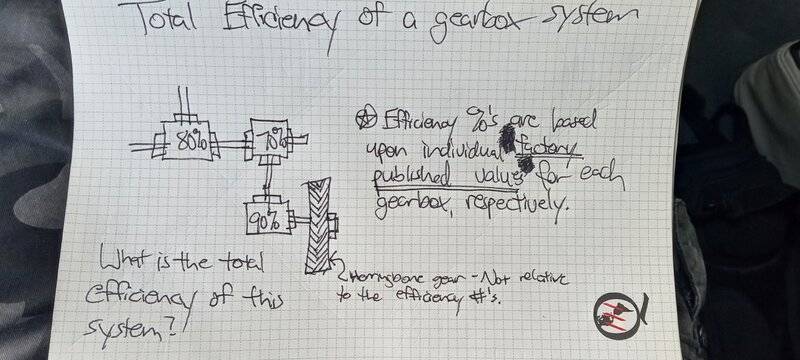
Trying to determine the total efficiency of a system of gearboxes within a larger machine system
Please see the attached sketch. Basically I have a system of three gear boxes, each with their own respective efficiencies. I'm trying to determine, at the end of this string of gearboxes, what the overall efficiency is. How might one go about determining this? Do you just take the average? 70 + 80 + 90 / 3?
IMG_20230622_190057704_HDR.jpg
 
Physics news on Phys.org
I'm no expert on gearboxes, but for most systems you would multiply the efficiencies of the series systems to get the overall efficiency. So 0.7 x 0.8 x 0.9 = ?
 
Reply
  • Like
Likes   Reactions: Pinon1977, Baluncore, Bystander and 1 other person
Consider a line of 16 gearboxes, each with an efficiency of 90%. The average efficiency would be 90%. But energy must pass through each gearbox in turn to reach the next, with a loss at each step.
In reality, the efficiency would be;
0.9016 = 0.1853 = 18.5%.
 
Baluncore said:
Consider a line of 16 gearboxes, each with an efficiency of 90%. The average efficiency would be 90%. But energy must pass through each gearbox in turn to reach the next, with a loss at each step.
In reality, the efficiency would be;
0.9016 = 0.1853 = 18.5%.

Wow!!!! That's not the explanation I was expecting, but it make sense to a certain degree.

Does it matter what kind of gearbox it is? Planetary vs worm gear vs helical, etc? I was loosely presuming that there would be some sort of gearbox constant or multiplier (depending upon the type of gearbox being used).
 
Pinon1977 said:
Does it matter what kind of gearbox it is? Planetary vs worm gear vs helical, etc?
Different types of gearboxes have different energy efficiencies.

Generally, a two-step reduction box is less efficient than a one-step reduction, but the one-step reduction weighs more for the same ratio and power.

The bearings used inside the gearbox make a big difference as they are subjected to significant side forces on the shafts.

Planetary gears can cancel side forces on the shafts, so are often more efficient.

The ease of driving a gearbox backwards has efficiency implications. A worm gear is very inefficient when driven backwards.