daniiela
- 2
- 0
I am currently in dynamics and I know the only thing holding me back is understanding the position of angles, no matter how much time I spend attempting to figure out the trig behind most of these problems I never gain any ground. If anyone can simply and sweetly explain to me why the equation of relative motion (IMAGE BELOW) uses sin(30) in the x-direction and cos(30) in the y-direction, and also how is it possible to use 60° rather than the 30°.
I would be unbelievably grateful if someone can shed light onto what may be the only reason holding me back from the grade I deserve in this class! If you can draw a simple picture that would be beyond fantastic as I am absolutely a visual learner.
Thank you soo much in advance!
-Daniela
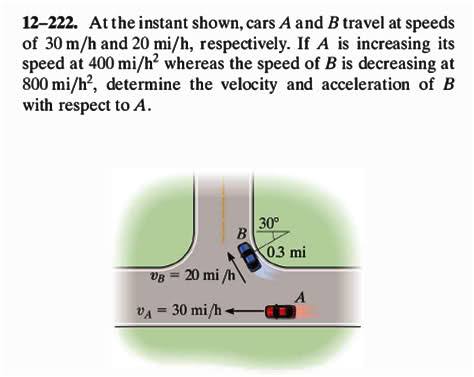
**The conceptual basis of the problem being one of relative motion I am having NO problem understanding. So please do not consider this a homework problem that I need help solving.**
I would be unbelievably grateful if someone can shed light onto what may be the only reason holding me back from the grade I deserve in this class! If you can draw a simple picture that would be beyond fantastic as I am absolutely a visual learner.
Thank you soo much in advance!
-Daniela
**The conceptual basis of the problem being one of relative motion I am having NO problem understanding. So please do not consider this a homework problem that I need help solving.**

