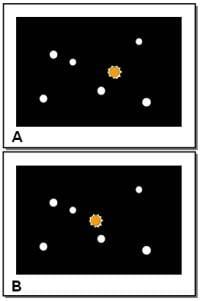
Trig Parallax: Measurement & Apparent Shift of Nearby Stars

  • Context: Stargazing 
  • Thread starter Thread starter Glenn G
  • Start date Start date
  • Tags Tags
    Parallax Trigonometric
Click For Summary
SUMMARY

The discussion focuses on the concept of trig parallax, specifically how astronomers measure the apparent shift of nearby stars against distant backgrounds. The angle p is determined by measuring the rotation of a telescope from a known position in June to the position of the star, using images taken in January and July. Accurate measurements require at least three observations to distinguish between parallax and stellar motion. The Gaia telescope and Hipparcos satellite are mentioned as tools that measure parallax, utilizing distant quasars as stable reference points for precise calculations.

PREREQUISITES
  • Understanding of trig parallax in astronomy
  • Familiarity with telescope operation and angular measurement
  • Knowledge of the Gaia telescope and Hipparcos satellite
  • Concept of proper motion in celestial objects
NEXT STEPS
  • Research the methodology of the Gaia telescope for measuring stellar parallax
  • Study the principles of angular measurement in astronomy
  • Explore the concept of proper motion and its impact on parallax measurements
  • Investigate the use of quasars as reference points in astronomical observations
USEFUL FOR

Astronomy students, astrophysicists, and anyone interested in the techniques used for measuring distances to stars and understanding stellar motion.

Glenn G
Messages
113
Reaction score
12
Hi community,
trigparallax.2.jpg


I get the concept of trig parallax and the apparent shift of nearby stars when viewed against a distant background, by viewing the star in say summer and then winter and it appears to move against the much further away distant background.
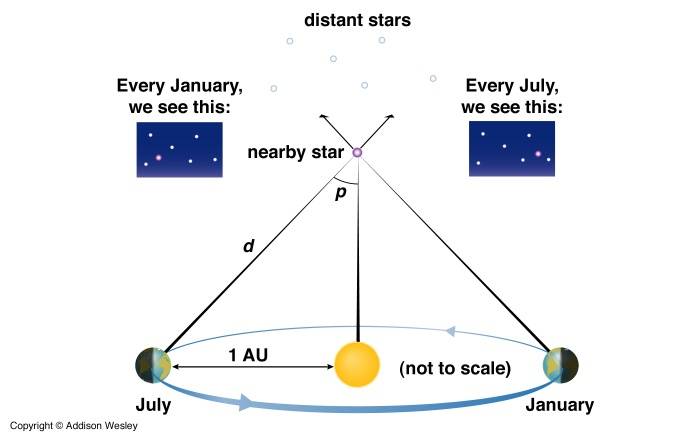
bt2lf1502_a.jpg

I get what the angle p represents from the diagram above.
To find the angle p, would the astronomer (in June say) star the telescope point along a line parallel with the sun star axis and then measure how far it has to rotate to point at the star, by alternate angles they have then moved through an angle p which is the same as the angle p labelled in the diagram.
I was then wondering that if all you had access to was the picture from Jan and July and you could measure the apparent linear movement of the star over that six month period and that you knew what the angular separation of two of the well known stars were in the distant constellation then you could find the angle p that way, or is that what the scientists do anyway?
thanks as always,
Glenn.
 
  • Like
Likes   Reactions: fqantonio
Astronomy news on Phys.org
Glenn G said:
To find the angle p, would the astronomer (in June say) star the telescope point along a line parallel with the sun star axis and then measure how far it has to rotate to point at the star, by alternate angles they have then moved through an angle p which is the same as the angle p labelled in the diagram.
I don't understand that sentence, but you don't point telescopes at the sun. Typically you measure the position relative to background stars: You remember the January position, and in June you measure the angle between that and the new position, a telescope also gives you the angular scale of its pictures. With two pictures and the known angular scale you can determine the angle p. If you also know when your images were taken (not necessarily at the two points in the picture...) and where in the sky the object is, you can determine its distance.

This is a simplified description. Stars move relative to the Sun. With just two images, you can't distinguish parallax from motion, you need at least three observations, better four or more. If you want to achieve a better precision, finding background stars gets more challenging. As an example, the Gaia telescopes measures the parallax of all stars in the Milky Way. It needs background sources outside the galaxy. Background sources can move as well. And so on. For really precise measurements you have to account for many different effects influencing the measurement.
 
  • Like
Likes   Reactions: fqantonio and Glenn G
Try looking at my Post #9 in this thread. It shows some actual data measured by the Hipparcos satellite. You can see the superposition of parallax and proper motion. With enough measurements, you can deduce bot the parallax and the proper motion.
 
  • Like
Likes   Reactions: Glenn G
Thanks so could the distant 'fixed' background be stars in another galaxy or indeed other galaxies for the fixed background? I'd imagine then that for different measurements made over a 12 month period the shift of these very distant entities would seem small compared to the star we're measuring the parallax angle of?
 
I think (not sure) that they use distant quasars as the stationary reference points. These are so distant that they effectively don't move at all, and are point sources so their positions can be accurately determined.
 

Similar threads

  • · Replies 0 ·
Replies
0
Views
3K
  • · Replies 7 ·
Replies
7
Views
5K
  • · Replies 4 ·
Replies
4
Views
2K
Replies
7
Views
2K
  • · Replies 3 ·
Replies
3
Views
3K
  • · Replies 1 ·
Replies
1
Views
6K
  • · Replies 11 ·
Replies
11
Views
4K
  • · Replies 46 ·
2
Replies
46
Views
8K
  • · Replies 7 ·
Replies
7
Views
4K
  • · Replies 1 ·
Replies
1
Views
3K