How Can I Use the Two-Point Correlation Function to Compare Image Structures?

Click For Summary
The discussion focuses on using the two-point correlation function to compare the structures of two isotropic images at different scales. The method involves applying a two-dimensional Fourier transform to the images, which allows for the calculation of a power spectrum that represents the magnitude of various spatial modes. Participants clarify that this approach does not bias the analysis towards specific axes, as it effectively captures diagonal modes as well. A suggested technique for estimating the power spectrum includes binning based on the distance from the origin in the frequency domain. The conversation emphasizes the importance of measuring the amplitude and separation of peaks in the resulting power spectrum.
mikeph
Messages
1,229
Reaction score
18
Hi

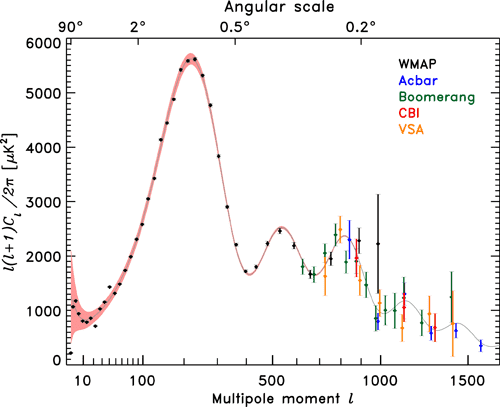
I have two images and I want to compare the "structures" of them at different scales. I remember from cosmology that the two point correlation function was used to extract similar structural information from the CMB, generating a graph of structure Vs scale. Then at certain length scales you have peaks which correspond to physical occurrences.

edit-this is the image I'm talking about.
cmb-cmbpowerspectrum.png
This is exactly what I'd like to apply to my image, but after searching the internet I can't find much that helps me actually numerically calculate this for an image. Does anyone know any good tutorials for actually doing this?It's my understanding that this method is favourable to taking a Fourier/cosine transform as these methods are biased towards finding structure along the x-y axes? My image is isotropic so I have no reason to care about one direction more than another.

Any help or pointing me in the right direction would be brilliant, thanks
Mike
 
Space news on Phys.org
MikeyW said:
Hi

I have two images and I want to compare the "structures" of them at different scales. I remember from cosmology that the two point correlation function was used to extract similar structural information from the CMB, generating a graph of structure Vs scale. Then at certain length scales you have peaks which correspond to physical occurrences.

edit-this is the image I'm talking about.

cmb-cmbpowerspectrum.png


This is exactly what I'd like to apply to my image, but after searching the internet I can't find much that helps me actually numerically calculate this for an image. Does anyone know any good tutorials for actually doing this?


It's my understanding that this method is favourable to taking a Fourier/cosine transform as these methods are biased towards finding structure along the x-y axes? My image is isotropic so I have no reason to care about one direction more than another.

Any help or pointing me in the right direction would be brilliant, thanks
Mike
Yeah, if you want to calculate this sort of thing for a flat, rectangular image, you just take the two-dimensional Fourier transform of the image (this doesn't bias things towards horizontal/vertical modes, by the way...it just as well represents diagonal modes). Then, once that's done, the image above is what is known as a "power spectrum": it is an estimate of the magnitude of modes of each size.

So, if your FFT is defined as a(k_x, k_y), then the power spectrum can be estimated by producing a series of bins where k_x^2 + k_y^2 are approximately equal, and averaging aa^* in each bin.

A rather easy way to do the binning would be to, for each k_x, k_y pair, compute \sqrt{k_x^2 + k_y^2}, and the bin it goes into is the nearest integer.
 
Measuring the amplitude and separation between peaks is the important part of this exercise. The first two peaks are solid. It gets squishy after that. You can't ignore data sets because they don't match the model.
 
Thanks Chalnoth - I already wrote a kind of distance binning algorithm, just didn't know how to use it.

Chronos- I'm not sure I understand your reply, I'm not ignoring any data.
 
MikeyW said:
Thanks Chalnoth - I already wrote a kind of distance binning algorithm, just didn't know how to use it.

Chronos- I'm not sure I understand your reply, I'm not ignoring any data.
No problem! If you have any further questions, feel free to ask. This kind of thing is what I do :)

...and I think he misread you.
 
Apologies, I never meant to suggest anyone was ignoring data.
 
Apologies, I never meant to suggest anyone was ignoring data.
 

Similar threads

  • · Replies 10 ·
Replies
10
Views
2K
  • · Replies 1 ·
Replies
1
Views
3K
  • · Replies 2 ·
Replies
2
Views
2K
  • · Replies 6 ·
Replies
6
Views
2K
  • · Replies 11 ·
Replies
11
Views
3K
  • · Replies 21 ·
Replies
21
Views
4K
Replies
1
Views
2K
  • · Replies 13 ·
Replies
13
Views
6K
  • · Replies 5 ·
Replies
5
Views
3K
Replies
1
Views
1K