transgalactic
- 1,386
- 0
[tex]
\lim _{x->+\infty} (x+2)^{\frac{2}{3}} -(x-2)^{\frac{2}{3}}[/tex]
i get infinity - infinity
its undefined
??
i get infinity - infinity
its undefined
??


transgalactic said:i get infinity - infinity

infinity - infinity is one of several indeterminate forms. None of them are ever an answer.transgalactic said:[tex] \lim _{x->+\infty} (x+2)^{\frac{2}{3}} -(x-2)^{\frac{2}{3}}[/tex]
i get infinity - infinity
its undefined
??
transgalactic said:[tex] \lim _{x->+\infty} (x+2)^{\frac{2}{3}} -(x-2)^{\frac{2}{3}}[/tex]
i get infinity - infinity
its undefined
??
tiny-tim said:Hi transgalactic!
It's easier to read if you write …
[tex]\lim _{x->+\infty} (x+2)^{2/3} -(x-2)^{2/3}[/tex]
eek! you're not allowed to do that!
Hint: write it [tex]\lim _{x->+\infty} x^{2/3}\left((1 + 2/x)^{2/3} -(1 - 2/x)^{2/3}\right)[/tex]
cleopatra said:(x-2)2/3 is less than (x+2)2/3 so each time the x gets larger a larger sum is in (x-2) than(x+2) so it goes down... to minus infinity.
Mark44 said:Another approach is to multiply the original expression by 1 like so:
[tex](x + 2)^{2/3} - (x - 2)^{2/3} \frac{(x + 2)^{4/3} + (x + 2)^{2/3}(x - 2)^{2/3} + (x - 2)^{4/3}} {(x + 2)^{4/3} + (x + 2)^{2/3}(x - 2)^{2/3} + (x - 2)^{4/3}}[/tex]
This looks pretty complicated, but it's based on a relatively simple idea: that (a - b)(a2 + ab + b2) = a3 - b3.
After using this technique, the numerator can be simplified to a single term, and the limit of the whole expression can be found without much trouble.
Agreed that this is a simple problem, and that the limit is 0. Tiny Tim's approach is superior to mine in its simplicity. Your approach, using a computer-generated graph, is useful for gaining understanding about the behavior of this function, but that's about it. It is well-known that computers don't produce exact results, because of the limited precision they use in their calculations, and especially so in raising to fractional powers. And in some cases, they can produce results that are incorrect (e.g., the earlier Intel Pentium math coprocessors back in 1992 or so). You also said that for large x, x + 2 was about the same as x - 2. This is correct, and is helpful in understanding, but it should be said in mathematical terms. Otherwise, it's akin to arm-waving, IMO.djeitnstine said:Why need to get so complicated :S this is quite a simple problem. Quite frankly the answer is 0. There is an asymptote in the graph tending towards 0 as x increases towards positive infinity. Now which result out of mine or tinytim's did not explain this?
djeitnstine said:I can re iterate of course "Eventually does it matter that you add 2 or subtract 2 from say...10000000000000000? It will approximate to [tex]x^{\frac{2}{3}}-x^{\frac{2}{3}}[/tex] in the end..." which of course is always tending towards 0...
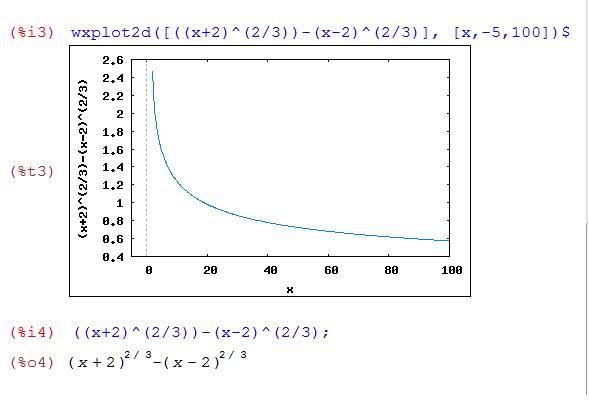
Mark44 said:Agreed that this is a simple problem, and that the limit is 0. Tiny Tim's approach is superior to mine in its simplicity. Your approach, using a computer-generated graph, is useful for gaining understanding about the behavior of this function, but that's about it. It is well-known that computers don't produce exact results, because of the limited precision they use in their calculations, and especially so in raising to fractional powers. And in some cases, they can produce results that are incorrect (e.g., the earlier Intel Pentium math coprocessors back in 1992 or so). You also said that for large x, x + 2 was about the same as x - 2. This is correct, and is helpful in understanding, but it should be said in mathematical terms. Otherwise, it's akin to arm-waving, IMO.
My approach is different from, and slightly more complicated, than Tiny Tim's. But so what? Multiplying by a factor to produce a difference of cubes isn't all that complicated, and the intent was to show another method of approach that might be useful in other problems.
The more tools you have to work with, the more problems you're equipped to solve.
 … expand the bracket first, then multiply by the x2/3, then take the limit.