Understand CMB Anisotropies & Interpret Figures

  • Context: Graduate 
  • Thread starter Thread starter ChrisVer
  • Start date Start date
  • Tags Tags
    Cmb
Click For Summary
SUMMARY

This discussion focuses on the interpretation of CMB anisotropies, specifically the C_l^{TT} parameter, which quantifies temperature fluctuations in the Cosmic Microwave Background (CMB). Key features include the first peak representing the sound horizon and the distinction between odd and even peaks due to dark matter's influence on primordial plasma. The overall downward trend in the power spectrum is attributed to the blurriness of the surface of last scattering, which suppresses power at small angular scales. The discussion highlights the importance of Spherical Harmonic transforms in representing the CMB power spectrum.

PREREQUISITES
  • Understanding of CMB anisotropies and the C_l^{TT} parameter
  • Knowledge of primordial plasma dynamics and sound horizon concepts
  • Familiarity with dark matter's role in cosmic structure formation
  • Basic grasp of Spherical Harmonic transforms and their application in cosmology
NEXT STEPS
  • Study Wayne Hu's CMB tutorials for in-depth explanations of CMB power spectrum
  • Research the implications of dark matter on cosmic structure and CMB anisotropies
  • Explore the mathematical foundations of Spherical Harmonic transforms in cosmology
  • Investigate the effects of the surface of last scattering on CMB observations
USEFUL FOR

Astronomers, cosmologists, and physics students interested in understanding CMB anisotropies and their implications for the universe's structure and composition.
ChrisVer
Science Advisor
Messages
3,372
Reaction score
465
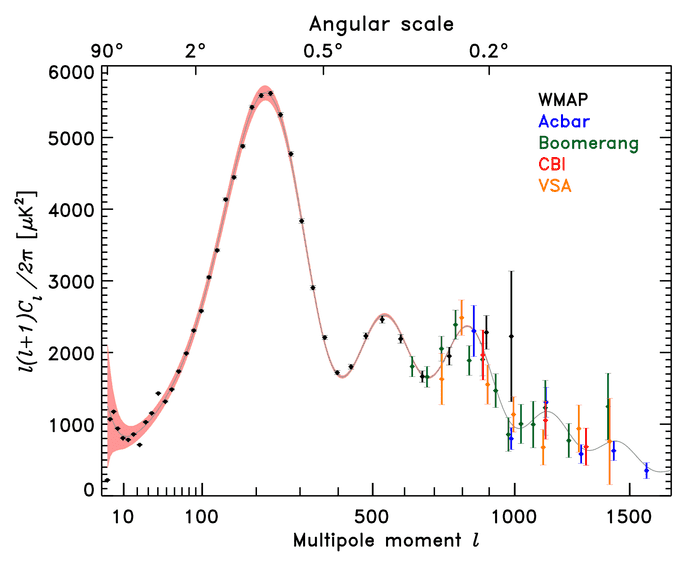
Can someone help me understand what information we extract from such kind of figure?

2000px-PowerSpectrumExt.svg.png


In fact the C_l^{TT} parameter gives us information on the amplitude of the temperature fluctuations \Delta T/T... However I don't understand why there is such a peak formation (1 very large, 2 smaller and 2 even smaller), or why this is given in terms of multipole index l.
 
Space news on Phys.org
Some of the primary features on this graph:
1. The overall downward trend after the first peak is due to the fact that the primordial plasma took hundreds of thousands of years to transition to a gas. This has the impact of making the surface of last scattering (where the CMB photons came from) blurry. That blurriness is suppresses power at small angular scales. If it were not for this blurring effect, the CMB power spectrum would have very little overall increasing or decreasing trend.
2. The first peak is the "sound horizon". This is the distance that sound waves in the primordial plasma were able to travel from the time inflation ended to the time the CMB was emitted.
3. The difference in the even and odd peaks is due to dark matter. Within the primordial plasma, normal matter was able to bounce back out of gravity wells, while dark matter would just fall in. The first peak represents matter that just had enough time to fall into a gravitational potential well. The second peak is matter that had enough time to fall in and bounce back out. The third peak is matter that fell in, bounced out, then fell back in again. Normal matter contributes to all of the peaks, while dark matter only contributes to the odd-numbered peaks. This ratio of odd-to-even peaks is the most sensitive measurement we have of the ratio of normal matter to dark matter.

There are other things we can glean from the CMB power spectrum, but hopefully you can see why there is the overall trend here.

As for while it's given in terms of multipole index, this is because the sky has the geometry of the surface of a sphere, and the equivalent to Fourier transforms on the surface of a sphere are Spherical Hermonic transforms. In spherical harmonics, the power spectrum C_\ell is the variance of all waves on the sky which have a wavelength on the sky of approximately \pi/\ell radians across the surface of the sky.
 

Similar threads

  • · Replies 1 ·
Replies
1
Views
2K
  • · Replies 8 ·
Replies
8
Views
3K
  • · Replies 5 ·
Replies
5
Views
7K
  • · Replies 6 ·
Replies
6
Views
4K
  • · Replies 7 ·
Replies
7
Views
3K
  • · Replies 2 ·
Replies
2
Views
5K
  • · Replies 8 ·
Replies
8
Views
7K
  • · Replies 13 ·
Replies
13
Views
6K
  • · Replies 8 ·
Replies
8
Views
4K
  • · Replies 2 ·
Replies
2
Views
3K