Understanding Dimensional Analysis: Solving for i, j, and k Values

Join the discussion
Ask a follow-up here, or get your own question answered by working scientists, mathematicians and engineers — people, not an autocomplete.
Real named experts · corrections over time · the nuance an AI answer skips
1 reply · 2K views
dexstarr
Messages
4
Reaction score
0
I'm having trouble understanding a step. How are the values of " i , j , and k " derived? When equating the powers what step has to be done? I have been stumped on this for a while and I think I'm just over thinking it.

https://www.dropbox.com/s/agc0ga9hsjd04jn/Sample%20Problem.png
 

Attachments
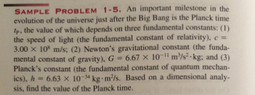
  • Sample Problem.png
    Sample Problem.png
    19.7 KB · Views: 129
Mathematics news on Phys.org
What they have done is to use the fact that the fundamental quantities of length and mass must have exponents of zero, since we wish only to have a unit of time left, with an exponent of 1. So this gives us 3 equations in 3 unknowns.