Understanding Henkin Theory: Addressing Questions and Clarifications

  • Context:
  • Thread starter Thread starter Mathelogician
  • Start date Start date
  • Tags Tags
    Theory
Join the discussion
Registration is free. Ask a follow-up in this thread, or start your own.
3 replies · 2K views
Mathelogician
Messages
35
Reaction score
0
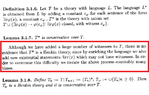
Look at the picture; i need to know why the red part holds?
I mean in T*, we have added proper constants to all 'existential formed' sentences of T. So what would remain from such formulas that the red part mentions and that we use the lemma 3.1.8 to overcome the problem?

- - - Updated - - -

And the other question is that is the axiom set of T* what is said in the image or there must be a Gama instead of T in the definition 3.1.6?
 

Attachments

  • Untitled.png
    Untitled.png
    17.5 KB · Views: 126
Physics news on Phys.org
Mathelogician said:
I mean in T*, we have added proper constants to all 'existential formed' sentences of T. So what would remain from such formulas that the red part mentions and that we use the lemma 3.1.8 to overcome the problem?
By adding constants, we added new existential formulas: the ones that contain new constants. It does not follow from anywhere that these formulas should have witnesses. Now, I don't have a good example of a theory $T$ such that $T^*$ is not a Henkin theory. I would be very interested in such example because all textbooks that I saw simply give the proof, but don't motivate it with examples.

Mathelogician said:
And the other question is that is the axiom set of T* what is said in the image or there must be a Gama instead of T in the definition 3.1.6?
By $\Gamma$ you must mean an axiom set of $T$. Yes, if $T$ has an axiom set $\Gamma$ different from itself, $T$ can be replaced with $\Gamma$ in the definition of $T^*$. It does not matter because we are interested in the theory as a whole. There is no harm in declaring all theorems of $T$ axioms. In particular, there is no requirement in this section that the axiom set should be finite.
 
By adding constants, we added new existential formulas: the ones that contain new constants.
You mean that a formula of the form ( Ex A(x) -> A(c) ) for some constant c, is also a formula of existential form? I thought a formula of existential form is of form Ex (Ax).
May you explain more?
 
Mathelogician said:
You mean that a formula of the form ( Ex A(x) -> A(c) ) for some constant c, is also a formula of existential form? I thought a formula of existential form is of form Ex (Ax).
No, I agree that existential formulas are of the form ∃x A(x). And yes, the axioms we added to T to form T* are not existential formulas. But in order for T* to be a Henkin theory, we must take all existential formulas ∃x A(x) (and not just axioms) in the language of T*, i.e., L with added constants, and make sure that ∃x A(x) -> A(c) ∈ T* for some c ∈ L*.

For example, suppose that L has a unary functional symbol f and L* adds a new constant c that is not in L. Then ∃x f(x) = c is an existential formula in L* but not in L. Since it is not in the language L, there is no requirement that we add its witness when forming T*. But for T* to be a Henkin theory, ∃x f(x) = c must have a witness in T*, and so far there are no reasons for this.