Understanding Optical Isomers: Identifying Correct Answers for Problem 1

  • Thread starter Thread starter Janiceleong26
  • Start date Start date
  • Tags Tags
    Isomers Optical
Join the discussion
Ask a follow-up here, or get your own question answered by working scientists, mathematicians and engineers — people, not an autocomplete.
Real named experts · corrections over time · the nuance an AI answer skips
5 replies · 3K views
Janiceleong26
Messages
276
Reaction score
4
1. Homework Statement
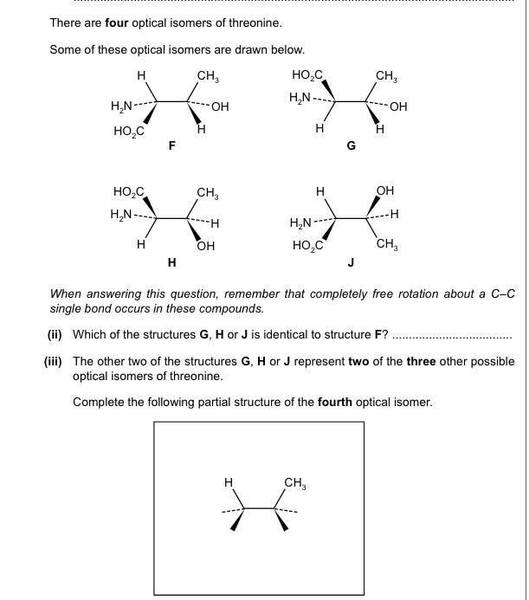
image.jpg

I thought G was the answer for part i) but it should be J, why?
I can roughly see the pattern- the RHS of G is rotated 120 ° and J is formed, but why isn't G or H the answer?
How to see if any two structures are optical isomers of each other? Does mirror images come into place here?

Homework Equations

The Attempt at a Solution

 
Physics news on Phys.org
Janiceleong26 said:
I thought G was the answer for part i) but it should be J, why?
I can roughly see the pattern- the RHS of G is rotated 120 ° and J is formed, but why isn't G or H the answer?

There are two general approaches one can take to solving problems like these:
1) Build models of each of the stereoisomers and do the rotations yourself (with practice you will be able to do these rotations in your head).
2) Try to assign each stereocenter as R or S (building models can help with this process as well).
 
Ygggdrasil said:
There are two general approaches one can take to solving problems like these:
1) Build models of each of the stereoisomers and do the rotations yourself (with practice you will be able to do these rotations in your head).
2) Try to assign each stereocenter as R or S (building models can help with this process as well).
Thanks, will do.
Can u tell me if I'm right.. the fourth optical isomers is the mirror image of G ?
 
Ygggdrasil said:
Yes, the missing stereoisomer is the mirror image (enantiomer) of G.
Ok thanks
 
Or you can imagine yourself in the plane of the paper looking along the C-C ← bond like along the arrow. Then as you know the ___ is in the plane of the paper, the - - going behind, and the other one sticking out. You can mentally rotate them clockwise or anticlockwise. They have just chosen to put the group (-CH3) that is in the plane at the bottom in one case and at the top in the other. Which they are free to do, there is free rotation around the C-C bond so you can have the same molecule which looks superficially different. (And geometrically you don't need to put that the group in the plane at all so there are several other possible representations – I don't know if there is some convention in chemistry that I have missed out on restricting this).
I was finding looking at them in a slightly trancelike state (it's late) that I was actually seeing them in three dimensions. Useful thing maybe to try to get a habit of.
 
  • Like
Likes   Reactions: Janiceleong26