dhtikna
- 4
- 0
When dealing with lenses which have one curved/flat surface silvered why do we consider light to refract twice before hitting the silver side? This diagram should show what i mean:
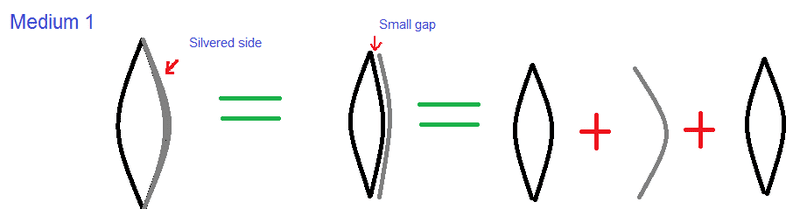
The way it appears to me is that after light enters the un-silvered surface it refracts then it does not refract but directly hits the silver surface and reflects. In this case we need to use the following formula:
μ2/v - μ1/u = μ2-μ1/R
at the two refractions, instead of the lens formula. What's wrong in my thinking?
P.S. This is my first post, sorry that i didn't use the template, i don't see how i can format my question like that
The way it appears to me is that after light enters the un-silvered surface it refracts then it does not refract but directly hits the silver surface and reflects. In this case we need to use the following formula:
μ2/v - μ1/u = μ2-μ1/R
at the two refractions, instead of the lens formula. What's wrong in my thinking?
P.S. This is my first post, sorry that i didn't use the template, i don't see how i can format my question like that