Understanding the Form of the Y(2,0) Spherical Harmonic

Click For Summary

Discussion Overview

The discussion revolves around the interpretation of the Y(2,0) spherical harmonic in the context of angular momentum eigenstates. Participants explore the implications of the visual representation of spherical harmonics and how they relate to the concept of angular momentum in quantum mechanics, particularly focusing on the intuitive understanding of these states.

Discussion Character

  • Conceptual clarification, Debate/contested

Main Points Raised

  • One participant expresses confusion about the Y(2,0) spherical harmonic, suggesting that the disk around the z-axis indicates a probability of the particle having angular momentum L_z > 0.
  • Another participant clarifies that the disk does not imply that the particle is following an orbit, emphasizing that the particle's behavior cannot be described in classical terms.
  • A further response reiterates the need to abandon classical interpretations, stating that the spherical harmonics represent stationary states rather than orbits.

Areas of Agreement / Disagreement

Participants generally agree that classical interpretations do not apply to the quantum states represented by spherical harmonics, but there is a lack of consensus on how to intuitively understand the implications of the Y(2,0) state.

Contextual Notes

The discussion highlights the limitations of classical analogies in quantum mechanics and the challenges of intuitively grasping the nature of stationary states represented by spherical harmonics.

Archeon
Messages
7
Reaction score
0
I am basically just rewriting a question that was posted on other forums.
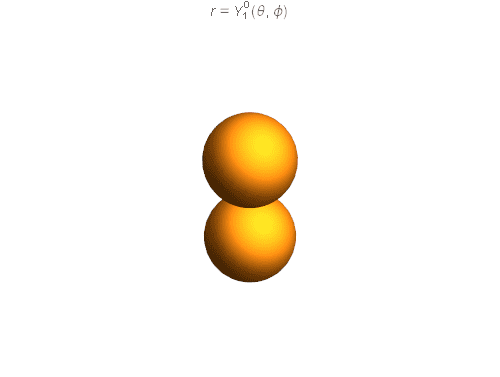
While watching videos of a MIT lecture on the eigenstates of angular momentum (video: '16. Eigenstates of the Angular Momentum II' by MIT OpenCourseWare) the professor visualized different spherical harmonics for low values of the quantum number l. He showed that for Y(l = 1, m = 0) the function has the following form:
HmK2L.png

explaining that since m=0 there is no angular momentum L_z and the probability of finding it in the x-y plane is practically zero.
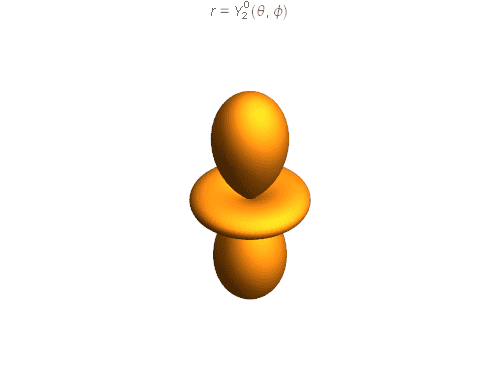
He then went on to show the Y(l=2, m=0) state, as seen below:
6gfDh.png

This strikes me as odd, however, as the disk around the z-axis would imply to me that there is a good probability that the particle is spinning along the z-axis and as a result carries some angular momentum L_z > 0. How, if at all possible, can this phenomenon be explained intuitively?

Thanks in advance
 
Physics news on Phys.org
Archeon said:
This strikes me as odd, however, as the disk around the z-axis would imply to me that there is a good probability that the particle is spinning along the z-axis and as a result carries some angular momentum L_z > 0. How, if at all possible, can this phenomenon be explained intuitively?

Thanks in advance

The disk around the z-axis implies that the particle might be found there. It doesn't mean that the particle is following any sort of orbit that has that shape.

More generally, you can't really say the particle has an orbit at all (not in the classical sense).
 
Archeon said:
This strikes me as odd, however, as the disk around the z-axis would imply to me that there is a good probability that the particle is spinning along the z-axis and as a result carries some angular momentum L_z > 0. How, if at all possible, can this phenomenon be explained intuitively?
You have to let go of classical pictures. The particle is not moving inside the orbital. They represent stationary states.
 
  • Like
Likes   Reactions: vanhees71
I see. Thanks for the clear answers.
 

Similar threads

  • · Replies 14 ·
Replies
14
Views
2K
  • · Replies 5 ·
Replies
5
Views
1K
  • · Replies 1 ·
Replies
1
Views
1K
  • · Replies 1 ·
Replies
1
Views
3K
  • · Replies 2 ·
Replies
2
Views
1K
  • · Replies 13 ·
Replies
13
Views
2K
  • · Replies 7 ·
Replies
7
Views
3K
  • · Replies 8 ·
Replies
8
Views
2K
  • · Replies 10 ·
Replies
10
Views
2K
  • · Replies 14 ·
Replies
14
Views
2K