Where is Laplace's Equation Valid in Different Domains?

Click For Summary
SUMMARY

The discussion focuses on the validity of Laplace's Equation in different domains, particularly in the context of Vanderlinde's textbook. The participants clarify that the solution to Laplace's Equation is valid within specified boundaries, such as those defined by conductors and nested regions. The equation can be applied both inside and outside the defined boundaries, provided the boundary conditions are clearly specified. However, the discussion emphasizes that the fields inside and outside a closed conductor are generally unrelated, highlighting the importance of understanding boundary conditions in electrostatics.

PREREQUISITES
  • Understanding of Laplace's Equation and its applications in electrostatics.
  • Familiarity with boundary conditions in potential theory.
  • Knowledge of harmonic functions and their properties.
  • Basic concepts of static electric fields and charge distributions.
NEXT STEPS
  • Study the implications of boundary conditions on solutions to Laplace's Equation.
  • Explore the differences between Laplace's Equation and Poisson's Equation.
  • Investigate the role of harmonic functions in electrostatics.
  • Learn about series expansions in the context of potential theory.
USEFUL FOR

Students and professionals in physics, particularly those studying electrostatics, mathematical physics, and potential theory. This discussion is beneficial for anyone seeking to deepen their understanding of Laplace's Equation and its applications in various domains.

yucheng
Messages
232
Reaction score
57
Hi!

This thread might well be similar to:
https://www.physicsforums.com/threa...classical-electrodynamics-3rd-edition.910410/

I'm self-studying Vanderlinde and having a great time. However, I think that I am conflating and confusing many different things. Let me just ask them here:

Chapter 5 Laplace's equations.
  1. When solving the equation, ending in a series expansion, in what domain is the expansion valid?

    1638353977752.png

    The potential is specified for side 4, while the other sides are set to zero. From what I know of, the potential is a harmonic function i.e. it takes on a maximum or a minimum at the boundaries. Does this mean that the solution I have found is only valid within the boundary? I think so.

    But then, you can specify two disconnected, nested boundaries like the circle as the lower bound to the radial distance, and infinity.

    So, the author arrives at the equation

    1638354203530.png


    So, where is equation 5-15 valid? It can be used for both the region within and the region outside of the parallelepiped right, as long as the boundary conditions are specified (and delineates the bounding region)?
  2. On page 93, Vanderlinde mentions that we are solving for static fields with charges on the boundary. For problems where a potential is specified on a conductor, find the potential in space, fields etc., does this mean that the equation is only valid for the region of interest, but not the conductor?
  3. In Example 5.3 on page 100, the author gives coaxial nonconducting cylinders with surface charge densities giving rise to potential, and solves the Laplace's equation by specializing V with r = a.
    1638355150214.png

    But doesn't this mean that ##\nabla^2 V \neq 0 ## anymore, at least on the boundary? So... why are we not solving Poisson's equation instead, with a dirac delta function for the charge density, of course? :smile:
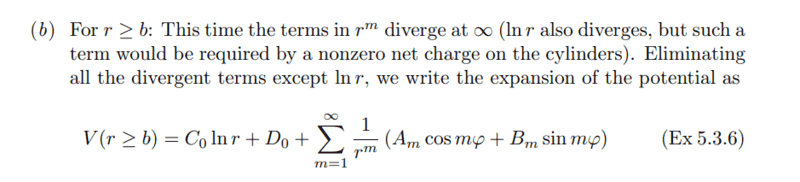
  4. Why is ##\ln r## needed to to have a nonzero net charge?
1638355402908.png

Thanks in advance!
 
Physics news on Phys.org
yucheng said:
So, where is equation 5-15 valid?
I think this depends on what one means by valid. May this expression be numerically evaluated outside the region for which it was initially derived versus does it still represent the actual field outside the region. If the series converges outside the region then the answer is maybe but usually not. For example a closed metal box the fields outside and inside are generally unrelated.
 
  • Like
Likes   Reactions: yucheng

Similar threads

  • · Replies 4 ·
Replies
4
Views
2K
  • · Replies 11 ·
Replies
11
Views
2K
  • · Replies 27 ·
Replies
27
Views
3K
  • · Replies 1 ·
Replies
1
Views
1K
  • · Replies 4 ·
Replies
4
Views
2K
  • · Replies 2 ·
Replies
2
Views
7K
  • · Replies 3 ·
Replies
3
Views
552
  • · Replies 22 ·
Replies
22
Views
3K
  • · Replies 22 ·
Replies
22
Views
4K
  • · Replies 5 ·
Replies
5
Views
1K