Use Sauerbrey equation explain Δf Vs. analyte concentration

Click For Summary
SUMMARY

The discussion centers on the application of the Sauerbrey equation to relate the change in resonance frequency of a quartz crystal microbalance (QCM) to analyte concentration. The Sauerbrey equation quantitatively describes how the frequency shift (Δf) is directly proportional to the mass change on the crystal surface, which is influenced by analyte adsorption. Participants emphasize the importance of considering both the Sauerbrey equation and adsorption isotherms to fully understand the relationship between frequency changes and analyte concentration in Newtonian liquids.

PREREQUISITES
  • Understanding of the Sauerbrey equation
  • Familiarity with quartz crystal microbalance (QCM) technology
  • Knowledge of adsorption isotherms
  • Basic principles of fluid dynamics, particularly in Newtonian liquids
NEXT STEPS
  • Study the derivation and applications of the Sauerbrey equation in detail
  • Explore the different types of adsorption isotherms and their relevance to QCM measurements
  • Investigate the effects of liquid viscosity (ηL) and shear modulus (μ) on frequency shifts in QCM
  • Learn about advanced QCM techniques for analyzing complex mixtures and their concentrations
USEFUL FOR

This discussion is beneficial for researchers and professionals in analytical chemistry, materials science, and sensor technology, particularly those working with quartz crystal microbalances and studying surface interactions in liquid environments.

Carmen Wong
Messages
2
Reaction score
0
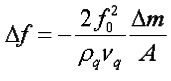
1. Explain, using the Sauerbrey equation, how the change in the resonance frequency of a quartz crystal can be related to an analyte concentration


2. Sauerbrey equation:
upload_2015-5-5_1-38-32.png


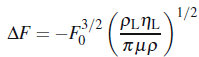
3. I knew Quartz crystal microbalance work according to the change of frequency after mass loaded, and when working in a Newtonian liquid the corresponding frequency shift is
upload_2015-5-5_1-42-29.png
(Kanazawa and Gordon, 1985), whichηL is the liquid viscosity; andμ is the shear modulus.
But I cannot understand the relation between the change of frequency and the analyte concentration according to the Sauerbrey equation.

thank you for helping
 
Physics news on Phys.org
And not through the adsorption isotherm?
 
Borek said:
And not through the adsorption isotherm?
Thank you for replying. It could be relate to the surface adsorption, but must explain according to the Sauerbrey equation.
 
I haven't said "don't use Sauerbrey equation". I said "combine it with an isotherm".
 
  • Like
Likes Carmen Wong

Similar threads

  • · Replies 11 ·
Replies
11
Views
4K
  • · Replies 1 ·
Replies
1
Views
4K
  • · Replies 48 ·
2
Replies
48
Views
10K