Valentine Monopole & Detector Constructions

  • Context: Undergrad 
  • Thread starter Thread starter jake jot
  • Start date Start date
  • Tags Tags
    Detector Monopole
Click For Summary
SUMMARY

The forum discussion centers on the construction and detection of magnetic monopoles, referencing Ethan Siegel's article on the topic. It highlights the technological advancements since 1982, particularly in the context of Cabera's experiment, which utilized a superconducting coil and a SQUID magnetometer within a specialized setup to detect monopoles. The discussion emphasizes that while technology has evolved, the fundamental requirements of the experiment remain unchanged, with potential improvements being the use of modern data recording and temperature control systems. Additionally, there is a request for a comprehensive list of existing monopole detectors worldwide.

PREREQUISITES
  • Understanding of superconductivity and its critical temperature
  • Familiarity with SQUID magnetometers and their operational principles
  • Knowledge of Gauss's Law for Magnetism and its implications
  • Basic concepts of symmetry breaking in particle physics
NEXT STEPS
  • Research the design and functionality of Cabera's magnetic monopole detector
  • Explore advancements in SQUID technology and its applications in modern physics
  • Investigate current experiments and projects focused on magnetic monopole detection
  • Compile a list of existing magnetic monopole detectors and their accessibility
USEFUL FOR

Physicists, researchers in particle physics, and experimental scientists interested in magnetic monopole detection and advanced measurement techniques.

jake jot
Messages
302
Reaction score
17
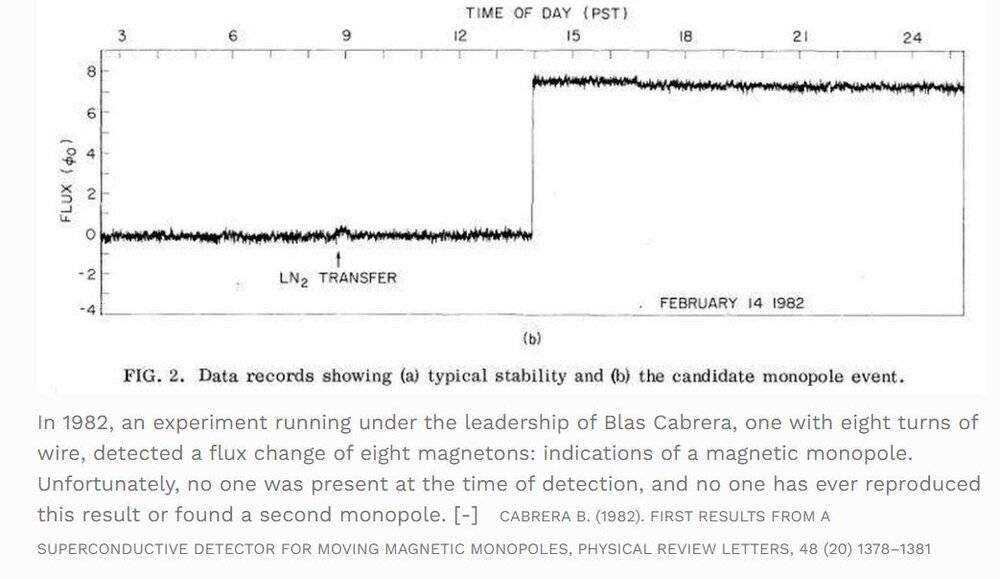
Here is a high quality article about it written by Ethan Siegel, with Ph.D. astrophysicist, author, and science communicator, who professes physics and astronomy at various colleges and has won numerous awards for science writing since 2008. So it's not a crackpot source.

The Enduring Mystery Of Detecting The Universe's Only Magnetic Monopole (forbes.com)
monopoles.JPG


Comparing 1982 to 2020, it's nearly 40 years. Technology have evolved so much. So how do you build a monopole detector? Is there one now as small as thermal scanner? I need to get one to test something.

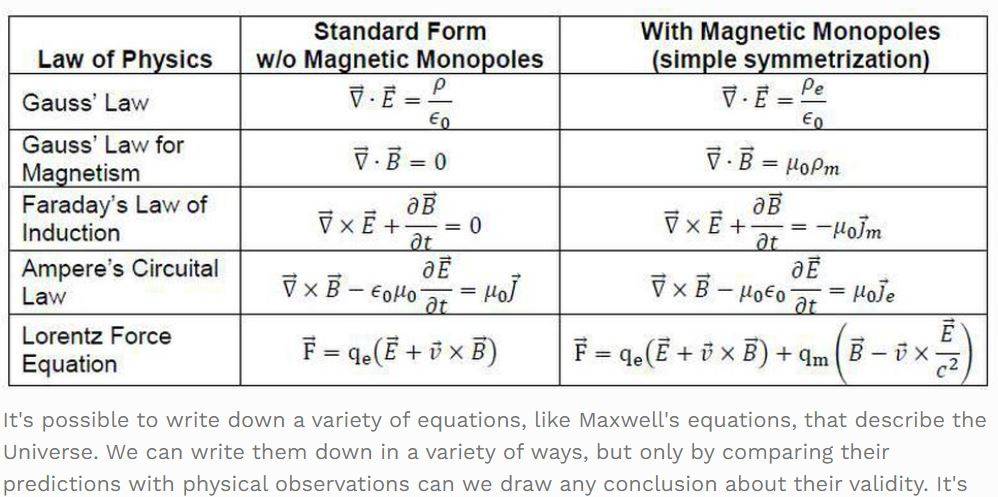
Another thing. The following is based on the articles. So if there are magnetic monopoles. Gauss's Law for Magnetism is not wrong, but only extended?
maxwell equations monopoles.JPG


In particle physics, they use the concept of symmetry breaking where at high temperature, there is more symmetry. So what efforts of this concept were used in the above? What I read in wiki is not clear on this, so asking for clarifications. Thanks.
 
Physics news on Phys.org
jake jot said:
Comparing 1982 to 2020, it's nearly 40 years. Technology have evolved so much. So how do you build a monopole detector? Is there one now as small as thermal scanner? I need to get one to test something.

Another thing. The following is based on the articles. So if there are magnetic monopoles. Gauss's Law for Magnetism is not wrong, but only extended?
Reproducing Cabera's experiment is not a DIY project. The experiment consisted of two cylindrical, corrugated, mu-metal jackets; the outer jacket was needed to isolate the system from external magnetic noise and the inner jacket, which was bathed in liquid helium in a glass dewar, was mechanically expanded and transitioned through its superconducting critical temperature in order to reduce the ambient magnetic field. This brilliant procedure reduced the ambient field by an order of about ##10^{8}##. Within the inner jacket Cabera placed a superconducting coil attached to a SQUID magnetometer. If a magnetic monopole flew through the coil the SQUID would transition to a higher current state, in units of ##\phi_0##, according to its I-V curve, and be recorded on a chart recorder.
Although technology has changed the physical requirements of the experiment have not. The only advances of the last 40 years that I can see that would improve or simplify the experiment would be replacing the chart recorder and controlling the temperature with a computer.
 
Fred Wright said:
Reproducing Cabera's experiment is not a DIY project. The experiment consisted of two cylindrical, corrugated, mu-metal jackets; the outer jacket was needed to isolate the system from external magnetic noise and the inner jacket, which was bathed in liquid helium in a glass dewar, was mechanically expanded and transitioned through its superconducting critical temperature in order to reduce the ambient magnetic field. This brilliant procedure reduced the ambient field by an order of about ##10^{8}##. Within the inner jacket Cabera placed a superconducting coil attached to a SQUID magnetometer. If a magnetic monopole flew through the coil the SQUID would transition to a higher current state, in units of ##\phi_0##, according to its I-V curve, and be recorded on a chart recorder.
Although technology has changed the physical requirements of the experiment have not. The only advances of the last 40 years that I can see that would improve or simplify the experiment would be replacing the chart recorder and controlling the temperature with a computer.

Do you have a list of all magnetic monopole detectors in the world (in all countries)? Which of them are accessible to the public?

I want to try something none of them have literally tried before.
 
  • Skeptical
Likes   Reactions: Motore

Similar threads

  • · Replies 0 ·
Replies
0
Views
2K
  • · Replies 10 ·
Replies
10
Views
3K
  • · Replies 13 ·
Replies
13
Views
3K
  • · Replies 38 ·
2
Replies
38
Views
10K
  • · Replies 8 ·
Replies
8
Views
6K
  • · Replies 6 ·
Replies
6
Views
5K
  • · Replies 7 ·
Replies
7
Views
4K
  • · Replies 1 ·
Replies
1
Views
4K
  • · Replies 9 ·
Replies
9
Views
4K