Variance of 'concatenated' distributions

  • Context: Graduate 
  • Thread starter Thread starter query_ious
  • Start date Start date
  • Tags Tags
    Distributions Variance
Click For Summary

Discussion Overview

The discussion revolves around the statistical modeling of experimental data related to the measurement of mRNA molecules in boxes, specifically focusing on the variance of concatenated distributions. Participants explore the implications of variable tagging efficiency on the observed variance and mean in the context of binomial distributions.

Discussion Character

  • Exploratory
  • Technical explanation
  • Debate/contested
  • Mathematical reasoning

Main Points Raised

  • One participant describes an experimental setup involving m boxes, each containing k molecules of mRNA, and suggests that a binomial model with variable success probability p may better fit the observed data than a constant p.
  • Another participant questions the dependence of p on m and proposes that this could improve predictive accuracy.
  • A participant provides a formula for calculating variance in a simplified model where half the boxes have p=0.05 and the other half have p=0.10, incorporating the means of the individual distributions.
  • Concerns are raised about the accuracy of the amplification and detection processes, questioning whether they yield exact measurements of the labeled RNA sequences.
  • There is a request for clarification on the derivation of variance calculations and the nature of the random variables being graphed.
  • Participants express confusion regarding the graph's representation of mean versus variance and the differences between individual data points.

Areas of Agreement / Disagreement

Participants do not reach a consensus on the modeling approach or the implications of variable tagging efficiency. Multiple competing views regarding the nature of the distributions and the statistical treatment of the data remain unresolved.

Contextual Notes

Participants note limitations in understanding the derivation of variance formulas and the assumptions underlying the experimental setup, including the potential variability in tagging efficiency across different experimental batches.

query_ious
Messages
23
Reaction score
0
The below is motivated by a problem I'm observing in my experimental data

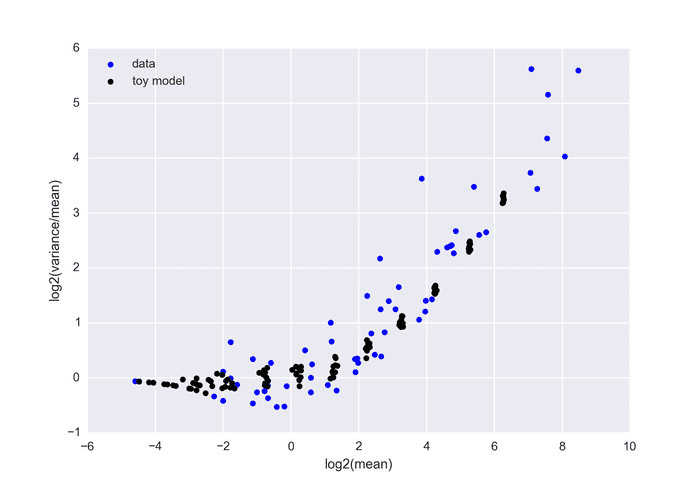
I have m boxes, where each box is supposed to contain k molecules of mRNA. The measurement process includes labeling all the molecules with a box-specific tag, mixing them, amplifying them to detectable levels and deconvoluting based on tags. As tag-labeling is a lossy process with estimated efficiency of 5-10% and as we are essentially counting successes a binomial model with n=k and 0.05<p<0.1 sounds fitting. Graphing the variance/mean vs. mean shows that it doesn't fit to the straight line expected from a binomial with constant p. If we assume that p is variable, however, things work out well. (see bottom for data)

The intuition is that we are 'concatenating' distributions - as an example assume that m/2 boxes are sampled with p=0.05 and m/2 boxes with p=0.1. Then the distribution of all m boxes would be an 'overlap' of 2 binomials each with the same n but different p. Intuitively I would expect the mean to be bound between the mean of the two distributions (as the mean is a point found between the two other points) while I would expect the variance to be larger than either of the two variances (as variance is correlated with the width of the distribution and the 'overlapping' width is by definition longer than each of its components). Simulations support my argument but I don't know how to go about formalizing it and I don't know how to use this to assist is modeling the data. (Esp - how to use this to estimate the variability in tagging efficiency).

What do you say?

The below graph shows real data (each point is generated from 24 boxes with equal k) versus the toy model suggested above (100 boxes with p=0.05 and 100 boxes with p=0.1 for different n).

[Edited for clarity + typos]
GtcJQYA.png
 
Last edited:
Physics news on Phys.org
I don't see the image. Just a blank space.
Edit: Looks like some decoding problem. The image exists, but it does not get displayed correctly here. Downloading and opening it locally works.
How did you get the individual data points? Each one is one experiment with m boxes? How do they differ from each other?

Could p depend on m? That would allow to make better predictions.

For the simplified model with m/2 at p=0.05 and m/2 at p=0.10, variance should be 1/2 Var(k,p=0.05) + 1/2 Var(k,p=0.10) + (k*0.025)^2 where the last term is the deviation between mean of the total distribution (k*0.075) and mean of the individual sample distributions (k*0.05 and k*0.10 respectively).
Making more complex models is possible in the same way, but you quickly end up fitting curves to get the best model.
 
Last edited:
mfb said:
I don't see the image. Just a blank space.
I see it on my screen... not sure how to fix this.

mfb said:
How did you get the individual data points
The setup is a bit detailed but basically this is one big experiment where a mix of ~100 RNA types is pipetted into 24 boxes such that each box gets an equal amount of mix. Each box is labeled separately and then all boxes are pooled into one big box, amplified and separated algorithmically. Each data point in the graph is generated from a 24-member list consisting of the number of estimated molecules for a certain RNA type in all 24 boxes.

mfb said:
Could p depend on m?
I don't expect it to but it might vary between experimental batches. I tested this and didn't see much of a difference.

mfb said:
For the simplified model with m/2 at p=0.05 and m/2 at p=0.10, variance should be 1/2 Var(k,p=0.05) + 1/2 Var(k,p=0.10) + (k*0.025)^2
Would you mind sharing the derivation? I'm a bit lost...
 
Are the "amplification process" and the detection afterwards exact? If you start with n marked RNA sequences, you will always measure that number n?

The leftmost numbers would correspond to a mean of <1/16, or just one labeled RNA sequence from a single box out of 24? Then they should have a more discrete spacing, and the data samples should not have a well-defined variance.
And what about the data point at (4,3.6)? A mean of 16, a variance of ~200? Would be interesting to see the actual distribution for those outliers.

query_ious said:
Would you mind sharing the derivation? I'm a bit lost...
In general, if you add two distributions with known means µ1 and µ2 and variances V1 and V2, and if a fraction p comes from distribution 1 and (1-p) from distribution 2, the new mean is
$$\mu = p\mu_1 + (1-p) \mu_2$$
And the variance is
$$V = p(V_1+(\mu-\mu_1)^2) + (1-p) (V_2+(\mu-\mu_2)^2)$$
The latter formula is very similar to the parallel axis theorem in mechanics, as you are interested in the second moment in both cases.
 
query_ious said:
I have m boxes, where each box is supposed to contain k molecules of mRNA. The measurement process includes labeling all the molecules with a box-specific tag, mixing them, amplifying them to detectable levels and deconvoluting based on tags.

What does it mean to "deconvolute based on tags"?

I don't understand what you are graphing. The graph apparently shows the mean (of something) versus its variance. What is the random variable being sampled?

What makes the data points different? Are they from batches of repetitions of the above process? Or does each data point represent the sample mean and variance of a count of molecules with a given "label" taken over repetitions of the above process?
 

Similar threads

  • · Replies 29 ·
Replies
29
Views
6K
  • · Replies 1 ·
Replies
1
Views
2K
  • · Replies 3 ·
Replies
3
Views
2K
Replies
1
Views
4K
  • · Replies 1 ·
Replies
1
Views
2K
  • · Replies 7 ·
Replies
7
Views
2K
  • · Replies 2 ·
Replies
2
Views
2K
  • · Replies 4 ·
Replies
4
Views
2K
  • · Replies 9 ·
Replies
9
Views
3K
  • · Replies 1 ·
Replies
1
Views
2K