Vector addition and subtraction

  • Thread starter Thread starter Slimy0233
  • Start date Start date
  • Tags Tags
    Vector addition
Click For Summary
SUMMARY

The discussion centers on vector addition and subtraction, specifically addressing the calculation of the vector from point O1 to O2. The correct representation of the vector O12 is O2 - O1, not O1 + O2, as the latter does not adhere to vector addition principles. Participants clarify that vectors must be added with their tails and heads aligned, and they discuss the implications of moving vectors while preserving their direction and magnitude. A significant error in Griffiths' textbook regarding vector normalization is also highlighted, emphasizing the importance of understanding vector operations in physics.

PREREQUISITES
  • Understanding of vector notation and operations
  • Familiarity with coordinate systems and vector representation
  • Knowledge of vector addition and subtraction principles
  • Basic understanding of unit vectors and normalization
NEXT STEPS
  • Study vector operations in detail, focusing on vector addition and subtraction
  • Learn about unit vectors and their significance in vector calculations
  • Examine the concept of vector normalization and its applications
  • Review common errors in vector mathematics as presented in textbooks like Griffiths' Electrodynamics
USEFUL FOR

Students and educators in physics and mathematics, particularly those focusing on vector calculus and its applications in physics, as well as anyone seeking to clarify common misconceptions in vector operations.

Slimy0233
Messages
167
Reaction score
48
Homework Statement
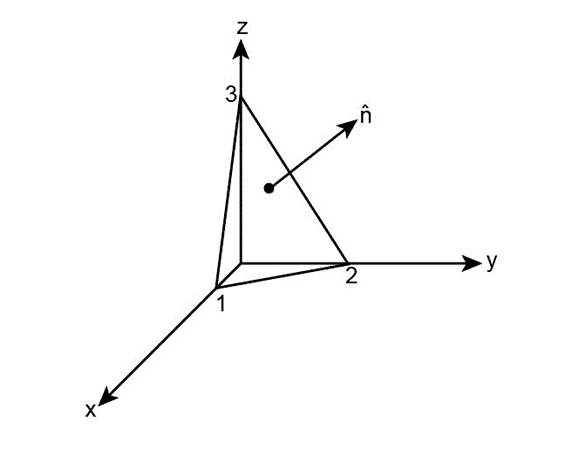
Use the cross product to find the components of the unit vector ˆn perpendicular to the shaded
plane in Fig. 1.11.
Relevant Equations
O1 = O2 + O12
Mentor note: Moved from General Math section, so is missing the homework template.
1686149207781.png

If you want the vector which represents the base from 1 to 2 (or O1 to O2 are the position vectors, I am using co-ordinates as names), what would O12 (vector from 1 to 2) and why?
1. Would it be O1 - O2 or O1 + O2? and why?

I got the wrong answer when I assumed O1 + O2, but I don't understand why? What's the difference?
 
Last edited by a moderator:
Physics news on Phys.org
Slimy0233 said:
Mentor note: Moved from General Math section, so is missing the homework template.View attachment 327562
If you want the vector which represents the base from 1 to 2 (or O1 to O2 are the position vectors, I am using co-ordinates as names), what would O12 (vector from 1 to 2) and why?
1. Would it be O1 - O2 or O1 + O2? and why?

I got the wrong answer when I assumed O1 + O2, but I don't understand why? What's the difference?
For clarity I'm going to rename points 1 and 2 as points A and B, respectively, and O is the origin. By vector addition, OA + AB = OB, so AB = OB - OA.
 
  • Informative
Likes   Reactions: Slimy0233
Mark44 said:
For clarity I'm going to rename points 1 and 2 as points A and B, respectively, and O is the origin. By vector addition, OA + AB = OB, so AB = OB - OA.

I understand what you are trying to say completely, but in purely a mathematical way, I can't add O1 and O2 because, it doesn't make much sense as in order to add two vectors the head of the first vector should be at the tail of the second vector or vice versa, am I right?
So, when I add vec(O1) and vec(O2), I am not getting vec(12), but rather I am getting a vector which would point to i + 2 j, which basically is like the middle point of those vectors (not really, but I lack the vocabulary to explain it). It makes sense now.also, I feel like I can also imagine this in a different way, a person can't travel in two directions simultaneously, so it doesn't make sense to add O1 and O2? Are my ways of interpreting this acceptable?

PS: Hey mentor, did you move this from vectors forum to help forum. It's not actually HW though, so I am not sure what the procedure was. It's a question from Griffiths which you can see here[the answer is wrong] Should I still have posted this on HW help even if it's not really HW (I am sorry, I haven't read all the rules yet, just the main ones]
 
Slimy0233 said:
I understand what you are trying to say completely, but in purely a mathematical way, I can't add O1 and O2 because, it doesn't make much sense as in order to add two vectors the head of the first vector should be at the tail of the second vector or vice versa, am I right?
No, not right. You can move vectors around as long as the move is strictly a translation that preserves the direction and length of the vector.
Slimy0233 said:
So, when I add vec(O1) and vec(O2), I am not getting vec(12), but rather I am getting a vector which would point to i + 2 j, which basically is like the middle point of those vectors (not really, but I lack the vocabulary to explain it).
Yes. At first I didn't pick up on vector O1 having its head at the point (1, 0) and similarly for vector O2. You can write these two vectors as <1, 0> and <0, 2>. Adding them would result in the vector <1, 2> or as you wrote it, i + 2j.
Slimy0233 said:
PS: Hey mentor, did you move this from vectors forum to help forum. It's not actually HW though, so I am not sure what the procedure was. It's a question from Griffiths which you can see here[the answer is wrong] Should I still have posted this on HW help even if it's not really HW (I am sorry, I haven't read all the rules yet, just the main ones]
Yes I moved it, based on a report from another mentor. It's enough like a homework question that the current section is where it belongs.

BTW, which part of the answer in Griffith do you believe is wrong? At a quick scan of the page, the work there looks fine to me.
 
Slimy0233 said:
PS: Hey mentor, did you move this from vectors forum to help forum. It's not actually HW though, so I am not sure what the procedure was. It's a question from Griffiths which you can see here[the answer is wrong] Should I still have posted this on HW help even if it's not really HW (I am sorry, I haven't read all the rules yet, just the main ones]
Per the PF rules, all schoolwork-type questions should go in the Homework Help forums, and not in the technical forums. The quote below is from the Rules (see INFO at the top of the page):

Greg Bernhardt said:
Posts Belong in the Homework Forum
Any and all high school and undergraduate homework assignments or textbook-style exercises for which you are seeking assistance are to be posted in the appropriate forum in our Homework & Coursework Questions area--not in blogs, visitor messages, PMs, or the main technical forums. This should be done whether the problem is part of one's assigned coursework or just independent study. The reason for this is that the scientific and mathematical sections of Physics Forums are to be reserved for discussions and not academic assistance.
 
Mark44 said:
No, not right. You can move vectors around as long as the move is strictly a translation that preserves the direction and length of the vector.
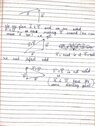
@Mark44 Thank you very much for that. But I kinda have a doubt regarding this. Even when you move vectors around, aren't you really bringing the vectors such that one vector's tail is at another's head?

If I am not articulate enough, this might aid what I am trying to say
DocScanner 07-Jun-2023 23-59.jpg

> BTW, which part of the answer in Griffith do you believe is wrong? At a quick scan of the page, the work there looks fine to me.

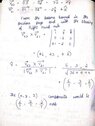
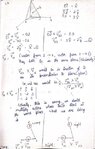
actually, they are slightly wrong, but I am pretty sure it's a calculation mistake. No solution is given in the book, it's just one of the exercises.DocScanner 07-Jun-2023 23-41_1(1).jpgDocScanner 07-Jun-2023 23-59.jpg

The answer should be 1/7*(6,3,2) as I have shown above, ignore the first page.
 

Attachments

  • DocScanner 07-Jun-2023 23-41_1.jpg
    DocScanner 07-Jun-2023 23-41_1.jpg
    36.8 KB · Views: 133
berkeman said:
Per the PF rules, all schoolwork-type questions should go in the Homework Help forums, and not in the technical forums. The quote below is from the Rules (see INFO at the top of the page):
hey, I am sorry for this. I must have read the rules thoroughly, which I will do soon enough. But while it comes to the rule you have kindly included in your reply, these type of questions are thought of as HW type questions and I can see why. But if you have theoretical questions, you can post this in the main forums right? I mean, theoretical doubts essentially like "What would be the intensity of light that would be observed during metal welding and why?" or something about vectors I dont' understand in Griffiths but is not like a question as it is here . I did read the rule, but I just had this doubt.
 
Slimy0233 said:
But if you have theoretical questions, you can post this in the main forums right? I mean, theoretical doubts essentially like "What would be the intensity of light that would be observed during metal welding and why?"
Usually that should qualify for the technical forums, but you can always PM a Mentor to check to be sure. It's sometimes a judgement call on whether the question could be for a points-paying schoolwork assignment. This old thread will help to explain the PF approach to schoolwork-type questions:

https://www.physicsforums.com/threads/homework-coursework-questions.373889/
 
berkeman said:
Usually that should qualify for the technical forums, but you can always PM a Mentor to check to be sure.
tbh, I hate to annoy mentors with trivial questions, (Ik you have got stuff to do). I mean, I would say in an ideal forum, there should not be much jobs for the moderator.

somewhat ironic that I am saying this but ok. I will read the rules throughly by tmr. Thank you for what you do here.
 
  • Like
Likes   Reactions: berkeman
  • #10
Slimy0233 said:
Even when you move vectors around, aren't you really bringing the vectors such that one vector's tail is at another's head?
That's not really different from what I said. As long as you move them rigidly, it doesn't matter.
Slimy0233 said:
actually, they are slightly wrong,

The answer should be 1/7*(6,3,2) as I have shown above, ignore the first page.
You're right, because their final vector isn't a unit vector. The vector <6, 3, 2> has a magnitude of ##\sqrt{49}##. I've gone through their work in detail, and can't find where they went wrong.
 
  • Like
Likes   Reactions: Slimy0233
  • #11
Slimy0233 said:
actually, they are slightly wrong, but I am pretty sure it's a calculation mistake.
It's worse than "slightly wrong" -- they have made a pretty serious mistake, one that I'm surprised to see in a book as well-known as Griffith's.
What they did was to calculate unit vectors ##\hat{r_1}## and ##\hat{r_2}##, and then crossed them to get ##\frac 1 {\sqrt{50}}< 6, 3, 2>##. Their mistake is in thinking that the cross product of unit vectors is also a unit vector. This happens if and only if the vectors being crossed happen to be perpendicular to each other. For the problem in this thread, the vectors are not perpendicular (their dot product is nonzero), so the result of crossing the unit vectors above has the right direction but isn't a unit vector.
 
  • Like
  • Informative
Likes   Reactions: berkeman and BvU
  • #12
Mark44 said:
It's worse than "slightly wrong" -- they have made a pretty serious mistake, one that I'm surprised to see in a book as well-known as Griffith's.
That answer is not from Griffiths. I have checked the solution manual and Griffiths explicitly says that the result of the cross product has to be normalized, and the answer he gives is the correct one.
 
  • Like
Likes   Reactions: BvU
  • #13
Mark44 said:
That's not really different from what I said. As long as you move them rigidly, it doesn't matter.
You're right, because their final vector isn't a unit vector. The vector <6, 3, 2> has a magnitude of ##\sqrt{49}##. I've gone through their work in detail, and can't find where they went wrong.
Yesterday at 10 PM: I will do that first thing in the morning. I should be learning from others mistake too ig.

Today: Even though I planned on solving it, didn't get enough time. I am glad you highlighted the mistake tho! @Mark44

Also I am sorry, I think I told you that it's not the solution given by Griffiths himself, but it's an exercise which the readers are supposed to solve as @DrClaude pointed out.

I really thought I mentioned it in my reply but I see that I didn't do so. My fault
 
  • #14
Slimy0233 said:
Also I am sorry, I think I told you that it's not the solution given by Griffiths himself, but it's an exercise which the readers are supposed to solve
In the PDF at the top it says "Griffiths Electrodynamics 4e: Problem 1.4" -- I assumed this work came from the textbook itself. I don't have this textbook, so couldn't verify this for myself.
 

Similar threads

  • · Replies 3 ·
Replies
3
Views
2K
  • · Replies 8 ·
Replies
8
Views
2K
  • · Replies 2 ·
Replies
2
Views
2K
  • · Replies 6 ·
Replies
6
Views
2K
  • · Replies 1 ·
Replies
1
Views
2K
  • · Replies 9 ·
Replies
9
Views
2K
  • · Replies 14 ·
Replies
14
Views
3K
  • · Replies 14 ·
Replies
14
Views
2K
  • · Replies 12 ·
Replies
12
Views
4K
  • · Replies 21 ·
Replies
21
Views
8K