High School Vibration Patterns of Strings within Quarks?

Click For Summary
SUMMARY

The discussion centers on the feasibility of observing vibration patterns of strings within quarks as proposed by String Theory. It highlights the theoretical nature of String Theory and the significant energy requirements needed to detect string excitations, which exceed the capabilities of current particle colliders. No documented studies linking string vibrations to particle production were identified, emphasizing the challenges in experimental verification of these theoretical concepts.

PREREQUISITES
  • Understanding of String Theory fundamentals
  • Knowledge of particle physics and quark behavior
  • Familiarity with energy scales in high-energy physics
  • Awareness of current particle collider capabilities
NEXT STEPS
  • Research the implications of String Theory on particle physics
  • Explore the energy requirements for string excitation detection
  • Investigate current advancements in particle collider technology
  • Study theoretical models that attempt to link string vibrations to observable phenomena
USEFUL FOR

Physicists, researchers in theoretical physics, and students interested in the intersection of String Theory and particle physics.

Hatem
Messages
1
Reaction score
0
Is it possible to study/observe the virbation patterns of a string within a quark?
I understang that String Theory is a theoretical framework, however is it possible to make an observation linking the vibrations of the strings within the quarks to the particles produced?
If so, has there even been such a documented study?
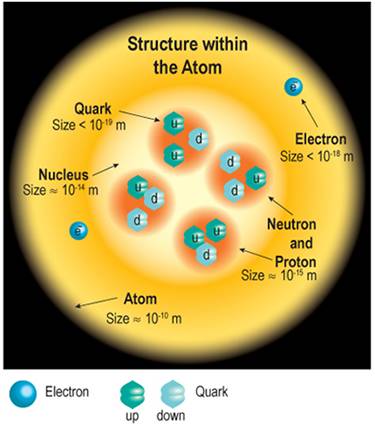
Quark.jpg
 
Physics news on Phys.org
In theory, string excitations could show up, but in most models the energy needed to detectably excite the strings is far beyond what colliders can produce.
 
"Supernovae evidence for foundational change to cosmological models" https://arxiv.org/pdf/2412.15143 The paper claims: We compare the standard homogeneous cosmological model, i.e., spatially flat ΛCDM, and the timescape cosmology which invokes backreaction of inhomogeneities. Timescape, while statistically homogeneous and isotropic, departs from average Friedmann-Lemaître-Robertson-Walker evolution, and replaces dark energy by kinetic gravitational energy and its gradients, in explaining...

Similar threads

  • · Replies 1 ·
Replies
1
Views
2K
  • · Replies 6 ·
Replies
6
Views
3K
  • · Replies 6 ·
Replies
6
Views
6K
  • · Replies 12 ·
Replies
12
Views
5K
  • · Replies 4 ·
Replies
4
Views
2K
Replies
1
Views
864
  • · Replies 47 ·
2
Replies
47
Views
8K
  • · Replies 1 ·
Replies
1
Views
3K
  • · Replies 10 ·
Replies
10
Views
3K
  • · Replies 4 ·
Replies
4
Views
3K