Voyager 1: order-of-magnitude cross-track drift and speed loss over the next 100–1000 years

mumbletypeg
Messages
1
Reaction score
3
TL;DR
How far will Voyager 1 deviate from straight-line motion over 100–1000 years due to interstellar gas/dust? Order-of-magnitude only. Has this been calculated?
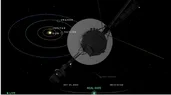
I’m looking for order-of-magnitude bounds on how much Voyager 1’s trajectory would depart from a constant-velocity inertial extrapolation over long time scales (100, 500, 1000 years).

1772478677519.webp


Two separate quantities:
  1. Cross-track deviation
    Lateral displacement relative to a straight-line extrapolation.
  2. Along-track lag
    Distance difference due to cumulative slowing.
Assume (adjust if better values exist):
  • Mass ≈ 730 kg
  • Effective cross-section ≈ 10.75 m² (3.7 m antenna dish)
  • Speed ≈ 17 km/s
  • Neutral hydrogen density ≈ 0.1 cm⁻³
  • Dust-to-gas mass ratio ≈ 1%

I’m not looking for precise ephemerides - just whether the drift is on the order of meters, kilometers, 10³ km, etc., after ~10³ years.

Has this already been calculated in the literature, or is a back-of-envelope estimate the right approach here?
 

Attachments
  • 1772478641313.webp
    1772478641313.webp
    16.2 KB · Views: 6
Last edited by a moderator:
  • Like
Likes   Reactions: DaveE and AlexB23
Physics news on Phys.org
Not that I can answer your question, but as I understand it, our knowledge of the interstellar medium is very much based on measurements made via Voyager 1 and 2. I am not aware if the range and range-rate profiles of the probes was/are factored into these models, but considering how minute effects can be and still are measured (e.g. the thermal Pioneer anomaly) I would expect a model of the Voyager probes non-gravitational interactions in the ISM to have been established to some level of detail as a part of this research. I would also expect that any cross-track drift, if measurable at all, to be many orders of magnitude more uncertain than the in-track range-rate.

Edit: fixed wording.
 
Last edited:
  • Like
Likes   Reactions: mumbletypeg
With your assumptions, the acceleration due to gas (or gas+dust, a 1% effect isn't important here) is ##\frac{v^2\rho A}{m} = 7\cdot 10^{-16} \frac{m}{s^2}##. Over 100 years such an acceleration leads to a displacement of 3.5 km, over 1000 years it leads to a displacement of 350 km along its trajectory. Compare this to the 500 billion km it travels in that time. The path is not a straight line due to gravity, which effectively gives it a bit of displacement orthogonal to its motion as well, but that's a tiny higher order effect.
 
  • Informative
Likes   Reactions: berkeman