rollingstein said:
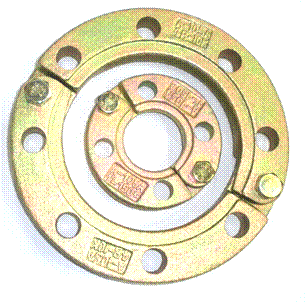
He also says [split flanges] expose twice as much area to corrosion. So maybe I'm missing something.
rollingstein: For a split flange, I currently got ~2.11 times as much surface area exposed to corrosion, compared to a solid flange.
I tried doing a comparison in the attached file. I only show one half of the pipe cross sections, due to symmetry. Figure 1 shows a solid flange. And figure 2 shows an equivalent split flange. I highlighted the relevant surfaces, for comparison between figures 1 and 2. The cyan surfaces are an exact match. The green surfaces differ.
Each surface is labeled with its relative length. I assumed the gasket interface surfaces do not leak, and thus do not corrode; therefore, I did not include the gasket interface surfaces in this comparison. I also did not include flange outside diameter ends, nor split flange ends, because these ends would need to corrode for a long time, before they would have much effect.
Instead of trying to show the split in the split flange in figure 2, I show the split in figure 3. I currently assumed each split covers (0.10*2*pi) rad = 36.0 deg.
Underneath each figure title, I show the total surface area of the highlighted surfaces in each figure. Notice that 2*pi*r divides out of each total. Therefore, the relevant, exposed surface area of figure 2 plus 3, divided by the surface area of figure 1, is currently, ratio = A2/A1 = (626 + 49.6)/320 = 2.11.
Of course, you could get a more accurate ratio if you perform more detailed, careful calculations than I did, or if you draw a particular connection design on cad, and then sum the relevant, exposed surface areas on cad.