What Could This Unidentified Moving Object in My Seestar S50 Sky Capture Be?

Click For Summary
SUMMARY

The unidentified moving object captured by the Seestar S50 telescope is likely a GSO satellite, as confirmed by the user after tracking it for 24 hours. The telescope features auto-tracking capabilities and has a focal length of 250mm with an aperture of 50mm. The user, who has only been observing for a month, successfully identified the object while pointing at NGC 2264. The discussion highlights the importance of understanding field of view calculations and the limitations of the Seestar's camera settings.

PREREQUISITES
  • Understanding of telescope specifications, specifically Seestar S50 features
  • Familiarity with celestial navigation tools like Stellarium
  • Basic knowledge of field of view calculations in astronomy
  • Awareness of satellite tracking and identification methods
NEXT STEPS
  • Research how to calculate field of view for telescopes
  • Learn about GSO satellites and their tracking methods
  • Explore advanced features of the Seestar S50 telescope
  • Investigate the process of identifying celestial objects using software like Stellarium
USEFUL FOR

Astronomy enthusiasts, beginner telescope users, and anyone interested in satellite tracking and celestial object identification will benefit from this discussion.

Skywave
Messages
8
Reaction score
6
TL;DR
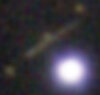
I was capturing an area of the sky and picked up something that I cannot explain. I need to find out how to find out what it is.
I was capturing an area of the sky using my Seestar S50, and there is something in the picture that I cannot explain. The capture has been going to about 40 minutes, and during that entire time it has moved around 3mm on my screen (and it is still going).

I've looked at Stellarium, and looked at online images, and this line does not appear anywhere.

How do I go about finding out what it is?
PS. I'm a noob. Only had my scope for about 1 month or so.
 

Attachments

  • photo_2024-04-22_20-09-35.jpg
    photo_2024-04-22_20-09-35.jpg
    4.3 KB · Views: 83
Astronomy news on Phys.org
Hard to assume it's a celestial object. Could be a spider in a web in the foreground for all we know.

But let's pretend it's actually celestial.
I assume your Seestar has autotrkacing.
What were you pointing at? What is the object you were tracking?
What mag are you set at?

A stationary object in your FoV over 40 minutes would span 10 degrees of sky.
 
  • Like
Likes   Reactions: russ_watters
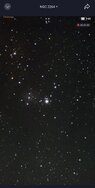
Cone Nebula.
Will upload a full pic in a bit.
Viewing from Krugersdorp, South Africa (-26.08, 27.78).
 

Attachments

  • photo_2024-04-22_20-48-40.jpg
    photo_2024-04-22_20-48-40.jpg
    22.5 KB · Views: 71
  • image_2024-04-22_205020621.png
    image_2024-04-22_205020621.png
    39 KB · Views: 107
Seestar has auto tracking.
I've restarted capturing, and the line continues from where it left off. None of the other stars are creating trails, so I'm assuming the tracking is working fine.
Pointing at NGC 2264 (according to the app, and as stated I am a noob, so I have to believe this)
There is no place for a spider to make a web in the view of the telescope, so I can confidently rule that out.
"Mag"? Are you referring to magnification? If so, the Seestar doesn't have settings for magnification. It just does the 10sec exposures, and stacks. (The Seestar has an aperture of 50mm and a focal length of 250mm)
 
Is that a crop from a larger picture? What camera settings did you use?
 
russ_watters said:
Is that a crop from a larger picture? What camera settings did you use?
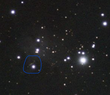
Yes, it's a crop. The full image is on my 2nd post.
The Seestar doesn't have camera settings, except for enabling or disabling the internal light pollution filter, which was not enabled.
 
Tom.G said:
The sensor datasheet shows:
(https://www.google.com/url?q=https:...m/files/62/flyer_security/IMX462LQR_Flyer.pdf)
1920x1080 pixels
pixel dimensions 2.9μm square
sensor diagonal 6.46mm, aspect ratio 1/2.8

The optics:
(https://www.google.com/url?q=https://i.seestar.com/owe__prod/static/manuals/SeestarManualEN.pdf)
Focal Length 250mm
Aperture 50mm
f/5

I tried finding the Field Of View from the above but was getting nonsense answers. Maybe someone else here will have better luck.

Cheers,
Tom
Hi Tom

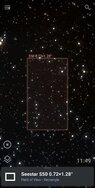
Thanks for all that info. Here is the FoV you need (I had it setup in Stellarium)
 

Attachments

  • photo_2024-04-23_11-51-02.jpg
    photo_2024-04-23_11-51-02.jpg
    28.2 KB · Views: 83
24hour followup: It's still (roughly) there.

1713893015114.png


So now I'm thinking it might be a GSO satellite?
 
  • #10
Mystery solved!
(A bit sad that I cannot name it Planet Bob).
But... I've captured Tyche :)

1713893624883.jpeg
 
  • Like
Likes   Reactions: collinsmark, Tom.G, russ_watters and 1 other person
  • #11
I haven't done much astronomy myself but I'd say thats pretty impressive to capture an asteroid within a month of observing. :thumbup:
 
  • Like
  • Care
Likes   Reactions: collinsmark, sophiecentaur, russ_watters and 1 other person

Similar threads

  • · Replies 14 ·
Replies
14
Views
2K
  • · Replies 5 ·
Replies
5
Views
2K
  • · Replies 4 ·
Replies
4
Views
2K
  • · Replies 13 ·
Replies
13
Views
4K
  • · Replies 19 ·
Replies
19
Views
8K
  • · Replies 13 ·
Replies
13
Views
5K
Replies
0
Views
2K
Replies
3
Views
2K
  • · Replies 4 ·
Replies
4
Views
2K
  • · Replies 4 ·
Replies
4
Views
3K