What Does the Barycentre Represent in Crystal Field Splitting?

Join the discussion
Registration is free. Ask a follow-up in this thread, or start your own.
3 replies · 8K views
ampakine
Messages
60
Reaction score
0
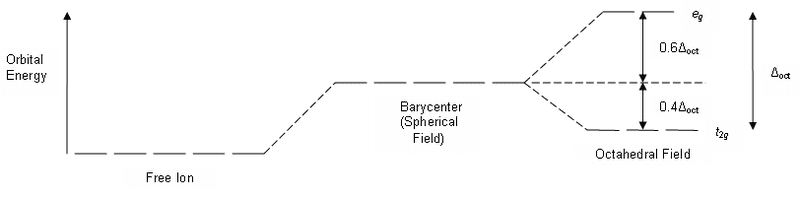
In this diagram
800px-Crystal_Field_Splitting_4.png

I can't figure out what that barycentre part of the diagram means. The first section of the diagram represents the energy of the d orbitals before the ligands come into the picture and the 3rd section represents the energy of the d orbitals after the 6 ligands have arranged in an octahedral structure. What does the 2nd section of the graph represent?

On one explanation of CFSE they say this:
If you put an electron into the t2g, like that for Ti3+, then you
stabilize the barycenter of the d orbitals by 0.4 Δo.
but I have no idea what this means. What is the barycentre?
 
Chemistry news on Phys.org
Well, barycenter literally means center of mass. In this case, it is just representing the idea that, since energy must be conserved, and you split two states up (doubly degenerate eg level) and three states down (triply degenerate t2g level), the barycenter is just the place where the five-fold degenerate energy level would have been in the absence of the splitting, but including the average effect of the crystal field interaction, distributed over 5 orbitals. Does that help?
 
Last edited:
Ah right, thanks. The only explanation of barycentre I could find were ones relating to astronomy. As for this concept, I've settled for the idea that the middle part of the graph represents the situation in which the ligands form a theoretical spherical charge around the atom as opposed to their charges arranged in an octahedral (or tetrahedral, square planar etc.) structure. In this imaginary spherical distribution of charge each d orbital feels the same amount of repulsion so they remain degenerate.
 
ampakine said:
Ah right, thanks. The only explanation of barycentre I could find were ones relating to astronomy. As for this concept, I've settled for the idea that the middle part of the graph represents the situation in which the ligands form a theoretical spherical charge around the atom as opposed to their charges arranged in an octahedral (or tetrahedral, square planar etc.) structure. In this imaginary spherical distribution of charge each d orbital feels the same amount of repulsion so they remain degenerate.

Bingo