What Does the Encircled Equation Mean?

  • Context:
  • Thread starter Thread starter Drain Brain
  • Start date Start date
  • Tags Tags
    Mean
Join the discussion
Ask a follow-up here, or get your own question answered by working scientists, mathematicians and engineers — people, not an autocomplete.
Real named experts · corrections over time · the nuance an AI answer skips
3 replies · 2K views
Drain Brain
Messages
143
Reaction score
0
Hello! :)

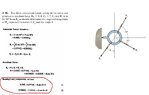
I just want to ask how, did the encircled portion come about?

It says that it equates the $\hat{i}$ and $\hat{j}$ components.

but when I tried that, this is what I get

$0.5447F_{1}=F_{3}(\sin(\theta)-\cos(\theta))$ ---> This expression doesn't ring a bell. It doesn't make any sense to me.
 

Attachments
  • mechanicsCHII-46.jpg
    mechanicsCHII-46.jpg
    39.9 KB · Views: 94
Mathematics news on Phys.org
Drain Brain said:
Hello! :)

I just want to ask how, did the encircled portion come about?

It says that it equates the $\hat{i}$ and $\hat{j}$ components.

but when I tried that, this is what I get

$0.5447F_{1}=F_{3}(\sin(\theta)-\cos(\theta))$ ---> This expression doesn't ring a bell. It doesn't make any sense to me.

Hi Drain Brain,

The $\mathbf F_R$ on the left hand side is really:
$$\mathbf F_R = 0\cdot \boldsymbol{\hat\imath} + 0 \cdot \boldsymbol{\hat\jmath}$$
Since the $\boldsymbol{\hat\imath}$ component is completely independent from the $\boldsymbol{\hat\jmath}$, we match them left and right.

Put otherwise, we separate the equation in:
- Sum of the horizontal forces is zero
- Sum of the vertical forces is zero
 
I like Serena said:
Hi Drain Brain,

The $\mathbf F_R$ on the left hand side is really:
$$\mathbf F_R = 0\cdot \boldsymbol{\hat\imath} + 0 \cdot \boldsymbol{\hat\jmath}$$
Since the $\boldsymbol{\hat\imath}$ component is completely independent from the $\boldsymbol{\hat\jmath}$, we match them left and right.

Put otherwise, we separate the equation in:
- Sum of the horizontal forces is zero
- Sum of the vertical forces is zero

Hi, I Like Serena!

Can you tell me why the i and j components become 0?

What I'm thinking about the problem is that the components of $F_{R}$ are equal in magnitude but opposite in direction that's why they cancel each other and produce a resultant of 0. Is my line of thinking correct? If not please explain to me why the components became both 0. Thanks!
 
Drain Brain said:
Hi, I Like Serena!

Can you tell me why the i and j components become 0?

What I'm thinking about the problem is that the components of $F_{R}$ are equal in magnitude but opposite in direction that's why they cancel each other and produce a resultant of 0. Is my line of thinking correct? If not please explain to me why the components became both 0. Thanks!

It's because the problem statement says:

The three concurrent forces acting on the screw eye produce a resultant force of $\mathbf F_R = \mathbf 0$.