Discussion Overview
The discussion centers around the behavior of a photon in superposition when interacting with a black hole's gravitational field. Participants explore theoretical implications of this interaction, including the nature of wave functions and the concept of superposition in quantum mechanics, as well as the classical treatment of light in general relativity.
Discussion Character
- Exploratory
- Debate/contested
- Technical explanation
- Conceptual clarification
Main Points Raised
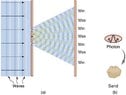
- Some participants propose that a photon in superposition spreads out like a fan and question what happens when part of it is captured by a black hole's gravity.
- Others argue that mainstream quantum mechanics suggests photons do not have a well-defined wave function, challenging the initial premise of superposition.
- A participant questions the distinction between objects in superposition and those with definite properties, suggesting that this distinction is not clear-cut.
- One participant elaborates on the analogy of a wave being stretched, indicating that a part of the wave could change direction after interacting with a black hole's gravity.
- Another participant emphasizes that photons are fully relativistic quantum systems and should be studied using quantum electrodynamics (QED) or quantum field theory (QFT) for accurate behavior description.
- Concerns are raised about the use of the term "superposition" in popular science literature, with calls for more precise definitions in the context of quantum mechanics.
- Some participants express skepticism about the validity of the initial claims, describing them as filled with misconceptions and difficult to address.
- There is a suggestion that classical electromagnetic waves may be sufficient for discussing light in a general-relativistic context, rather than focusing on photons.
Areas of Agreement / Disagreement
Participants do not reach consensus on the nature of photons, superposition, or the implications of gravitational interactions with black holes. Multiple competing views remain, particularly regarding the interpretation of quantum mechanics and the applicability of classical versus quantum descriptions of light.
Contextual Notes
Participants note limitations in the understanding of superposition and wave functions, as well as the potential for confusion arising from popular science explanations. The discussion reflects a range of assumptions about the nature of light and gravity, and the mathematical frameworks used to describe them.