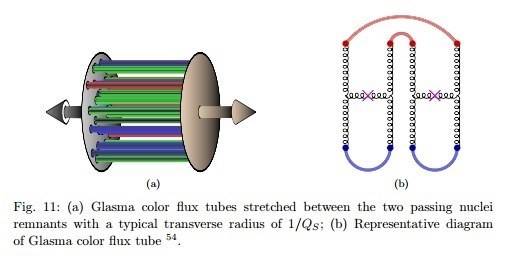
What is the best interpretation of this collision graphic?

Click For Summary
SUMMARY

The discussion focuses on the interpretation of a graphic depicting Proton/Lead collisions, specifically addressing the representation of protons and the colored bars in the graphic. The gray disks symbolize protons that appear flattened due to relativistic effects, while the colored bars illustrate strong color fields resulting from confinement in Quantum Chromodynamics (QCD). The concept of color flux tubes and string tension is emphasized, explaining how quarks remain confined within hadrons and cannot be separated without significant energy input, leading to the formation of new colorless hadrons.

PREREQUISITES
  • Understanding of Quantum Chromodynamics (QCD)
  • Familiarity with relativistic effects in particle physics
  • Knowledge of confinement and color charge in particle interactions
  • Basic grasp of potential energy in quantum systems
NEXT STEPS
  • Study the concept of color confinement in Quantum Chromodynamics (QCD)
  • Learn about the role of gluons as carriers of color charge
  • Investigate the implications of string tension in hadron physics
  • Explore the historical context of Weisskopf's contributions to particle physics
USEFUL FOR

Particle physicists, researchers in high-energy physics, and students studying Quantum Chromodynamics and confinement phenomena will benefit from this discussion.

edguy99
Gold Member
Messages
449
Reaction score
28
A recent article on Proton/Lead collisions (http://physics.aps.org/articles/v8/61) used a graphic seen in earlier articles on Proton/Proton collisions (ie. http://arxiv.org/pdf/1206.0148v1.pdf). I understand the gray disks to represent protons just after the collision (flattened due to relativity at their high speeds), but I am not sure how to understand the colored bars. Appreciate insight anyone would have on this.

ProtonCollision.jpg
 
Physics news on Phys.org
Well, this is a cartoon which is somewhat popular in the heavy-ion community. We draw disks for the colliding nuclei, because we consider them as highly Lorentz contracted, which is of course true, but you'd never see them like this "pancakes", because you have to take into account also the retardation effects of the light emitted from the object, and doing so this leads to a rotation rather like seeing Lorentz contracted objects. This was made clear already in the early 50ies by Weisskopf. If needed, I can find the reference.

Put this aside, the cartoon is pretty intuitive. The colored bars represent the very strong color fields. Due to confinement, which is a non-perturbative phenomenon, the force doesn't behave as naively expected from a massless vector field. In QED you'd have some Coulomb force, but the electromagnetic interaction is not confining, because the photons are not charged themselves. The gluons, as the quanta of the color-gauge field in QCD, themselves carry color charges, which leads to the completely different behavior. If you have two (heavy) quarks, you have to overcome a strong force, which is described by a potential like
$$V_{\text{eff}}(r)=-\frac{k}{r}+\sigma r.$$
The latter term is non-perturbative and the picture is that color flux tubes form, leading to the string tension ##\sigma##. Phenomenologically if you try to pull quarks within a hadron appart, you'll not be able to separate them and observe just free quarks but you need to put more and more energy into the system to overcome the string tension. At one point the strings break, and you create more colorless hadrons instead of freeing the quarks. This is roughly what's intended to be depicted by these colored flux tubes.
 
  • Like
Likes   Reactions: edguy99

Similar threads

  • · Replies 2 ·
Replies
2
Views
3K
Replies
2
Views
3K
  • · Replies 1 ·
Replies
1
Views
2K
  • · Replies 33 ·
2
Replies
33
Views
5K
  • · Replies 4 ·
Replies
4
Views
3K
  • · Replies 1 ·
Replies
1
Views
2K
  • · Replies 0 ·
Replies
0
Views
3K
  • · Replies 13 ·
Replies
13
Views
5K
  • · Replies 4 ·
Replies
4
Views
1K
  • · Replies 62 ·
3
Replies
62
Views
12K